

Small businesses face an increasingly complex cybersecurity landscape in 2026. With employees accessing company data from laptops, smartphones, tablets, and even IoT devices, every endpoint represents a potential vulnerability. For companies in Lethbridge and throughout Alberta, protecting these diverse access points requires specialized expertise and continuous monitoring that most internal IT teams cannot provide alone. Managed endpoint security services deliver comprehensive protection by combining advanced technology with expert oversight, allowing businesses to secure their digital perimeter without diverting resources from core operations.
Understanding Managed Endpoint Security Services
Managed endpoint security services provide outsourced protection for all devices that connect to your business network. These services encompass threat detection, incident response, vulnerability management, and continuous monitoring performed by specialized security professionals. Unlike traditional antivirus software that requires internal management, this approach transfers the responsibility of securing endpoints to experienced teams who monitor threats around the clock.
The scope extends far beyond simple malware protection. Modern managed endpoint security services address sophisticated attack vectors including ransomware, zero-day exploits, and advanced persistent threats. Service providers deploy multiple layers of defense across your entire device ecosystem, creating a unified security posture that adapts to emerging risks.
Key Components of Endpoint Protection
A comprehensive endpoint security strategy incorporates several critical technologies working in concert:
- Next-generation antivirus that uses behavioral analysis rather than signature-based detection
- Endpoint detection and response (EDR) for identifying suspicious activities in real-time
- Application whitelisting to prevent unauthorized software execution
- Data loss prevention to protect sensitive information from unauthorized transmission
- Patch management ensuring all systems remain current with security updates
- Device encryption securing data at rest on laptops and mobile devices
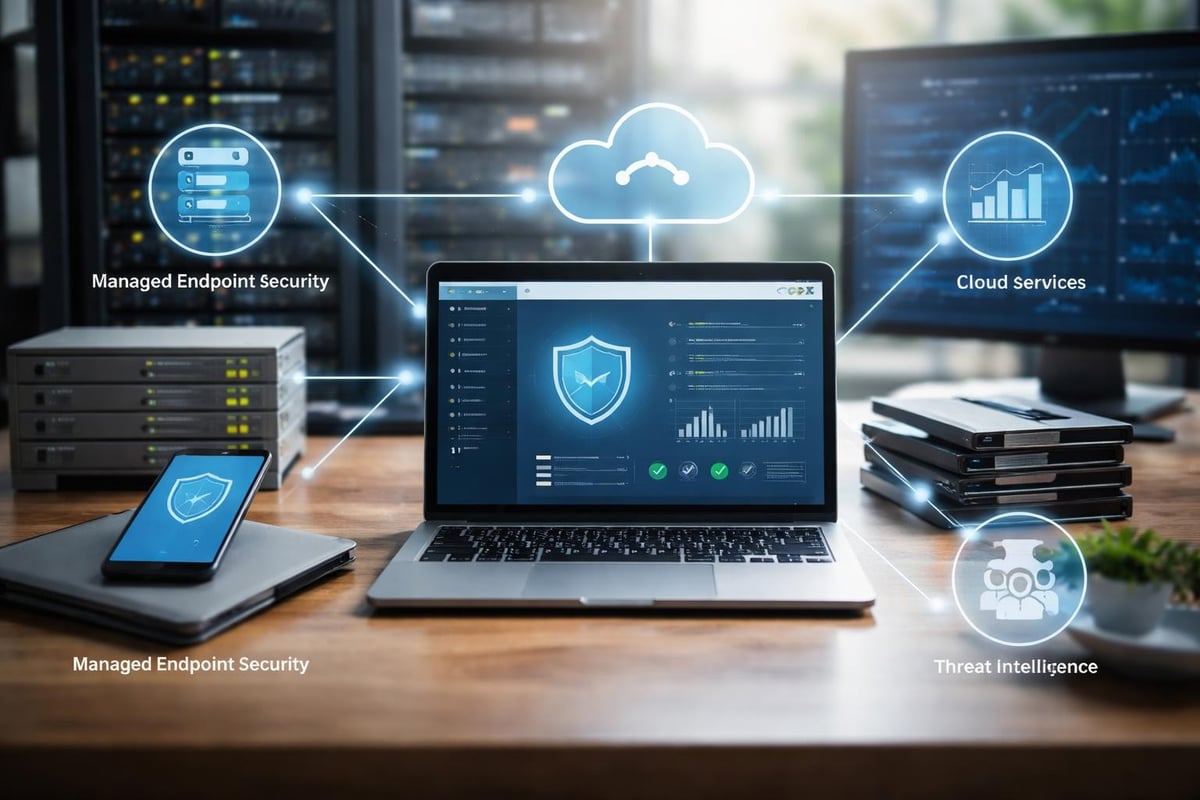
According to NetWitness’s explanation of managed EDR, these detection and response capabilities enable security teams to identify sophisticated threats that traditional tools miss. The combination of automated monitoring and human expertise creates a defense mechanism that evolves with the threat landscape.

Benefits for Small and Medium Businesses
Implementing managed endpoint security services delivers measurable advantages that directly impact business operations and financial health. Small businesses particularly benefit from accessing enterprise-grade security without the overhead of building internal teams.
Cost Efficiency and Predictability
Managing security internally requires significant capital investment in tools, training, and personnel. The average cybersecurity professional commands a salary exceeding $90,000 annually, placing dedicated security staff beyond reach for most small businesses. Managed services convert these capital expenses into predictable operational costs with fixed monthly fees.
This pricing model eliminates surprise expenses when security incidents occur. Service agreements typically include incident response, remediation, and recovery support within the standard fee structure. For businesses operating on tight budgets, this predictability enables accurate financial planning while maintaining robust protection.
Access to Specialized Expertise
The cybersecurity field evolves rapidly, with new threats emerging daily. Maintaining current knowledge requires continuous education and certification that few small business IT teams can sustain. Outsourcing endpoint security provides immediate access to teams who specialize exclusively in threat detection and response.
These experts bring experience across hundreds of client environments, exposing them to diverse attack patterns and defense strategies. When a novel threat emerges, managed service providers quickly deploy countermeasures across their entire client base, providing protection before individual businesses recognize the danger.
| Benefit Category | Internal Management | Managed Services |
|---|---|---|
| Initial Investment | $50,000-$150,000 | $0-$5,000 |
| Monthly Cost | $7,500-$15,000 | $2,000-$8,000 |
| Response Time | Business hours only | 24/7/365 |
| Expertise Breadth | Limited to staff knowledge | Industry-wide intelligence |
| Scalability | Requires hiring/training | Immediate expansion |
Faster Threat Detection and Response
Time represents the critical factor in cybersecurity incidents. The faster threats are identified and contained, the less damage they inflict. Managed endpoint security services employ continuous monitoring that detects anomalies immediately, regardless of when they occur.
Most breaches occur outside standard business hours when internal teams are unavailable. Twenty-four-hour monitoring ensures threats receive immediate attention, often neutralizing attacks before they accomplish their objectives. This rapid response capability significantly reduces the average dwell time between initial compromise and detection.
Essential Features to Evaluate
Not all managed endpoint security services deliver equivalent value. When evaluating providers, businesses should examine specific capabilities that differentiate effective solutions from basic offerings.
Real-Time Monitoring and Alerting
Effective services provide continuous surveillance of all endpoints, analyzing network traffic, application behavior, and system changes. Advanced endpoint security agents leverage machine learning to establish baseline behavior patterns, identifying deviations that indicate potential compromise.
Alert systems must balance sensitivity with practicality. Excessive false positives overwhelm security teams, while insufficient alerting allows threats to progress undetected. Quality providers fine-tune detection rules based on your specific environment, reducing noise while maintaining comprehensive coverage.
Comprehensive Asset Management
Security teams cannot protect assets they do not know exist. Shadow IT and unauthorized devices create blind spots that attackers exploit. Robust endpoint security begins with complete visibility into every device accessing network resources.
Following NCSC asset management guidance, effective services maintain accurate inventories automatically updating as devices join or leave the network. This inventory forms the foundation for applying appropriate security policies and ensuring no endpoint escapes protection.
Integration with Existing Infrastructure
Managed endpoint security services should complement rather than replace your current IT investments. Compatibility with existing tools prevents duplication while maximizing the value of previous technology purchases.
Cisco’s approach to endpoint protection demonstrates how managed services integrate with broader security ecosystems, sharing threat intelligence across platforms. This integration creates a cohesive defense where components reinforce each other rather than operating in isolation.
Implementation Best Practices
Successfully deploying managed endpoint security services requires careful planning and execution. Businesses that follow structured approaches achieve better outcomes with fewer disruptions.
Assessment and Planning Phase
Begin by conducting a comprehensive security assessment identifying current vulnerabilities and protection gaps. Document all endpoints including employee-owned devices accessing company data. This inventory establishes the scope of coverage needed and helps providers recommend appropriate service tiers.
- Catalog all devices accessing network resources including computers, mobile devices, and IoT equipment
- Identify critical assets requiring priority protection due to sensitivity or business importance
- Document compliance requirements applicable to your industry such as HIPAA, PCI-DSS, or GDPR
- Evaluate current security tools to determine which capabilities transfer to managed services
- Define success metrics establishing measurable goals for security improvement
Deployment and Transition
Transitioning to managed endpoint security services requires coordinating technology deployment with operational changes. Gradual rollouts minimize disruption while allowing time to address unexpected challenges.
Deploy agent software to endpoints in phases, beginning with less critical devices to test functionality. Monitor system performance ensuring security tools do not impair productivity. Establish communication channels between your team and the service provider, clarifying escalation procedures and response expectations.
Ongoing Optimization
Security effectiveness improves through continuous refinement. Regular reviews with your provider identify opportunities to enhance protection based on emerging threats and changing business requirements. Quarterly assessments should examine:
- Alert volume and accuracy adjusting detection rules to reduce false positives
- Response times for different incident categories
- Coverage gaps as new endpoints or applications are introduced
- User feedback regarding performance impacts or usability concerns
- Threat landscape changes requiring updated defense strategies
Addressing Common Challenges
Organizations implementing managed endpoint security services encounter predictable obstacles. Understanding these challenges enables proactive mitigation strategies that smooth the transition process.
User Adoption and Training
Employees sometimes view security measures as impediments to productivity. New authentication requirements, application restrictions, or monitoring tools can generate resistance without proper communication. Successful implementations emphasize the benefits employees gain through enhanced protection of personal data and reduced breach risks.
Training should address both the "how" and "why" of new security practices. Brief sessions explaining threat scenarios help users understand the purpose behind requirements, increasing compliance. Focus on practical demonstrations showing how security measures integrate into daily workflows with minimal friction.
Balancing Security with Productivity
Overly restrictive security controls impair legitimate business activities, prompting users to seek workarounds that undermine protection. Effective managed endpoint security services calibrate controls to match actual risk levels, implementing stringent measures for sensitive data while allowing flexibility for routine operations.
Regular dialogue between security teams and end users identifies friction points requiring adjustment. This feedback loop ensures security evolves alongside business needs rather than constraining growth.
| Challenge | Impact | Solution Approach |
|---|---|---|
| User resistance | Reduced compliance, workarounds | Comprehensive training, clear communication |
| Performance degradation | Productivity loss, complaints | Resource-optimized agents, phased deployment |
| False positive alerts | Alert fatigue, missed threats | Tuned detection rules, machine learning |
| Integration complexity | Delayed deployment, functionality gaps | Compatibility assessment, vendor coordination |
| Compliance uncertainty | Audit failures, penalties | Regular compliance reviews, documentation |
Maintaining Visibility and Control
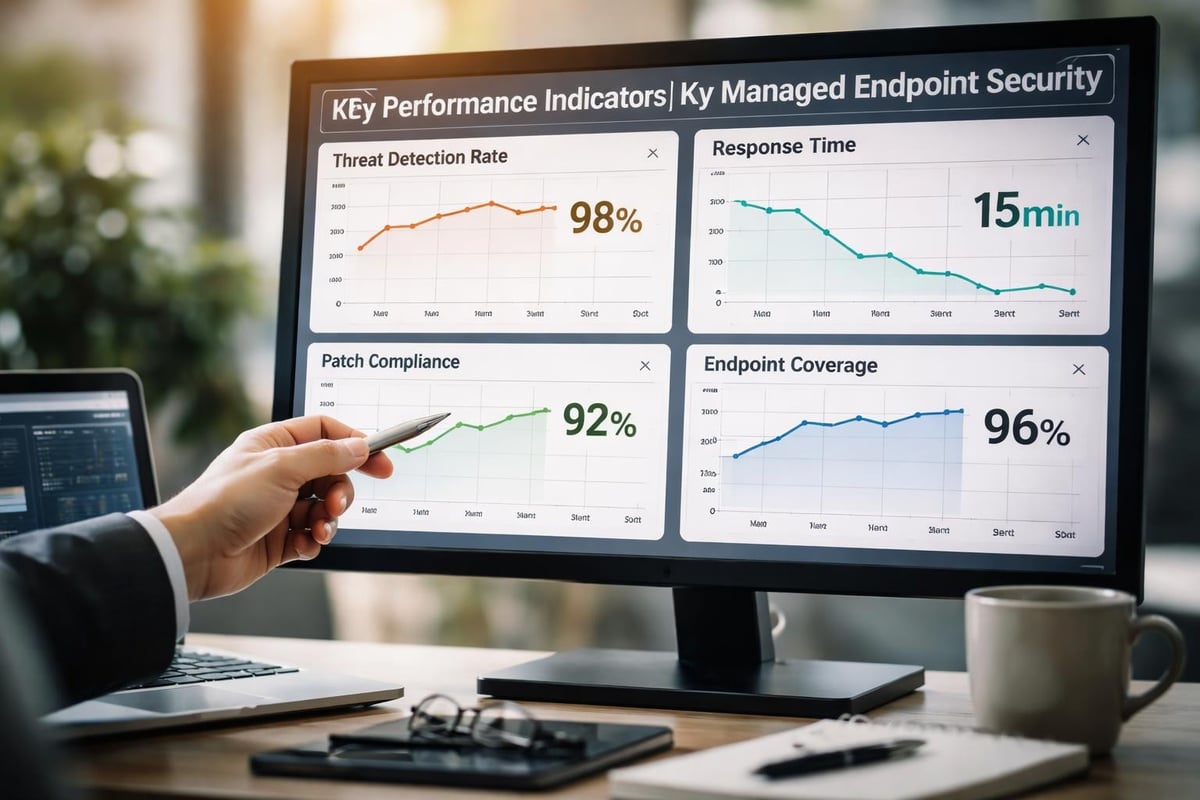
Outsourcing security management does not mean surrendering oversight. Businesses must maintain transparency into security operations, understanding what actions providers take on their behalf. Quality managed services include detailed reporting, regular briefings, and access to security dashboards showing current protection status.
Selecting the Right Provider
The managed security services market offers numerous options varying significantly in capability, focus, and value. Making informed provider selections requires evaluating factors beyond basic pricing.
Criteria for Evaluation
Start by examining the provider's technical capabilities and certifications. Look for teams holding recognized security credentials such as CISSP, CEH, or GIAC certifications. Ask about their security operations center infrastructure, including redundancy and geographic distribution.
Request case studies demonstrating experience with businesses similar to yours in size and industry. Providers familiar with your sector understand relevant compliance requirements and common threat vectors. This domain expertise accelerates deployment and improves security outcomes.
Service Level Agreements
SLAs define the commitments providers make regarding response times, uptime, and support availability. Carefully review these agreements, ensuring they address scenarios critical to your business. Key SLA components include:
- Incident response timeframes for different severity levels
- System availability guarantees with remedies for downtime
- Communication protocols during active incidents
- Reporting frequency and detail for security status updates
- Performance metrics the provider commits to achieving
Understand the provider's escalation process and confirm you have direct access to senior technical resources when needed. Some providers restrict client contact to account managers, creating communication delays during critical incidents.
Local Versus National Providers
Businesses must weigh the advantages of local providers against larger national firms. Local managed service providers like those serving Lethbridge and Southern Alberta offer personalized attention and faster on-site response when physical intervention is required. They understand regional business environments and maintain relationships built on direct interaction.
National providers typically offer broader resources and more specialized expertise across diverse security domains. They invest heavily in proprietary tools and maintain larger security operations centers. However, client relationships may feel more transactional with account managers rotating frequently.
For many small businesses, regional providers deliver the optimal balance of expertise, accessibility, and value. Their proximity enables face-to-face meetings, fostering collaboration that improves security outcomes. When evaluating options, consider which relationship model aligns with your preferences and operational requirements.
Integration with Broader IT Strategy
Managed endpoint security services function most effectively as components of comprehensive IT management rather than standalone solutions. Aligning endpoint protection with network security, data backup, and infrastructure monitoring creates synergies that enhance overall resilience.
Coordinating Multiple Service Layers
Endpoints represent just one element in your security architecture. Effective protection requires coordination across firewalls, email security, cloud access controls, and user authentication systems. When these components operate independently, gaps emerge that attackers exploit.
Selecting providers who offer integrated services simplifies this coordination. Single vendors managing multiple security domains maintain consistent policies and share intelligence across platforms. This integration reduces complexity while improving threat visibility. Explore additional managed IT services that complement endpoint protection for comprehensive coverage.
Supporting Business Continuity
Endpoint security directly impacts business continuity planning. Rapid recovery from security incidents requires coordination between endpoint protection, data backup systems, and disaster recovery procedures. When ransomware encrypts endpoint data, restoration depends on recent backups and tested recovery processes.
Managed services should include tabletop exercises simulating security incidents to validate response procedures. These exercises identify weaknesses in coordination between security and backup systems, enabling corrections before actual incidents occur. Regular testing ensures business continuity plans remain current as infrastructure evolves.
Future Trends in Endpoint Security
The endpoint security landscape continues evolving rapidly, driven by technological advancement and shifting threat patterns. Understanding emerging trends helps businesses prepare for future requirements.
Zero Trust Architecture
Traditional security models assume devices inside the network perimeter are trustworthy. Zero trust architecture eliminates this assumption, requiring continuous verification regardless of network location. Every access request undergoes authentication and authorization, with privileges granted for specific resources rather than broad network access.
Managed endpoint security services increasingly incorporate zero trust principles, implementing granular access controls and continuous authentication. This approach significantly reduces breach impact by limiting lateral movement even when individual endpoints are compromised.
AI-Powered Threat Detection
Artificial intelligence and machine learning enhance threat detection capabilities beyond human capacity. These systems analyze millions of events simultaneously, identifying subtle patterns indicating sophisticated attacks. As threats grow more advanced, AI-driven detection becomes essential for maintaining effective protection.
Quality managed services invest continuously in AI capabilities, training models on threat intelligence gathered across their entire client base. This collective learning improves detection accuracy while reducing false positives that burden security teams.
Extended Detection and Response
EDR solutions are evolving into extended detection and response (XDR) platforms that correlate data across endpoints, networks, clouds, and applications. This broader visibility reveals attack chains spanning multiple systems, enabling more effective response to complex threats.
Managed service providers adopting XDR platforms deliver superior protection by connecting events across your entire infrastructure. Rather than analyzing endpoint alerts in isolation, they understand how compromised devices relate to broader attack campaigns targeting your organization.
Protecting the expanding array of devices accessing business networks requires specialized expertise and continuous vigilance that managed endpoint security services deliver effectively. By combining advanced technology with experienced security professionals, these services provide small businesses with enterprise-grade protection at accessible price points. Delphi Systems Inc. helps Lethbridge area businesses implement comprehensive endpoint security as part of integrated IT management, ensuring your infrastructure remains secure while you focus on business growth. Contact us to discuss how our fixed-rate managed services can strengthen your security posture without straining your budget.

