
Small businesses face an unprecedented challenge in 2026: protecting sensitive information from increasingly sophisticated cyber threats while maintaining operational efficiency. Data breaches cost companies an average of $4.45 million, and the consequences extend far beyond financial loss to include damaged reputations, lost customer trust, and regulatory penalties. Implementing comprehensive data security solutions has become a critical priority for businesses of all sizes, particularly those in Lethbridge and surrounding areas where small enterprises rely heavily on digital infrastructure to compete effectively.
Understanding Modern Data Security Solutions
Data security solutions encompass a broad range of technologies, practices, and policies designed to protect digital information from unauthorized access, corruption, or theft. These solutions address multiple threat vectors simultaneously, creating layered defenses that protect data at rest, in transit, and during processing.
Core Components of Effective Data Security:
- Encryption technologies that render data unreadable without proper authorization
- Access control systems that verify user identities and enforce permissions
- Network monitoring tools that detect unusual activity patterns
- Backup and recovery solutions that ensure business continuity after incidents
- Endpoint protection that secures individual devices accessing your network
The complexity of modern data security solutions reflects the evolving threat landscape. Cybercriminals continuously develop new attack methods, requiring businesses to adopt adaptive, multi-layered approaches rather than relying on single-point solutions.
Essential Technologies for Data Protection
Encryption as a Foundation
Encryption transforms readable data into coded format, making it useless to unauthorized parties even if intercepted. Modern data security solutions employ encryption at multiple levels: full-disk encryption for storage devices, file-level encryption for sensitive documents, and transport layer security for data moving across networks.
The strength of encryption depends on key management practices. Businesses must establish secure processes for generating, storing, and rotating encryption keys. According to research on trusted computational environments, maintaining privacy-compliant evaluations on personal data requires robust encryption frameworks that don't compromise security during processing.
Access Control and Identity Management
Controlling who can access specific data represents a fundamental security principle. Role-based access control (RBAC) assigns permissions based on job functions, ensuring employees only access information necessary for their responsibilities.
Multi-factor authentication (MFA) adds critical protection by requiring multiple verification methods before granting access. This might include:
- Something you know (password)
- Something you have (security token or smartphone)
- Something you are (biometric verification)
Authoritative data sources in identity management play a crucial role in maintaining data integrity and security throughout access control systems.
Network Security Infrastructure
Firewalls, intrusion detection systems, and virtual private networks (VPNs) form the backbone of network-level data security solutions. Firewalls monitor and filter incoming and outgoing traffic based on predetermined security rules, blocking potentially harmful connections before they reach internal systems.
Modern intrusion detection systems use machine learning algorithms to identify anomalous behavior patterns that might indicate security breaches. These systems continuously analyze network traffic, user activities, and system logs to spot threats that traditional signature-based tools might miss.
Data Governance and Compliance Frameworks
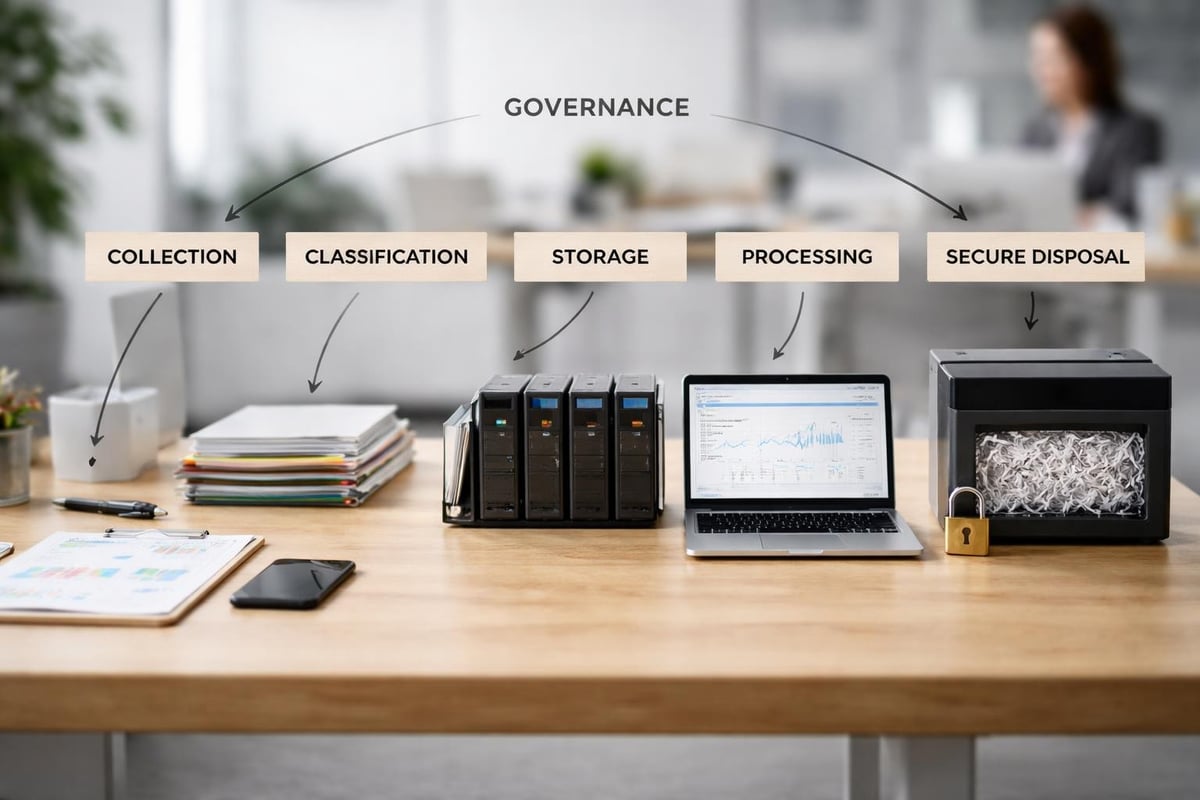
Effective data security solutions extend beyond technical controls to include comprehensive governance frameworks. These frameworks define how organizations collect, store, process, and dispose of data throughout its lifecycle.
Establishing Data Classification Systems
Not all data requires the same level of protection. Classification systems categorize information based on sensitivity and regulatory requirements:
| Classification Level | Examples | Security Measures |
|---|---|---|
| Public | Marketing materials, published reports | Basic access controls |
| Internal | Employee directories, internal communications | Standard encryption, authentication |
| Confidential | Financial records, customer data | Strong encryption, MFA, audit logging |
| Restricted | Trade secrets, personal health information | Maximum security, strict access limits |
This tiered approach allows businesses to allocate security resources efficiently, applying the strongest protections where they matter most. Establishing authoritative data sources within these frameworks ensures accuracy and reliability across all classification levels.
Regulatory Compliance Requirements
Small businesses must navigate complex regulatory landscapes that vary by industry and geography. Common frameworks include:
- PIPEDA (Personal Information Protection and Electronic Documents Act) for Canadian businesses handling personal information
- PCI DSS (Payment Card Industry Data Security Standard) for organizations processing credit card transactions
- HIPAA (Health Insurance Portability and Accountability Act) for healthcare-related data
- GDPR (General Data Protection Regulation) for businesses serving European customers
Compliance requires ongoing documentation, regular audits, and employee training programs. The Congressional Research Service compilation on cybersecurity provides authoritative resources for understanding various data security requirements.
Implementing Backup and Disaster Recovery
Data security solutions must account for both prevention and recovery. Even with robust preventive measures, businesses need strategies to restore operations quickly after security incidents or system failures.
The 3-2-1 Backup Strategy
This proven approach minimizes data loss risk:
- Maintain three copies of important data
- Store backups on two different media types
- Keep one copy offsite or in the cloud
Cloud-based backup solutions offer particular advantages for small businesses, providing scalable storage capacity without significant infrastructure investments. These solutions typically include automated scheduling, versioning capabilities, and geographic redundancy.
Recovery Time and Point Objectives
Businesses must define acceptable parameters for recovery:
Recovery Time Objective (RTO): Maximum acceptable downtime before operations must resume. A retail business might set a 4-hour RTO, while a manufacturing facility might require 24 hours.
Recovery Point Objective (RPO): Maximum acceptable data loss measured in time. An RPO of one hour means the business can tolerate losing up to one hour of data.
These objectives drive backup frequency and storage infrastructure decisions. Businesses with stringent RTOs and RPOs require more frequent backups and faster recovery mechanisms, potentially including real-time replication and hot standby systems.
Cybersecurity Awareness and Training
Technical data security solutions provide limited protection if employees lack security awareness. Human error accounts for a significant percentage of data breaches, making training programs essential components of comprehensive security strategies.
Building Security-Conscious Culture
Effective training programs cover:
- Phishing recognition: Identifying suspicious emails, links, and attachments
- Password hygiene: Creating strong passwords and using password managers
- Social engineering tactics: Recognizing manipulation attempts
- Secure mobile device usage: Protecting data on smartphones and tablets
- Incident reporting procedures: Knowing how and when to report security concerns
Training should occur during onboarding and continue through regular refresher sessions. Simulated phishing campaigns test employee awareness and identify areas requiring additional education.
Developing Response Protocols
Even with preventive measures, security incidents occur. Clear response protocols minimize damage by ensuring rapid, coordinated action. Response plans should identify:
- Detection and reporting procedures
- Initial containment steps
- Investigation and assessment responsibilities
- Communication protocols for stakeholders
- Recovery and restoration processes
- Post-incident analysis requirements
Regular tabletop exercises test these protocols, revealing gaps and improving team readiness.
Advanced Security Measures for 2026
Artificial Intelligence and Machine Learning
Modern data security solutions increasingly incorporate AI technologies that identify threats faster than human analysts. These systems analyze vast data volumes, detecting subtle patterns indicating potential breaches.
However, AI systems themselves require cybersecurity guidance to maintain data integrity and prevent adversarial attacks. The NSA emphasizes sourcing reliable data and maintaining robust security practices specifically for AI implementations.
Zero Trust Architecture
Traditional security models assumed threats originated outside the network perimeter. Zero trust assumes no user or device is inherently trustworthy, requiring continuous verification regardless of location.
Key Zero Trust Principles:
- Verify explicitly using all available data points
- Apply least-privilege access policies
- Assume breach and minimize potential damage
This approach particularly benefits small businesses with remote workers and cloud-based operations, where traditional perimeter-based security proves insufficient.
Data Loss Prevention (DLP)
DLP solutions monitor data movement across networks, endpoints, and cloud services. These tools prevent sensitive information from leaving the organization through unauthorized channels, whether accidentally or maliciously.
DLP policies can:
- Block emails containing credit card numbers or social security numbers
- Prevent copying sensitive files to USB drives
- Alert administrators when unusual data transfers occur
- Encrypt sensitive data automatically when shared externally
Selecting the Right Data Security Solutions
Assessing Business Needs
Small businesses should begin with comprehensive risk assessments identifying:
- Data inventory: What information does the business collect and store?
- Threat landscape: What risks are most relevant to the industry and location?
- Compliance requirements: What regulations apply to the business?
- Resource constraints: What budget and personnel are available?
- Business priorities: Which systems and data are most critical?
This assessment informs security strategy, ensuring resources address the highest-priority risks first.
Evaluating Solution Providers
When selecting data security solutions, businesses should consider:
| Evaluation Criteria | Questions to Ask |
|---|---|
| Scalability | Can the solution grow with the business? |
| Integration | Does it work with existing systems? |
| Support | What assistance is available during implementation and operation? |
| Total Cost | What are ongoing licensing, maintenance, and training costs? |
| Proven Track Record | What results have similar businesses achieved? |
Managed IT service providers offer particular value for small businesses lacking dedicated security staff. These providers deliver enterprise-grade data security solutions at predictable costs, allowing businesses to focus on core activities while experts handle security infrastructure.

Cloud Security Considerations
Cloud computing has transformed how businesses operate, but it introduces unique security challenges. While cloud providers invest heavily in infrastructure security, businesses remain responsible for protecting their data and applications.
Shared Responsibility Model
Understanding where provider responsibilities end and customer responsibilities begin is crucial:
Provider Responsibilities:
- Physical security of data centers
- Network infrastructure protection
- Hypervisor and virtualization security
- Hardware maintenance and updates
Customer Responsibilities:
- Access management and identity controls
- Data encryption and key management
- Application security and patch management
- Compliance with regulatory requirements
Securing Cloud Environments
Effective cloud data security solutions include:
- Cloud access security brokers (CASBs) that provide visibility and control over cloud applications
- Cloud workload protection platforms that secure virtual machines and containers
- Secure configuration management ensuring cloud resources follow security best practices
- Regular auditing of permissions, access logs, and resource usage
The holistic approach to data protection outlined in recent research emphasizes securing data across sharing, communicating, and computing environments, particularly relevant for cloud-based operations.
Monitoring and Continuous Improvement
Data security solutions require ongoing attention rather than one-time implementation. Threat landscapes evolve, new vulnerabilities emerge, and business requirements change.
Security Information and Event Management (SIEM)
SIEM platforms aggregate and analyze security data from across the IT environment, providing centralized visibility into potential threats. These systems correlate events from firewalls, servers, applications, and endpoints to identify complex attack patterns.
Real-time alerting ensures security teams respond quickly to critical events, while historical analysis reveals trends and informs strategic improvements.
Regular Security Assessments
Businesses should conduct periodic assessments including:
- Vulnerability scans identifying technical weaknesses in systems and applications
- Penetration testing simulating real attacks to evaluate defense effectiveness
- Configuration reviews ensuring systems follow security best practices
- Access audits verifying permissions remain appropriate as roles change
- Policy reviews updating security policies to reflect current threats and business needs
These assessments often reveal gaps in data security solutions, enabling proactive remediation before attackers exploit vulnerabilities.
Managing Third-Party Risks
Small businesses increasingly rely on vendors, suppliers, and service providers who access their data or systems. These relationships introduce security risks requiring careful management.
Vendor Due Diligence
Before engaging third parties, businesses should:
- Review security certifications and compliance attestations
- Assess data handling and protection practices
- Evaluate incident response capabilities
- Understand subcontractor relationships
- Verify insurance coverage for data breaches
Formal vendor risk management programs document these assessments and establish ongoing monitoring processes.
Contractual Protections
Contracts with third parties should specify:
- Data security requirements and standards
- Audit rights and reporting obligations
- Breach notification timelines
- Liability and indemnification provisions
- Data return and destruction procedures upon contract termination
These provisions create accountability and provide recourse if vendors fail to maintain adequate security.
Budget Considerations for Small Businesses
Implementing comprehensive data security solutions requires financial investment, but costs vary significantly based on business size, industry, and risk profile.
Fixed-Rate Service Models
Many small businesses benefit from managed service arrangements offering predictable monthly costs. These models typically include:
- Ongoing monitoring and maintenance
- Regular security updates and patches
- Help desk support for security issues
- Compliance reporting and documentation
- Strategic planning and consulting
Fixed-rate structures simplify budgeting and ensure continuous protection without surprise expenses. For businesses in Lethbridge and surrounding areas, local managed service providers understand regional compliance requirements and business challenges.
Return on Investment
While data security solutions represent significant investments, the costs pale compared to breach consequences. Calculating potential ROI should consider:
- Avoided breach costs: Direct expenses including forensics, legal fees, notification costs, and regulatory fines
- Prevented downtime: Lost revenue during system outages
- Protected reputation: Customer trust and brand value
- Maintained compliance: Avoiding penalties and maintaining business licenses
- Increased efficiency: Streamlined operations through better data management
Emerging Threats and Future Trends
The data security landscape continues evolving rapidly. Businesses must stay informed about emerging threats and prepare for future challenges.
Ransomware Evolution
Ransomware attacks have grown more sophisticated, with criminals now exfiltrating data before encryption to enable double extortion. Modern data security solutions must address both encryption prevention and data theft protection.
Internet of Things Vulnerabilities
Connected devices from security cameras to smart thermostats introduce new attack vectors. Many IoT devices lack basic security features, creating entry points for network infiltration.
Quantum Computing Threats
While still emerging, quantum computers threaten current encryption standards. Forward-thinking organizations are beginning to implement quantum-resistant cryptography to protect long-term sensitive data.
Research on data reliability challenges highlights the importance of staying current with authoritative sources as the cybersecurity landscape evolves.
Integration with Business Operations
Effective data security solutions support rather than hinder business operations. Poorly implemented security creates friction that frustrates employees and reduces productivity.
Balancing Security and Usability
Security measures should be transparent to users when possible, working in the background without disrupting workflows. When user interaction is necessary, processes should be streamlined and intuitive.
Single sign-on (SSO) solutions exemplify this balance, improving both security and user experience by reducing password fatigue while maintaining strong authentication.
Enabling Business Growth
Robust data security solutions actually enable business growth by:
- Building customer confidence in data handling practices
- Meeting partner security requirements for collaboration
- Facilitating expansion into regulated industries
- Supporting remote work and flexible arrangements
- Protecting intellectual property that drives competitive advantage
For more insights on integrating security with business strategy, visit the Delphi Systems blog for regular updates on managed IT services best practices.
Protecting business data requires comprehensive strategies combining technology, processes, and people in coordinated defense systems. Small businesses in Lethbridge and surrounding areas need data security solutions tailored to their specific risks, compliance requirements, and operational realities. Delphi Systems Inc. provides managed IT services with fixed-rate pricing that includes robust cybersecurity, data backup and recovery, network monitoring, and ongoing support, enabling small businesses to maintain secure, efficiently managed IT infrastructure while focusing on core business activities.

