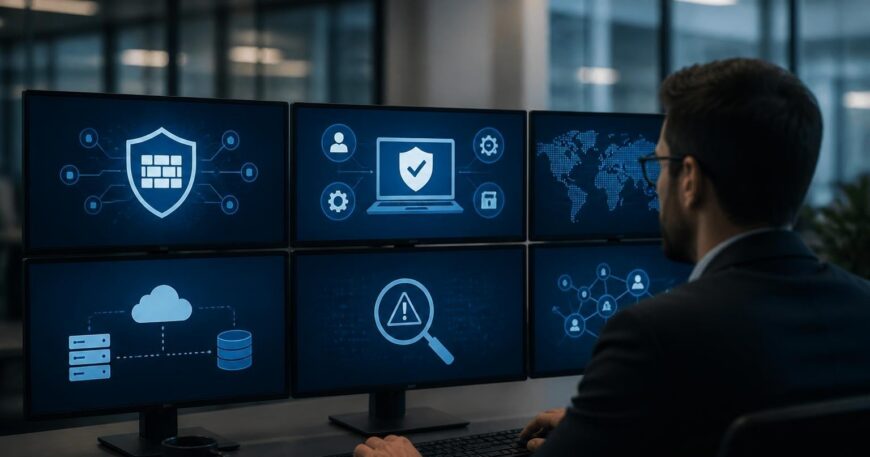
Small businesses face increasingly sophisticated cyber threats in 2026, making robust protection essential for survival. Implementing the right cyber security software for business isn't just about preventing data breaches but protecting your reputation, customer trust, and financial stability. With cybercriminals targeting small and medium-sized enterprises more aggressively than ever, understanding which security tools your organization needs has become a critical business decision. This comprehensive guide explores the essential software solutions that form a complete security strategy, helping you make informed choices that protect your business without overwhelming your budget or IT resources.
Understanding Modern Cyber Security Software Requirements
Business cybersecurity has evolved dramatically over the past few years. The software solutions available today address threats that didn't exist even two years ago, from AI-powered phishing attacks to sophisticated ransomware variants designed specifically for small business networks.
Modern cyber security software for business must provide multilayered protection. A single antivirus program no longer suffices when your employees access company data from multiple devices and locations. Today's security ecosystem requires coordinated tools that work together to monitor, detect, prevent, and respond to threats across your entire digital infrastructure.
Core Protection Categories
Every business security strategy should include software solutions across several critical categories:
- Endpoint protection platforms that secure laptops, desktops, mobile devices, and servers
- Firewall systems that monitor and control incoming and outgoing network traffic
- Email security gateways that filter malicious messages before they reach employee inboxes
- Data backup and recovery tools that ensure business continuity after an incident
- Network monitoring solutions that identify suspicious activity in real-time
- Identity and access management systems that control who can access sensitive resources
The Federal Trade Commission guide for small business cybersecurity emphasizes that protection requires both technological solutions and employee awareness. Your software choices should complement your team's security training rather than replace it.

Essential Software Solutions for Small Business Protection
Selecting cyber security software for business requires understanding what each tool does and how it fits into your overall security posture. Different solutions address different threat vectors, and comprehensive protection means covering all potential entry points.
Endpoint Detection and Response Systems
Endpoint protection has moved far beyond traditional antivirus software. Modern endpoint detection and response (EDR) platforms use behavioral analysis and machine learning to identify threats that signature-based systems miss. These tools continuously monitor endpoint activities, detecting anomalies that indicate compromise.
When evaluating endpoint security software options, prioritize solutions that offer:
- Real-time threat detection and automated response
- Centralized management for all devices across your network
- Integration with your existing security tools and workflows
- Ransomware-specific protection with rollback capabilities
- Regular threat intelligence updates from global security networks
The right EDR solution should operate silently in the background while providing your IT team with detailed visibility into security events across all endpoints.
Network Firewall and Traffic Management
Firewalls form the first line of defense between your internal network and external threats. Next-generation firewalls go beyond simple port blocking to inspect packet contents, identify applications, and apply granular security policies based on user identity and behavior.
| Firewall Feature | Business Benefit | Implementation Priority |
|---|---|---|
| Deep packet inspection | Identifies malware in encrypted traffic | High |
| Application awareness | Controls specific program network access | High |
| Intrusion prevention | Blocks known attack patterns automatically | Critical |
| VPN capabilities | Secures remote worker connections | Critical |
| Threat intelligence integration | Updates defenses against new threats | Medium |
Small businesses should explore firewall software designed for SMB environments that balance robust protection with manageable complexity. Your firewall should protect without requiring a dedicated security specialist to configure and maintain.
Email Security and Anti-Phishing Tools
Email remains the primary vector for business cyber attacks. Phishing campaigns have become remarkably sophisticated, with attackers using social engineering and publicly available information to create convincing messages that bypass traditional spam filters.
Advanced email security solutions analyze sender reputation, examine link destinations, sandbox suspicious attachments, and use artificial intelligence to detect impersonation attempts. The best systems quarantine threats automatically while alerting users to potentially dangerous messages that require additional scrutiny.
Implementing a Coordinated Security Strategy
Purchasing cyber security software for business represents just the first step. Effective protection requires proper implementation, configuration, and ongoing management. Many security failures result not from inadequate tools but from misconfigured systems or incomplete deployment.
Integration and Centralized Management
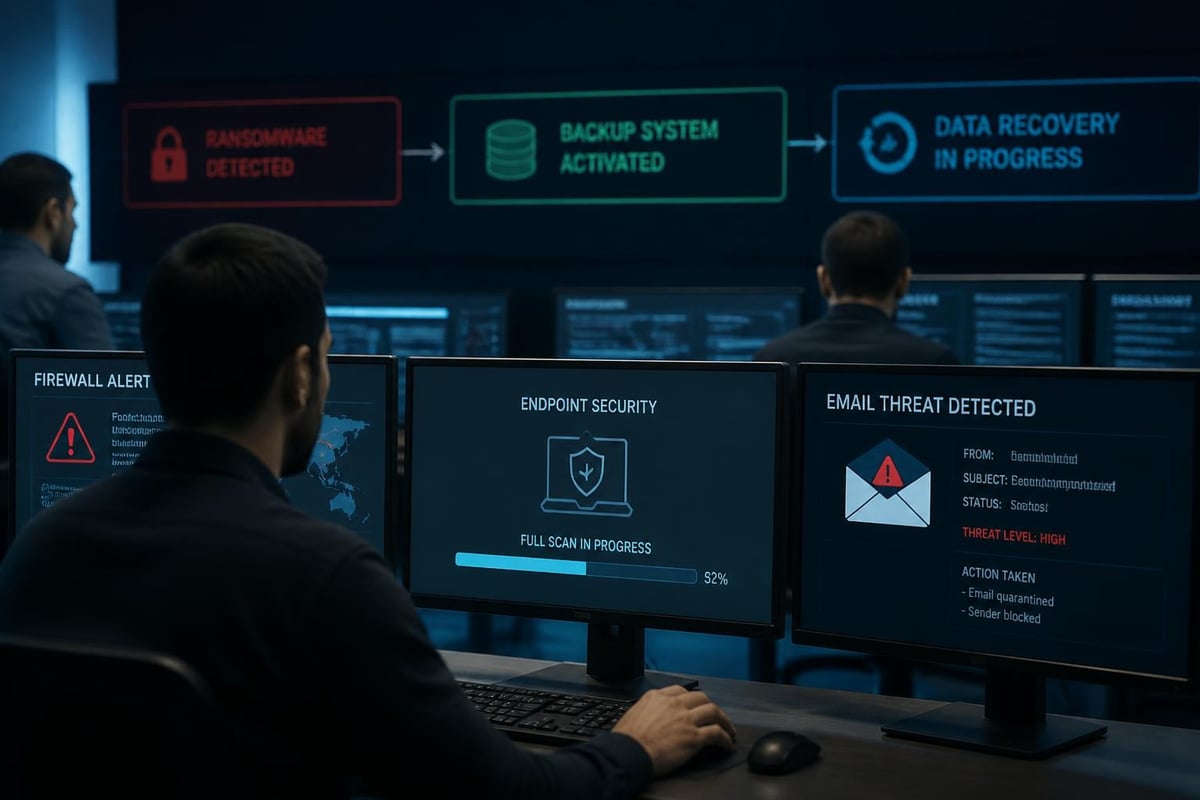
Your security tools should communicate with each other, sharing threat intelligence and coordinating responses. A firewall that detects suspicious traffic should alert your endpoint protection system. Your backup solution should trigger when ransomware activity is detected. This coordination requires either native integration between products or a security information and event management (SIEM) platform that brings everything together.
Benefits of integrated security platforms include:
- Reduced response time through automated threat sharing
- Simplified management with unified dashboards
- Fewer gaps in coverage through coordinated policies
- Lower total cost of ownership compared to disparate point solutions
For small businesses without dedicated security staff, managed detection and response services can provide the expertise needed to properly configure and monitor these integrated systems.
Vendor Selection and Evaluation Criteria
Choosing the right cyber security software for business means looking beyond marketing claims to evaluate real-world performance, support quality, and total ownership costs. The cheapest solution rarely provides the best value when you factor in deployment time, training requirements, and potential security gaps.
Key Evaluation Factors
Start by assessing vendors against these critical criteria:
- Detection effectiveness measured by independent testing labs
- False positive rates that don't overwhelm your team with alerts
- Performance impact on endpoint devices and network speed
- Scalability to grow with your business needs
- Support responsiveness during security incidents
- Compliance capabilities for industry-specific requirements
Resources like the Center for Internet Security provide vendor-neutral guidance on security best practices and controls that can inform your evaluation process. Their frameworks help you understand which capabilities matter most for your specific risk profile.
Total Cost of Ownership Analysis
Cyber security software costs extend well beyond license fees. Your total investment includes implementation services, training, ongoing management, and potential productivity impacts during deployment.
| Cost Component | Typical Range | Budget Planning Tip |
|---|---|---|
| Software licenses | $50-200 per user annually | Compare all-inclusive vs. module pricing |
| Implementation services | $2,000-10,000 one-time | Verify what's included in quoted price |
| Training and onboarding | $500-3,000 one-time | Consider vendor-provided resources |
| Ongoing management | 10-20 hours monthly | Factor in-house time or managed services |
| Updates and renewals | Included or 20% annually | Clarify renewal terms upfront |
Small businesses often find that managed IT services provide better value than purchasing and managing security software independently. Predictable monthly costs replace unpredictable security incidents and emergency remediation expenses.
Compliance and Regulatory Considerations
Many industries require specific cyber security software for business operations to meet regulatory standards. Healthcare organizations need HIPAA-compliant solutions. Financial services firms must satisfy various banking regulations. Even businesses without industry-specific mandates should consider data privacy laws affecting customer information.
Meeting Industry Standards
Your security software choices should directly support compliance requirements:
- Audit logging that captures user activities and system events
- Encryption capabilities for data at rest and in transit
- Access controls that enforce principle of least privilege
- Incident response features that document security events
- Regular reporting that demonstrates ongoing compliance
The best approach treats compliance as a minimum baseline rather than a target. Security practices that exceed regulatory requirements provide better protection and position your business favorably as standards evolve.
Cloud-Based vs. On-Premises Security Solutions
The shift toward cloud computing has transformed cyber security software for business deployment models. Cloud-based security solutions offer advantages in scalability, automatic updates, and reduced infrastructure requirements, but on-premises options still make sense for certain use cases.
Cloud Security Advantages
Modern cloud-delivered security platforms provide several compelling benefits:
- Automatic updates that protect against emerging threats immediately
- Reduced hardware and maintenance overhead
- Flexible scaling as your business grows
- Access to enterprise-grade protection at SMB prices
- Management from anywhere with internet connectivity
Cloud solutions typically operate on subscription pricing, converting capital expenses into predictable operational costs that simplify budgeting.
When On-Premises Makes Sense
Some businesses still benefit from on-premises security software deployment:
Organizations with strict data residency requirements may need to keep all security logs and monitoring data within their own infrastructure. Businesses with limited or unreliable internet connectivity require security that functions independently of cloud access. Companies with existing on-premises investments might integrate new security tools with current infrastructure more cost-effectively than migrating everything to the cloud.
The reality is that most businesses benefit from hybrid approaches, using cloud security where it provides clear advantages while maintaining on-premises tools for specific requirements.

Ongoing Management and Security Maintenance
Installing cyber security software for business represents just the beginning of effective protection. Security tools require continuous attention to remain effective against evolving threats. Outdated security software provides minimal protection and can actually create vulnerabilities.
Essential Maintenance Activities
Effective security management includes regular tasks that keep your protection current:
- Applying software updates and patches within 72 hours of release
- Reviewing security logs and alerts daily for suspicious activity
- Testing backup recovery procedures quarterly to verify reliability
- Updating security policies as business operations change
- Conducting security awareness training at least twice annually
- Performing vulnerability assessments quarterly or after major changes
Many small businesses lack the internal resources to handle these tasks consistently. According to research on software supply chain security, maintaining vigilance across all potential vulnerability points requires dedicated expertise and time.
The Managed Services Advantage
Managed IT service providers deliver the consistent attention that effective security requires. With fixed monthly costs, businesses gain access to security specialists who monitor systems continuously, apply updates promptly, and respond to threats immediately. This model provides enterprise-level protection at small business prices while allowing internal teams to focus on core business activities.
Delphi Systems Inc. combines comprehensive security software with expert management, ensuring your protection remains effective as threats evolve. Their proactive approach identifies and addresses vulnerabilities before they become incidents.
Building a Security-Aware Culture
The most sophisticated cyber security software for business fails when employees bypass protections or fall victim to social engineering. Technology and training must work together to create a security-conscious workplace culture.
Employee Security Training
Regular training helps employees recognize and respond appropriately to threats:
- Phishing identification through realistic simulated attacks
- Password hygiene emphasizing unique, complex credentials
- Physical security covering device handling and workspace protection
- Incident reporting making it easy to flag suspicious activities
- Policy understanding ensuring everyone knows their security responsibilities
Training should be ongoing rather than annual, with brief refresher sessions and timely updates when new threats emerge. Resources from CSO Online can help you stay informed about current threat landscapes and training priorities.
Creating Accountability
Security policies only work when consistently enforced. Clear expectations, regular reminders, and visible leadership commitment signal that cybersecurity matters to your organization. Recognizing employees who identify potential threats encourages vigilance across your team.
Measuring Security Effectiveness
Investing in cyber security software for business requires demonstrating value and identifying improvement opportunities. Effective measurement goes beyond counting blocked threats to assess overall security posture and readiness.
Key Security Metrics
Track these indicators to evaluate your security program effectiveness:
| Metric | What It Measures | Target Range |
|---|---|---|
| Mean time to detect | How quickly threats are identified | Under 1 hour |
| Mean time to respond | Speed of threat containment | Under 4 hours |
| Patch compliance rate | Percentage of systems current | Above 95% |
| Failed login attempts | Potential credential attacks | Trending data |
| Security awareness scores | Training program effectiveness | Above 80% |
| Backup success rate | Recovery readiness | 100% |
Regular reporting on these metrics helps you understand whether your security investments deliver expected protection. Trends matter more than single measurements, revealing whether your security posture improves over time.
Continuous Improvement
Security isn't a destination but an ongoing journey. Regular assessments identify gaps in your current protections, while staying informed about emerging threats helps you adapt before attackers exploit new vulnerabilities. The Cybersecurity Reference Library provides vendor-neutral resources that support continuous security improvement.
Quarterly security reviews should examine recent incidents, evaluate new threat intelligence, assess technology changes, and update policies accordingly. This disciplined approach keeps your protection relevant as both your business and the threat landscape evolve.
Future-Proofing Your Security Investment
Cyber security software for business must adapt to changing threat landscapes, emerging technologies, and evolving business needs. Making choices today that remain effective tomorrow requires understanding likely security trends and selecting flexible solutions.
Emerging Security Technologies
Several technologies are reshaping business cybersecurity:
- AI-powered threat detection that identifies zero-day attacks through behavioral analysis
- Zero-trust architecture that continuously verifies rather than automatically trusting
- Extended detection and response (XDR) that correlates threats across all security layers
- Security orchestration and automation that accelerates incident response
- Passwordless authentication reducing credential-based attack vectors
While these technologies continue maturing, choosing vendors who invest in innovation helps ensure your security remains effective as threats evolve. Look for providers with clear technology roadmaps and regular capability enhancements.
Planning for Growth
Your security software should scale efficiently as your business expands. Solutions that work for fifteen employees may struggle at fifty. Consider future needs when making current decisions:
Evaluate licensing models that accommodate growth without dramatic cost increases. Assess architectural flexibility supporting multiple locations or remote workforces. Consider integration capabilities with tools you might adopt as you expand. Review vendor stability ensuring they'll support you long-term.
The right cyber security software for business grows with you, protecting your expanding operations without requiring complete replacement every few years.
Protecting your business from cyber threats requires the right combination of software tools, expert management, and consistent attention. By implementing multilayered security solutions, maintaining vigilant monitoring, and fostering security awareness throughout your organization, you create robust defenses against increasingly sophisticated attacks. Delphi Systems Inc. delivers comprehensive managed IT services that include expert cybersecurity implementation and ongoing management, allowing Lethbridge businesses to maintain peak security posture while focusing on core operations. Contact them today to discuss how their fixed-rate IT services can strengthen your security and enhance overall productivity.

