

Small businesses face unprecedented challenges in protecting sensitive information as cyber threats evolve and regulatory requirements become more stringent. Data protection for businesses is no longer optional but a critical operational necessity that impacts customer trust, legal compliance, and financial stability. With the average cost of data breaches climbing year over year, implementing robust data protection strategies has become essential for maintaining competitive advantage and ensuring business continuity. For companies in Lethbridge and beyond, understanding how to secure customer information, employee records, and proprietary business data forms the foundation of responsible business operations in 2026.
Understanding Data Protection Requirements
Data protection for businesses encompasses multiple layers of security measures, legal compliance, and operational procedures designed to safeguard information throughout its lifecycle. Modern businesses handle vast quantities of sensitive data, from customer payment details to employee social security numbers, making comprehensive protection frameworks essential.
The regulatory landscape varies by jurisdiction, but core principles remain consistent across frameworks. The U.S. Federal Trade Commission provides authoritative guidance on how businesses should secure sensitive data and prevent misuse, highlighting fundamental obligations regardless of company size. These requirements extend beyond basic security measures to include documentation, incident response planning, and regular security assessments.
Key Compliance Frameworks
Understanding which regulations apply to your business depends on several factors:
- Geographic location of your operations and customers
- Industry sector and specific regulatory bodies overseeing your field
- Type of data collected, processed, and stored
- Volume and sensitivity of personal information handled
- Third-party relationships and data sharing arrangements
| Framework | Primary Focus | Applicability |
|---|---|---|
| GDPR | EU citizens' personal data | Businesses serving EU customers |
| CCPA/CPRA | California consumer rights | Companies with California customer data |
| PIPEDA | Canadian privacy standards | Organizations operating in Canada |
| HIPAA | Healthcare information | Medical providers and partners |
| SOC 2 | Service organization controls | Technology and service providers |
Small businesses often assume they're exempt from stringent requirements, but most privacy regulations apply regardless of company size. The data protection principles outlined by the Information Commissioner’s Office emphasize that accountability extends to organizations of all sizes, requiring practical steps tailored to operational scale.

Building a Data Protection Strategy
Creating an effective data protection strategy begins with understanding what data your business collects and why. Many small businesses accumulate information without clear retention policies, creating unnecessary risk and compliance challenges. A structured approach to data protection for businesses involves mapping data flows, classifying information sensitivity, and implementing appropriate safeguards.
Data Inventory and Classification
Start by conducting a comprehensive audit of all information assets:
- Identify data sources including customer databases, email systems, cloud storage, and physical records
- Document data types such as financial information, health records, personal identifiers, and business intelligence
- Map data flows tracking how information moves between systems, departments, and third parties
- Classify sensitivity levels using categories like public, internal, confidential, and restricted
- Establish retention schedules determining how long different data types should be kept
This foundational work enables targeted protection measures rather than applying blanket policies that may over-protect low-risk data while under-protecting critical assets. The SNIA best practices framework provides technical guidance for managing data throughout its lifecycle, from creation through secure disposal.
Access Control Implementation
Limiting who can access specific data represents one of the most effective protection measures. Implementing the principle of least privilege ensures employees access only the information necessary for their roles.
Essential access control elements:
- Role-based access permissions aligned with job functions
- Multi-factor authentication for sensitive systems
- Regular access reviews and permission audits
- Immediate access revocation upon employee departure
- Privileged account monitoring and logging
Modern managed IT services can automate many access control functions, reducing the administrative burden while improving security consistency. Network monitoring tools detect unusual access patterns that may indicate compromised credentials or insider threats.
Technical Safeguards and Security Measures
Data protection for businesses requires layering multiple technical controls to create defense in depth. No single security measure provides complete protection, making comprehensive coverage essential across all potential attack vectors.
Encryption Standards
Data in transit requires encryption protocols that protect information as it moves between locations:
- TLS 1.3 for web communications and email
- VPN tunnels for remote access
- Secure file transfer protocols (SFTP, HTTPS)
- End-to-end encryption for messaging systems
Data at rest demands encryption of stored information:
- Full disk encryption on all devices
- Database-level encryption for sensitive records
- Encrypted backup storage
- Secure key management systems
The FTC’s guide for protecting personal information emphasizes that encryption should be standard practice rather than an optional enhancement, particularly for businesses handling customer financial data or personal identifiers.

Backup and Recovery Systems
Robust backup strategies form the last line of defense against data loss:
| Backup Type | Frequency | Retention | Purpose |
|---|---|---|---|
| Full backup | Weekly | 4 weeks | Complete system restoration |
| Incremental | Daily | 2 weeks | Recent change recovery |
| Differential | Bi-weekly | 3 weeks | Moderate-term recovery |
| Cloud replication | Continuous | 90 days | Disaster recovery |
Testing recovery procedures regularly ensures backups function correctly when needed. Many businesses discover backup failures only during actual emergencies, making quarterly restoration tests crucial for validating data protection measures.
Network Security and Monitoring
Protecting data requires securing the networks through which it travels. Small businesses in Lethbridge face the same sophisticated threats as larger enterprises, making professional network security essential rather than optional.
Firewall and Intrusion Prevention
Modern firewalls do more than block unauthorized traffic. Next-generation firewalls combine multiple security functions:
- Application-level filtering and control
- Intrusion detection and prevention systems
- Malware scanning and blocking
- SSL/TLS inspection capabilities
- Threat intelligence integration
Network monitoring tools provide visibility into traffic patterns, enabling early detection of anomalies that may indicate security incidents. Continuous monitoring represents a cornerstone of effective data protection for businesses, allowing rapid response to emerging threats.
Endpoint Protection
Every device accessing business data represents a potential vulnerability. Comprehensive endpoint security includes:
- Advanced antivirus and anti-malware software
- Patch management ensuring systems stay current
- Device encryption and remote wipe capabilities
- Mobile device management for smartphones and tablets
- Application whitelisting on critical systems
The distributed nature of modern work environments, with employees accessing data from home offices and mobile devices, expands the attack surface considerably. Managing these endpoints consistently requires centralized tools and policies that enforce security standards regardless of device location.
Employee Training and Awareness
Technical controls alone cannot prevent all data breaches. Human error accounts for a significant percentage of security incidents, making employee education a critical component of data protection strategies.
Training Program Elements
Effective security awareness programs go beyond annual compliance videos:
- Regular training sessions covering current threats and best practices
- Simulated phishing campaigns testing and improving threat recognition
- Clear policies explaining acceptable use and data handling requirements
- Incident reporting procedures encouraging employees to report suspicious activity
- Role-specific training addressing unique risks for different positions
Small businesses benefit from making security training practical and relevant to daily operations. Abstract concepts about data protection resonate less than concrete examples demonstrating how security practices protect customer information and business operations.
Security Culture Development
Building a culture where security becomes everyone's responsibility requires consistent reinforcement:
- Leadership modeling secure behaviors
- Recognizing employees who identify threats
- Making security questions part of decision-making processes
- Regularly communicating security updates and threats
- Including security metrics in performance evaluations
When employees understand their role in protecting business data, they become active participants rather than reluctant policy followers. This cultural shift significantly enhances the effectiveness of technical security measures.
Third-Party Risk Management
Data protection for businesses extends beyond internal systems to include vendors, contractors, and service providers who access or process business information. Third-party breaches increasingly represent pathways for attackers to access target organizations.
Vendor Assessment Process
Before sharing data with external parties, conduct thorough security assessments:
Due diligence checklist:
- Review security certifications and audit reports
- Evaluate data handling and protection policies
- Assess incident response capabilities and history
- Verify compliance with relevant regulations
- Examine insurance coverage for data breaches
- Test security controls through questionnaires or audits
| Risk Level | Assessment Frequency | Requirements |
|---|---|---|
| Critical | Quarterly | SOC 2, penetration tests, insurance verification |
| High | Semi-annually | Security questionnaire, policy review |
| Moderate | Annually | Basic security confirmation |
| Low | Initial only | Limited assessment |
Contractual agreements should specify security requirements, breach notification timelines, and liability arrangements. Many small businesses overlook these provisions, discovering inadequate protections only after incidents occur.
Incident Response and Business Continuity
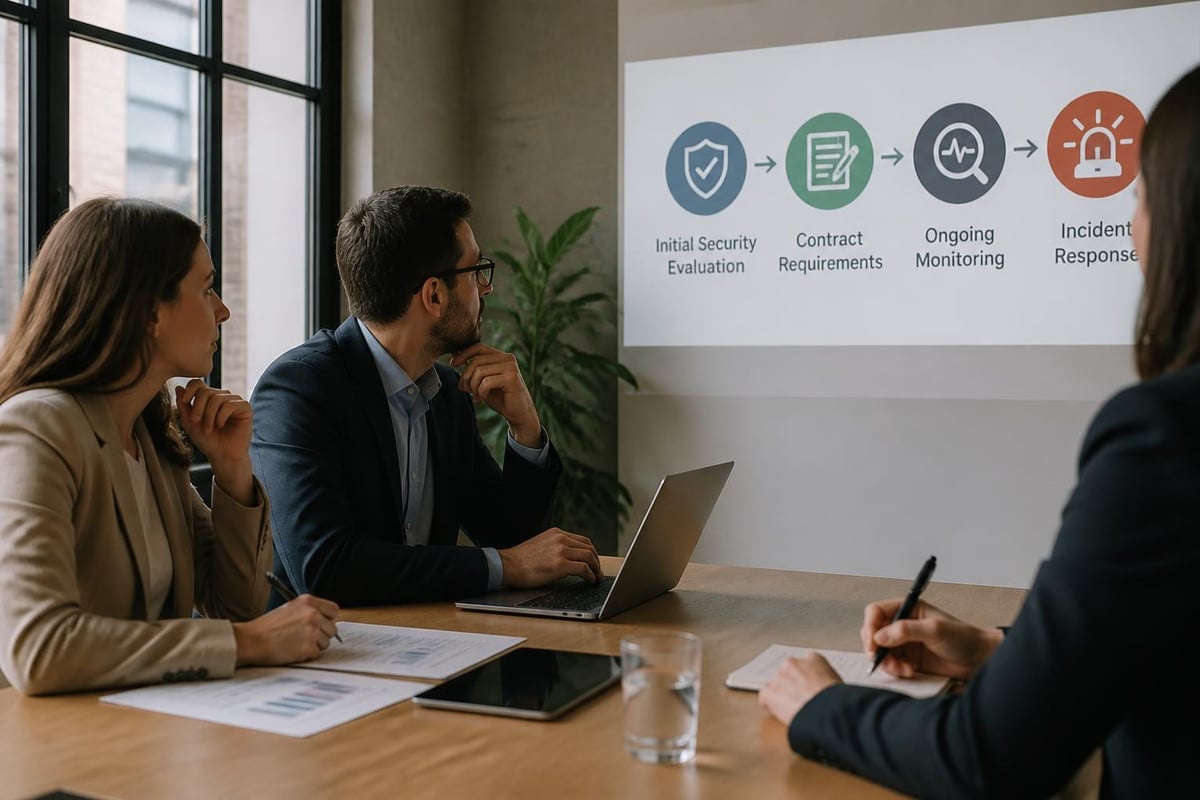
Despite best efforts, security incidents will occur. Prepared businesses minimize damage through structured response procedures and tested continuity plans. Effective incident response distinguishes between minor disruptions and catastrophic breaches.
Incident Response Framework
Preparation phase:
- Establish incident response team roles
- Document communication protocols
- Create decision trees for common scenarios
- Maintain updated contact lists
- Secure forensic tools and resources
Detection and analysis:
- Monitor security alerts and anomalies
- Investigate potential incidents promptly
- Determine scope and severity
- Preserve evidence for investigation
- Document all findings and actions
Containment and recovery:
- Isolate affected systems to prevent spread
- Implement temporary workarounds
- Restore systems from clean backups
- Verify complete threat removal
- Return to normal operations systematically
Post-incident review:
- Analyze root causes and contributing factors
- Update policies and procedures based on lessons learned
- Communicate findings to stakeholders
- Implement additional preventive measures
- Document incident for future reference
The FTC’s cybersecurity guidance for small businesses provides practical frameworks for developing incident response capabilities appropriate to business size and complexity.
Privacy by Design and Competitive Advantage
Forward-thinking businesses recognize that robust data protection creates competitive advantages rather than merely satisfying compliance obligations. Customers increasingly factor privacy practices into purchasing decisions, making security a differentiator in crowded markets.
Recent research published in Harvard Business Review demonstrates that treating data privacy as a growth strategy helps businesses build customer trust and drive revenue. Companies that transparently communicate their data protection practices and give customers meaningful control over their information consistently outperform competitors with minimal privacy programs.
Privacy by Design Principles
Integrating privacy considerations from project inception prevents costly remediation:
- Proactive rather than reactive security measures
- Privacy as default settings rather than opt-in requirements
- Embedded protection throughout system architecture
- Full lifecycle coverage from collection through deletion
- Transparency in data practices and policies
- User-centric design respecting individual rights
Small businesses can implement these principles without massive technology investments. Simple measures like collecting only necessary information, providing clear privacy notices, and enabling easy data access requests demonstrate commitment to responsible data handling.
Managed IT Services and Data Protection
Many small businesses lack internal expertise to implement comprehensive data protection programs. Managed IT services providers offer specialized knowledge and dedicated resources that would be cost-prohibitive to maintain in-house.
Service Components
Proactive security management:
- Continuous network monitoring for threats
- Regular vulnerability assessments and patching
- Security configuration management
- Firewall and intrusion prevention system management
- Email security and spam filtering
Data backup and recovery:
- Automated backup scheduling and verification
- Secure offsite and cloud storage
- Disaster recovery planning and testing
- Rapid restoration capabilities
- Compliance with retention requirements
Compliance support:
- Policy development and documentation
- Security awareness training delivery
- Audit preparation and support
- Incident response coordination
- Regulatory update monitoring
Fixed-rate pricing models make costs predictable while ensuring access to enterprise-grade security tools and expertise. This arrangement allows small businesses to focus on core operations while maintaining confidence in their data protection posture.
Continuous Improvement and Adaptation
Data protection for businesses requires ongoing refinement as threats evolve and business operations change. Static security programs quickly become obsolete, leaving gaps that attackers exploit. Successful organizations treat security as a continuous improvement process rather than a one-time implementation.
Regular assessment activities:
- Quarterly vulnerability scanning and penetration testing
- Annual comprehensive security audits
- Ongoing threat intelligence monitoring
- Policy reviews following regulatory changes
- Technology assessments for emerging solutions
- Incident trend analysis identifying patterns
Metrics provide visibility into program effectiveness:
| Metric | Target | Measurement Frequency |
|---|---|---|
| Patch compliance rate | >95% | Weekly |
| Backup success rate | >99% | Daily |
| Security training completion | 100% | Quarterly |
| Incident response time | <4 hours | Per incident |
| Failed login attempts | Trending down | Monthly |
Benchmarking against industry standards helps identify areas requiring additional focus. Small businesses should avoid comparing themselves solely to enterprises with vastly different resource levels, instead seeking peer comparisons that provide realistic context.
Implementing comprehensive data protection measures requires balancing security requirements with operational efficiency, a challenge that becomes more complex as businesses grow and regulations evolve. Small businesses that prioritize data security from the outset position themselves for sustainable growth while building customer trust that translates into competitive advantage. Delphi Systems Inc. specializes in helping Lethbridge-area businesses implement robust data protection programs through managed IT services, including cybersecurity, backup and recovery, and network monitoring, all delivered through transparent fixed-rate pricing that makes enterprise-grade security accessible to growing companies.

