

Modern businesses face increasingly sophisticated cyber threats that can compromise sensitive data, disrupt operations, and damage reputations. System security services have become essential components of any organization's IT strategy, providing the frameworks, tools, and processes needed to protect critical infrastructure from unauthorized access, data breaches, and malicious attacks. For small businesses in particular, implementing comprehensive security measures can mean the difference between thriving in a digital economy and falling victim to costly security incidents that threaten business continuity.
Understanding System Security Services
System security services encompass a broad range of protective measures designed to safeguard computer systems, networks, and data from threats. These services include identity and authentication management, access control, network security, encryption, monitoring, and incident response capabilities.
The System Security Services Daemon (SSSD) represents one critical component of modern security architecture, managing access to both local and remote identity resources. This type of service ensures that only authorized users can access specific systems and data, creating a foundational layer of protection against unauthorized access attempts.
Core Components of Effective Security Services
Effective system security services typically include several interconnected components that work together to create defense in depth:
- Identity and Access Management (IAM) controls who can access systems and what actions they can perform
- Network Security monitors traffic patterns and blocks malicious activity before it reaches critical systems
- Endpoint Protection secures individual devices including workstations, servers, and mobile devices
- Data Encryption protects sensitive information both in transit and at rest
- Security Information and Event Management (SIEM) aggregates and analyzes security events across the infrastructure
- Vulnerability Management identifies and addresses security weaknesses before attackers exploit them
These components must function cohesively rather than as isolated solutions. Integration allows security teams to correlate events across different systems, identifying sophisticated attacks that might evade individual security controls.

Implementing System Security Services
Implementation of system security services requires careful planning, proper configuration, and ongoing management. The CMS system and services acquisition policies emphasize the importance of proper documentation and secure configuration from the initial deployment phase.
Assessment and Planning Phase
Begin by conducting a comprehensive security assessment that identifies current vulnerabilities, evaluates existing controls, and determines risk tolerance levels. This assessment should examine:
- Current Infrastructure: Document all systems, applications, databases, and network components
- Data Classification: Identify what data you store, where it resides, and its sensitivity level
- Compliance Requirements: Determine regulatory obligations and industry standards that apply
- Business Impact Analysis: Evaluate how security incidents would affect operations
- Resource Availability: Assess budget, personnel, and technical capabilities
The OpenStack Security Guide on documentation requirements provides valuable insights into maintaining thorough system documentation. Proper documentation enables faster incident response, simplifies compliance auditing, and supports knowledge transfer when staff changes occur.
Configuration and Deployment
Once planning is complete, focus shifts to implementing specific security controls. Configuration management becomes critical at this stage, ensuring systems are hardened according to security best practices.
| Security Control | Implementation Priority | Maintenance Frequency |
|---|---|---|
| Multi-Factor Authentication | High | Quarterly Review |
| Firewall Rules | High | Monthly Updates |
| Patch Management | Critical | Weekly Scans |
| Access Reviews | Medium | Quarterly Audit |
| Security Training | Medium | Annual + New Hires |
| Backup Verification | High | Weekly Testing |
For organizations running Windows-based infrastructure, AWS EC2 Windows security best practices offer guidance on update management and configuration hardening that applies broadly beyond cloud environments.
Network Segmentation and Access Control
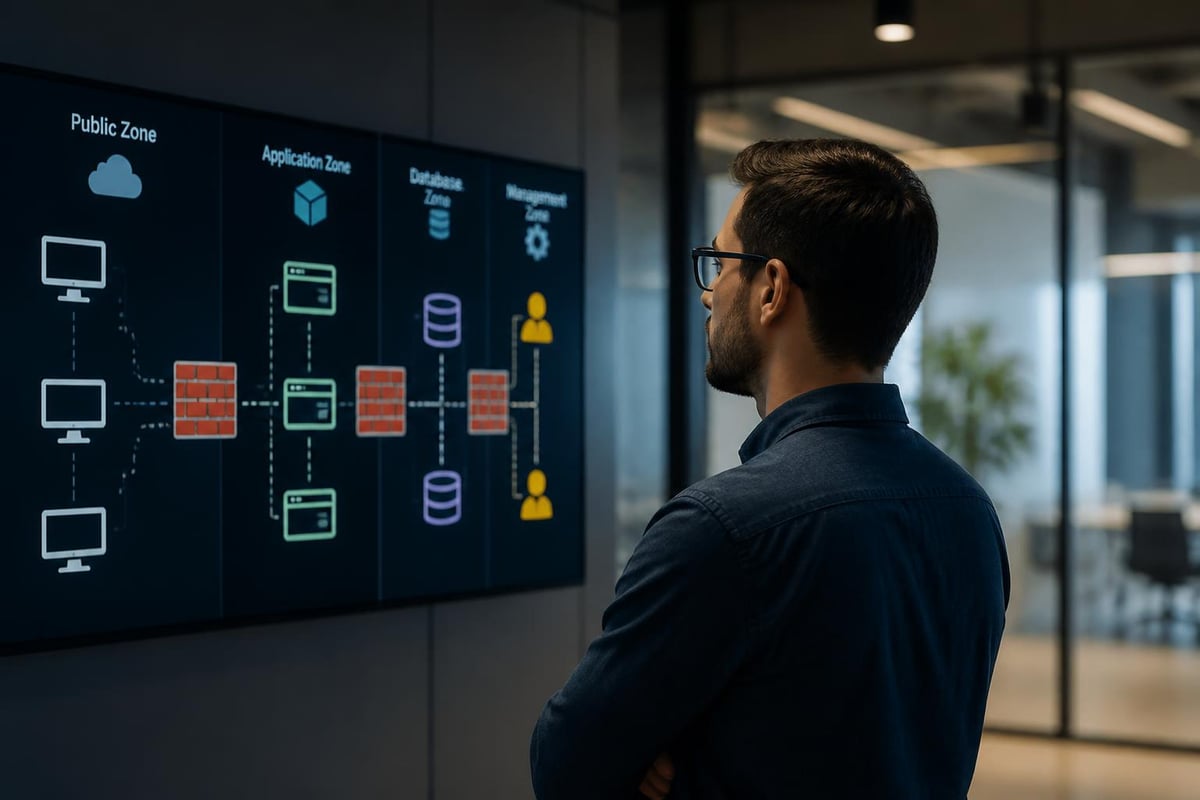
Network segmentation represents one of the most effective strategies for limiting the impact of security breaches. Harvard’s best practices for network security segmentation highlight how dividing networks prevents attackers from moving laterally through your infrastructure after gaining initial access.
Segmentation Strategies
Effective segmentation typically divides networks into zones based on function, security requirements, and trust levels:
- Public-Facing Zone: Web servers and public applications with strict inbound filtering
- Application Zone: Business applications with controlled access from user networks
- Database Zone: Backend systems with minimal direct access requirements
- Management Zone: Administrative systems isolated from general user access
- User Zone: Workstations and end-user devices with appropriate outbound filtering
Each zone should have clearly defined firewall rules governing what traffic can enter or exit. Default-deny policies work best, explicitly allowing only necessary communications rather than attempting to block known threats.
Access Control Implementation
System security services must enforce the principle of least privilege, granting users only the permissions necessary for their specific roles. Role-based access control (RBAC) simplifies this process by grouping permissions into roles aligned with job functions.
Regular access reviews ensure permissions remain appropriate as employees change roles or leave the organization. Automated provisioning and deprovisioning systems reduce the window of opportunity for unauthorized access when staff transitions occur.
Monitoring and Threat Detection
Continuous monitoring forms the backbone of effective system security services, enabling organizations to detect and respond to threats before they cause significant damage. Modern security operations rely on aggregating data from multiple sources to identify patterns indicating malicious activity.
Log Collection and Analysis
Comprehensive logging captures security-relevant events from:
- Authentication systems (successful and failed login attempts)
- Firewall and intrusion prevention systems (blocked traffic, detected attacks)
- Endpoint security software (malware detections, suspicious behavior)
- Application logs (errors, unauthorized access attempts)
- Database activity (query patterns, administrative actions)
SIEM platforms correlate these diverse log sources, applying analytics to distinguish genuine threats from normal activity. Alert tuning reduces false positives that cause security teams to ignore important warnings.
Incident Response Planning
Even with robust preventive controls, security incidents will eventually occur. Having a documented incident response plan ensures your organization can react quickly and effectively when breaches happen.
| Incident Response Phase | Key Activities | Responsible Party |
|---|---|---|
| Preparation | Develop playbooks, train staff | Security Team |
| Detection | Monitor alerts, investigate anomalies | SOC Analysts |
| Containment | Isolate affected systems | Incident Commander |
| Eradication | Remove malware, close vulnerabilities | Technical Team |
| Recovery | Restore systems, verify integrity | Operations Team |
| Lessons Learned | Document findings, improve processes | All Stakeholders |
Research on system security assurance demonstrates the importance of ensuring security features effectively enforce intended policies. Regular testing through tabletop exercises and simulated incidents validates that your response procedures will function under real-world pressure.
Vulnerability Management and Patch Administration
System security services must include proactive vulnerability management to address weaknesses before attackers exploit them. This ongoing process identifies, evaluates, prioritizes, and remediates security flaws in software and configurations.
Vulnerability Scanning
Automated scanners regularly probe systems for known vulnerabilities, misconfigurations, and compliance violations. Schedule scans at appropriate intervals:
- Critical Infrastructure: Weekly authenticated scans
- General Systems: Bi-weekly scans
- New Deployments: Before production release and after any changes
- External Perimeter: Monthly unauthenticated scans
Authenticated scanning provides deeper visibility into system configurations and installed software versions compared to external scans that only detect exposed services.
Patch Management Workflow
Effective patch management balances security needs against operational stability:
- Monitor: Subscribe to vendor security bulletins and vulnerability databases
- Assess: Evaluate severity, exploitability, and business impact
- Test: Validate patches in non-production environments
- Deploy: Roll out patches according to risk-based prioritization
- Verify: Confirm successful installation and system functionality
Critical patches addressing actively exploited vulnerabilities may require emergency deployment outside normal maintenance windows. Having pre-approved change procedures accelerates this process without sacrificing appropriate oversight.
Security Best Practices and Continuous Improvement
The effectiveness of system security services depends not only on initial implementation but on continuous refinement based on evolving threats and operational experience. A critical analysis of security best practices emphasizes that practices must be actionable and well-defined to provide meaningful security improvements.
Security Awareness Training
Human error remains one of the most significant security vulnerabilities in any organization. Regular training helps employees recognize and respond appropriately to security threats:
- Phishing Awareness: Train staff to identify suspicious emails and links
- Password Hygiene: Educate users on creating strong passwords and protecting credentials
- Physical Security: Remind employees about visitor protocols and device security
- Incident Reporting: Encourage prompt reporting of suspicious activity without fear of punishment
- Data Handling: Clarify proper procedures for managing sensitive information
Simulated phishing campaigns measure training effectiveness and identify employees who need additional support. Gamification and real-world examples increase engagement compared to dry policy documents.

Performance Metrics and Reporting
Measuring security program effectiveness requires tracking meaningful metrics that align with business objectives. Consider monitoring:
| Metric Category | Example Measures | Target Goals |
|---|---|---|
| Preventive Controls | Patch compliance rate | >95% within 30 days |
| Detective Controls | Mean time to detect (MTTD) | <4 hours |
| Responsive Controls | Mean time to respond (MTTR) | <8 hours |
| User Behavior | Phishing click rate | <5% |
| Compliance | Audit findings | Zero critical |
Regular reporting to leadership demonstrates security program value and justifies continued investment. Executive dashboards should translate technical metrics into business risk language that non-technical stakeholders understand.
Managed Security Services Options
Many small businesses lack the internal resources to implement and maintain comprehensive system security services effectively. Managed security service providers (MSSPs) offer an attractive alternative, delivering enterprise-grade security capabilities at predictable costs.
Benefits of Managed Security Services
Working with a managed services provider offers several advantages over building internal capabilities:
- Expertise Access: Leverage specialized knowledge without hiring full-time security staff
- 24/7 Monitoring: Continuous surveillance beyond normal business hours
- Technology Investment: Access enterprise tools without capital expenditure
- Scalability: Adjust service levels as business needs change
- Compliance Support: Maintain regulatory requirements with expert guidance
- Focus Resources: Free internal IT staff to focus on strategic initiatives
When evaluating potential providers, consider their experience in your industry, their service level agreements, their incident response capabilities, and how they handle communication during security events.
Service Level Agreements
Clear SLAs establish expectations around service delivery and create accountability mechanisms. Key SLA components for system security services include:
- Response Times: How quickly the provider acknowledges and begins working on issues
- Availability Guarantees: Uptime commitments for monitoring and security tools
- Escalation Procedures: When and how critical issues reach senior technical staff
- Reporting Requirements: Frequency and detail of security reports
- Performance Metrics: Specific measurements demonstrating service quality
Review SLA performance regularly and discuss any consistent shortfalls with your provider. Strong provider relationships involve open communication about expectations and mutual commitment to continuous improvement.
Cloud Security Considerations
As businesses increasingly adopt cloud services, system security services must extend beyond traditional on-premises infrastructure. Cloud environments introduce unique security challenges and opportunities that require adapted approaches.
Shared Responsibility Model
Cloud security operates on a shared responsibility model where the provider secures the underlying infrastructure while customers secure their data, applications, and access controls. Understanding exactly where this division occurs prevents dangerous gaps in security coverage.
For Infrastructure as a Service (IaaS), customers typically manage:
- Operating system security and patching
- Application security
- Identity and access management
- Data encryption
- Network configuration
Platform as a Service (PaaS) shifts more responsibility to the provider, but customers still control access policies and data protection. Software as a Service (SaaS) further reduces customer responsibility, though appropriate access controls and data governance remain critical.
Cloud-Specific Security Controls
Effective cloud security requires controls designed for distributed, dynamic environments:
- Cloud Access Security Brokers (CASB): Monitor and control cloud service usage
- Cloud Workload Protection: Secure virtual machines and containers
- Identity Federation: Centralize authentication across cloud and on-premises systems
- Data Loss Prevention: Prevent sensitive data from leaving authorized systems
- Configuration Management: Ensure cloud resources follow security baselines
API security becomes particularly important in cloud environments where automation and integration drive efficiency. Secure API keys, implement rate limiting, and monitor API usage patterns for anomalies.
Compliance and Regulatory Requirements
System security services must address relevant regulatory and compliance obligations that vary by industry and geography. Common frameworks include HIPAA for healthcare, PCI DSS for payment processing, SOC 2 for service providers, and various data privacy regulations.
Documentation and Audit Readiness
Comprehensive documentation supports both effective security management and compliance demonstration. Maintain current records of:
- System inventories and network diagrams
- Security policies and procedures
- Access control lists and user permissions
- Change management records
- Incident response logs
- Risk assessments and mitigation plans
Regular internal audits identify compliance gaps before external auditors discover them. Treating internal audits seriously creates a culture of continuous improvement rather than compliance as a checkbox exercise.
Privacy and Data Protection
Data privacy regulations like GDPR, CCPA, and similar laws impose specific requirements on how organizations collect, process, store, and protect personal information. System security services must support privacy objectives through:
- Data Minimization: Collect only necessary information
- Purpose Limitation: Use data only for stated purposes
- Storage Limitation: Retain data only as long as needed
- Access Controls: Restrict data access to authorized personnel
- Encryption: Protect data confidentiality through technical controls
- Breach Notification: Detect and report security incidents promptly
Privacy and security complement each other, with strong security controls enabling privacy commitments. Build privacy considerations into system design from the beginning rather than retrofitting them later.
Future Trends in System Security Services
The security landscape continues evolving rapidly as attackers develop new techniques and organizations adopt emerging technologies. Staying ahead requires awareness of trends shaping system security services.
Artificial Intelligence and Machine Learning
AI and machine learning increasingly augment human security analysts, processing vast amounts of data to identify subtle patterns indicating sophisticated attacks. These technologies excel at:
- Detecting anomalous user behavior that deviates from established baselines
- Identifying zero-day exploits that evade signature-based detection
- Automating routine analysis tasks, freeing analysts for complex investigations
- Predicting likely attack vectors based on threat intelligence
However, attackers also leverage AI to develop more effective attacks, creating an ongoing technological arms race. Human expertise remains essential for strategic decisions and handling novel situations.
Zero Trust Architecture
Traditional perimeter-based security assumes everything inside the network is trustworthy. Zero trust architectures eliminate this assumption, requiring verification for every access request regardless of origin. Core principles include:
- Verify Explicitly: Authenticate and authorize based on all available data points
- Least Privilege Access: Grant minimum permissions necessary for specific tasks
- Assume Breach: Design systems expecting attackers may already be present
Implementing zero trust requires significant architectural changes but provides stronger security in modern distributed environments where the traditional perimeter no longer exists.
Protecting your business infrastructure requires comprehensive system security services that address prevention, detection, and response across all aspects of your IT environment. For small businesses in Lethbridge and surrounding areas, partnering with an experienced provider offers access to enterprise-grade security capabilities without the overhead of building internal expertise. Delphi Systems Inc. delivers complete managed IT services including robust cybersecurity, continuous monitoring, and proactive threat management, allowing you to focus on growing your business while ensuring your critical systems remain secure and compliant.

