


Small businesses face an increasingly complex cybersecurity landscape in 2026, with threats evolving faster than most internal IT teams can manage. Managed service provider cyber security has emerged as a critical solution for organizations that need enterprise-level protection without the overhead of building dedicated security teams. For companies in Lethbridge and surrounding areas, partnering with a managed IT services provider offers access to specialized expertise, 24/7 monitoring, and proactive threat management that keeps business operations running smoothly while protecting sensitive data from sophisticated attacks.
Understanding the Managed Service Provider Cyber Security Model
Managed service provider cyber security represents a comprehensive approach to protecting business infrastructure through outsourced IT security services. Unlike traditional break-fix models where businesses only engage IT support when problems arise, this proactive framework continuously monitors, updates, and defends against emerging threats.
The model works through several integrated layers. Network monitoring forms the foundation, with security professionals watching for unusual activity patterns that might indicate breaches or attacks. Endpoint protection secures every device connecting to your network, from workstations to mobile devices. Data backup and recovery systems ensure business continuity even if ransomware or hardware failures occur.
Key Components of Effective Security Management
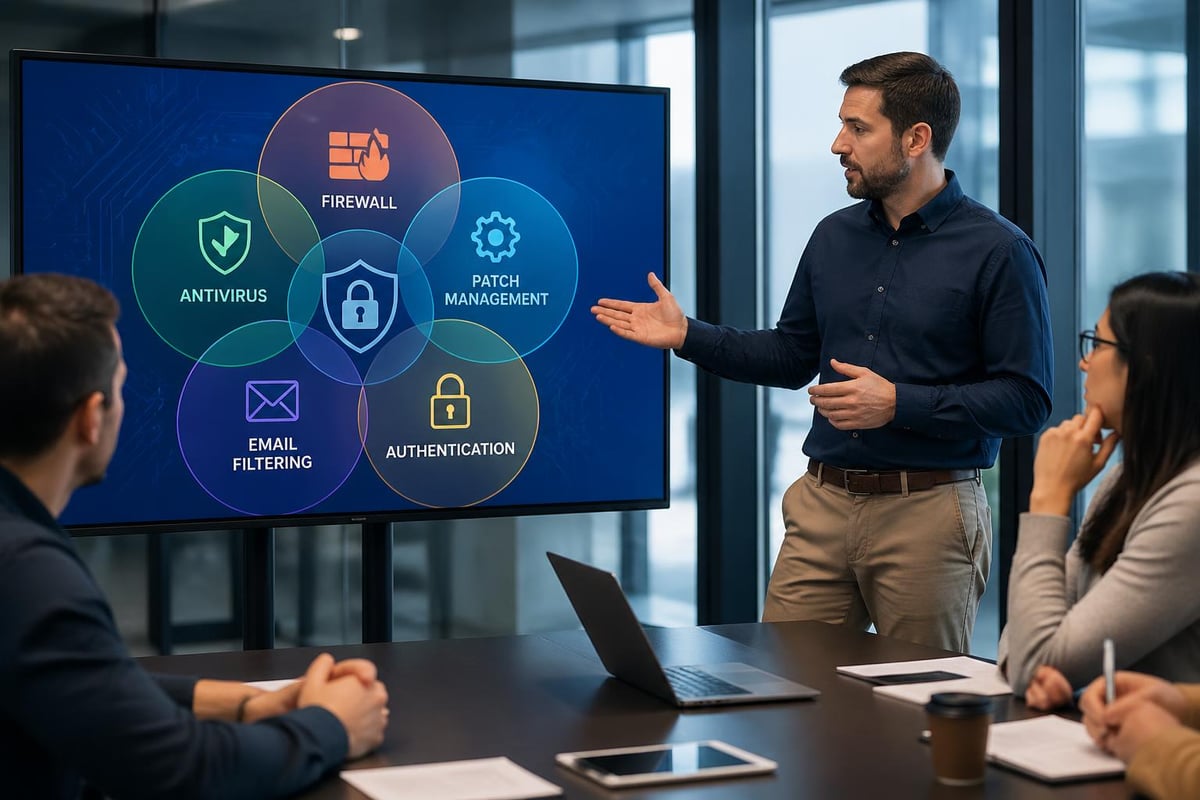
A robust managed service provider cyber security strategy includes multiple defensive elements working in harmony:
- Firewall management and configuration to block unauthorized access attempts
- Antivirus and anti-malware software with real-time threat intelligence updates
- Patch management ensuring all systems run current, secure software versions
- Email security filtering to prevent phishing and malicious attachments
- Multi-factor authentication adding extra verification layers beyond passwords
- Security awareness training helping employees recognize and avoid threats
These components create overlapping security layers that significantly reduce vulnerability to attacks. When one defense mechanism encounters a sophisticated threat, others provide backup protection.
Why Small Businesses Need Specialized Cyber Security Support
The assumption that small businesses aren't attractive targets for cybercriminals disappeared years ago. In 2026, supply chains represent weak links in cyber defenses, making smaller organizations stepping stones to larger corporate networks.
Small businesses face unique challenges when managing security internally. Budget constraints limit hiring specialized security professionals who command premium salaries. The skills shortage in cybersecurity means qualified candidates are scarce even when budgets allow. Technology evolves rapidly, requiring constant learning and adaptation that stretches limited IT resources.
Cost considerations heavily influence security decisions for smaller organizations. Building an in-house security operations center requires substantial investment in:
- Security information and event management (SIEM) platforms
- Threat intelligence feeds and analysis tools
- Incident response capabilities and forensic software
- Compliance management and reporting systems
- Continuous staff training and certification programs
Managed service provider cyber security transforms these capital expenses into predictable operational costs through fixed-rate fee structures. This approach provides access to enterprise-grade tools and expertise at a fraction of what building equivalent capabilities internally would cost.
The Threat Landscape Facing Modern Businesses
Cyber threats in 2026 have grown increasingly sophisticated and targeted. Ransomware groups specifically target managed service providers to access multiple client networks simultaneously, making provider security practices critical.
Common attack vectors include:
- Phishing campaigns using social engineering to steal credentials
- Zero-day exploits targeting unpatched software vulnerabilities
- Ransomware encrypting business data and demanding payment
- Business email compromise schemes redirecting financial transactions
- Insider threats from current or former employees
- Distributed denial-of-service attacks disrupting online operations
Each threat requires specific defensive strategies and rapid response capabilities that most small businesses cannot maintain independently.
Selecting the Right Managed Service Provider for Security
Choosing a managed service provider cyber security partner demands careful evaluation beyond comparing price sheets. The National Cyber Security Centre provides comprehensive guidance on selecting MSPs that emphasizes contract specifics, service level agreements, and incident management processes.
| Selection Criteria | What to Evaluate | Why It Matters |
|---|---|---|
| Security Certifications | ISO 27001, SOC 2, industry-specific compliance | Validates provider follows established security frameworks |
| Response Times | Guaranteed incident response and resolution windows | Minimizes business disruption during security events |
| Technology Stack | Tools, platforms, and security solutions deployed | Ensures current, effective protection mechanisms |
| Experience Level | Years in business, client retention, industry expertise | Indicates proven ability to manage complex security challenges |
| Transparency | Reporting frequency, detail level, communication practices | Enables informed decision-making and accountability |
Critical Questions for Provider Evaluation
Before committing to any managed service provider cyber security partnership, business leaders should obtain clear answers about operational practices and security measures.
How do you protect your own infrastructure? Providers must practice what they preach. Their internal security directly impacts client safety, as risk considerations for MSP customers demonstrate that vendor compromises can cascade to all clients.
What happens during a security incident? Understanding incident response procedures prevents confusion during critical moments. Documented processes should cover detection, containment, eradication, recovery, and post-incident analysis phases.
How do you handle data sovereignty and compliance? Businesses in regulated industries need assurance that providers understand and maintain required compliance standards. This includes data location, access controls, and audit trail maintenance.

Core Security Services Small Businesses Should Expect
Comprehensive managed service provider cyber security encompasses far more than installing antivirus software. Modern protection requires coordinated services addressing multiple threat vectors simultaneously.
Proactive Monitoring and Threat Detection
Security operations centers monitor client networks continuously, analyzing traffic patterns and system behaviors for anomalies. Artificial intelligence and machine learning enhance detection capabilities, identifying subtle indicators of compromise that rule-based systems might miss.
Monitoring extends beyond network perimeters to include:
- Dark web scanning for leaked credentials or company data
- Vulnerability assessments identifying system weaknesses before attackers exploit them
- Security log analysis correlating events across multiple systems
- Threat intelligence integration incorporating global attack pattern data
This proactive stance prevents many attacks before they impact business operations. When threats do penetrate initial defenses, early detection limits damage and speeds recovery.
Data Protection and Business Continuity
Managed service provider cyber security must ensure businesses can recover quickly from any incident. Automated backup systems create regular snapshots of critical data, storing copies in geographically separate locations to protect against localized disasters.
Recovery capabilities should include:
- Point-in-time restoration allowing rollback to pre-incident states
- Bare-metal recovery rebuilding entire systems from scratch if necessary
- Testing protocols verifying backup integrity through regular restoration drills
- Disaster recovery planning documenting recovery procedures and priorities
The Canadian Centre for Cyber Security emphasizes data security best practices when working with managed service providers, highlighting the importance of clear data handling agreements and recovery capabilities.
Compliance and Regulatory Considerations
Many industries face specific regulatory requirements governing data protection and privacy. Managed service provider cyber security services help businesses navigate these complex compliance landscapes without dedicating internal resources to regulatory tracking.
Industry-Specific Requirements
Different sectors face varying compliance obligations:
| Industry | Key Regulations | Primary Requirements |
|---|---|---|
| Healthcare | PHIA, PIPEDA | Patient data encryption, access controls, breach notification |
| Financial Services | OSFI guidelines, provincial regulations | Transaction security, customer data protection, audit trails |
| Retail | PCI DSS | Payment card data encryption, secure processing, network segmentation |
| Professional Services | PIPEDA, provincial privacy laws | Client confidentiality, data retention, consent management |
Providers familiar with industry requirements help businesses implement appropriate controls and maintain necessary documentation for audits.
Documentation and Audit Support
Compliance extends beyond technical controls to include policies, procedures, and proof of ongoing adherence. Managed service provider cyber security teams assist with:
- Security policy development aligned with regulatory requirements
- Employee security awareness training and documentation
- Audit log collection and retention
- Compliance reporting and assessment support
- Third-party audit coordination and evidence provision
This documentation proves invaluable during regulatory examinations or client security assessments.

Building a Security-First IT Culture
Technology alone cannot protect businesses from cyber threats. The most sophisticated managed service provider cyber security measures fail when employees unknowingly create vulnerabilities through risky behaviors.
Effective providers recognize that building a security-first framework requires integrating security awareness throughout organizations, not just implementing technical controls.
Employee Training and Awareness Programs
Human error contributes to the majority of successful cyberattacks. Comprehensive training programs address this vulnerability by teaching employees to:
- Recognize phishing attempts and social engineering tactics
- Create and manage strong, unique passwords properly
- Handle sensitive data according to established protocols
- Report suspicious activities without fear of blame
- Understand their role in maintaining organizational security
Training should occur regularly, not just during onboarding. Threats evolve constantly, requiring ongoing education to keep pace with emerging attack techniques.
Policy Development and Enforcement
Clear, enforceable security policies provide the framework for consistent security practices. Managed service providers help businesses develop policies covering:
- Acceptable use of company technology and networks
- Remote work security requirements and procedures
- Data classification and handling standards
- Incident reporting obligations and processes
- Vendor and third-party access management
Policies prove ineffective without enforcement mechanisms and regular reviews ensuring they remain current with business operations and threat landscapes.
Cost-Benefit Analysis of Managed Security Services
Budget-conscious business leaders naturally question whether managed service provider cyber security represents a worthwhile investment. The calculation extends beyond monthly service fees to consider the total cost of security management and potential breach impacts.
Total Cost of Ownership Comparison
Managing security internally involves numerous expenses beyond salaries:
| Cost Category | Internal Management | Managed Services |
|---|---|---|
| Staff Salaries | $75,000-$120,000 per security professional | Included in fixed monthly fee |
| Security Tools | $10,000-$50,000 annually for platforms and licenses | Included in service package |
| Training and Certifications | $3,000-$8,000 per employee annually | Provider maintains staff expertise |
| Infrastructure | Dedicated security systems and monitoring equipment | Shared across provider client base |
| Incident Response | Overtime costs, emergency consulting fees | Included with defined response times |
Fixed-rate fee structures provided by managed service providers transform unpredictable security costs into manageable operational expenses, simplifying budget planning and eliminating surprise expenditures.
Calculating Breach Impact Costs
The real value of managed service provider cyber security becomes apparent when considering breach consequences. Beyond immediate response costs, businesses face:
- Regulatory fines for compliance violations and data protection failures
- Customer notification expenses when personal information is compromised
- Business interruption losses during downtime and recovery periods
- Reputation damage affecting customer trust and future revenue
- Legal costs from lawsuits and regulatory proceedings
Canadian businesses reported average breach costs exceeding $6 million in 2025, with small businesses often suffering disproportionate impacts relative to their size. For many small organizations, a single significant breach could prove existential.
The Future of Managed Cyber Security Services
The managed service provider cyber security industry continues evolving rapidly as threats grow more sophisticated and businesses become increasingly dependent on digital infrastructure. Several trends are reshaping service delivery and capabilities.
Artificial Intelligence and Automation
Machine learning algorithms now detect anomalies and potential threats faster than human analysts can process security event logs. Automated response systems contain threats within seconds of detection, preventing lateral movement across networks before security teams even review alerts.
This automation doesn't eliminate human expertise. Rather, it frees security professionals to focus on complex threat analysis, strategic planning, and continuous improvement rather than routine monitoring tasks.
Integration of Cloud Security Services
As businesses migrate workloads to cloud platforms, managed service provider cyber security expands to protect hybrid and multi-cloud environments. This requires expertise spanning traditional network security, cloud-native security tools, and identity access management across distributed systems.
Providers increasingly offer unified security management across on-premises infrastructure, private clouds, and public cloud services, ensuring consistent protection regardless of where data and applications reside.
Zero Trust Architecture Implementation
The traditional security model of trusting everything inside the network perimeter while blocking external threats no longer provides adequate protection. Zero trust frameworks assume no user or device should be automatically trusted, requiring continuous verification of identity and authorization.
Managed service provider cyber security services help businesses implement zero trust principles through:
- Identity and access management platforms
- Micro-segmentation dividing networks into isolated zones
- Continuous authentication and authorization checking
- Least-privilege access limiting permissions to minimum necessary levels
These frameworks significantly reduce attack surfaces and limit damage when breaches occur.
Maximizing Value from Your Security Partnership
Selecting a capable managed service provider cyber security partner represents only the first step. Businesses must actively engage with providers to ensure services align with evolving needs and deliver maximum protective value.
Establishing Clear Communication Channels
Regular security review meetings ensure alignment between business objectives and security strategies. These sessions should cover:
- Recent security events and how they were addressed
- Emerging threats relevant to your industry or technology stack
- Planned security improvements and infrastructure changes
- Performance against service level agreements
- Budget considerations and cost optimization opportunities
Transparency from both parties enables proactive adjustments before small issues become significant problems.
Leveraging Provider Expertise for Strategic Planning
The best managed service providers function as strategic advisors, not just technical service vendors. Their broad exposure to security challenges across multiple clients provides valuable perspective on industry trends, effective solutions, and emerging risks.
Business leaders should tap this expertise when:
- Planning technology investments and evaluating security implications
- Considering expansion to new locations or markets
- Implementing new software systems or cloud services
- Developing business continuity and disaster recovery strategies
- Responding to changing regulatory requirements
This collaborative approach ensures security considerations integrate into business strategy rather than being treated as afterthoughts.
Continuous Improvement and Adaptation
The cyber security considerations for managed services consumers emphasize ongoing assessment and improvement rather than treating security as a static checkbox exercise.
Regular security assessments identify gaps in current defenses and opportunities for enhanced protection. Penetration testing validates that implemented controls function as intended. Incident response exercises prepare teams for coordinated action during actual security events.
Managed service provider cyber security has become essential for small businesses navigating an increasingly dangerous digital landscape while managing limited IT budgets and resources. The right partnership delivers enterprise-grade protection, compliance support, and business continuity capabilities that would be prohibitively expensive to build internally. For businesses in Lethbridge seeking comprehensive IT security alongside reliable support, cloud services, and network management, Delphi Systems Inc. offers the local expertise and proven track record to keep your operations secure and running efficiently.

