

Small businesses face an increasingly hostile digital environment where security threats in cyber security evolve faster than many organizations can adapt. For companies operating in Lethbridge and surrounding areas, understanding these threats isn't just about protecting data-it's about ensuring business continuity, maintaining client trust, and avoiding devastating financial losses. The cybersecurity landscape in 2026 presents challenges that require both awareness and proactive defense strategies, especially for organizations without dedicated in-house IT security teams.
The Current State of Cybersecurity Threats
The threat landscape has transformed dramatically over the past few years. Cybercriminals now operate with sophisticated tools, well-funded operations, and an alarming level of organization that rivals legitimate businesses.
Modern threat actors employ multiple tactics simultaneously, making detection and prevention increasingly complex. They leverage artificial intelligence to automate attacks, exploit zero-day vulnerabilities before patches become available, and target supply chains rather than individual organizations. Small businesses often become collateral damage in these campaigns, yet they lack the resources of enterprise-level corporations to defend themselves.
The financial impact of security threats in cyber security continues to climb. According to industry research, the average cost of a data breach for small to medium-sized businesses now exceeds $150,000 when accounting for downtime, recovery costs, legal fees, and reputational damage. Many organizations never fully recover from a significant security incident.
Why Small Businesses Are Primary Targets
Cybercriminals specifically target smaller organizations for several strategic reasons:
- Limited security resources compared to enterprise organizations
- Valuable data including customer information, financial records, and intellectual property
- Supply chain access to larger corporate partners
- Lower security awareness among employees
- Outdated infrastructure that contains known vulnerabilities
Small businesses also tend to underestimate their attractiveness as targets, operating under the false assumption that criminals only pursue major corporations.
Ransomware: The Persistent Enterprise Killer
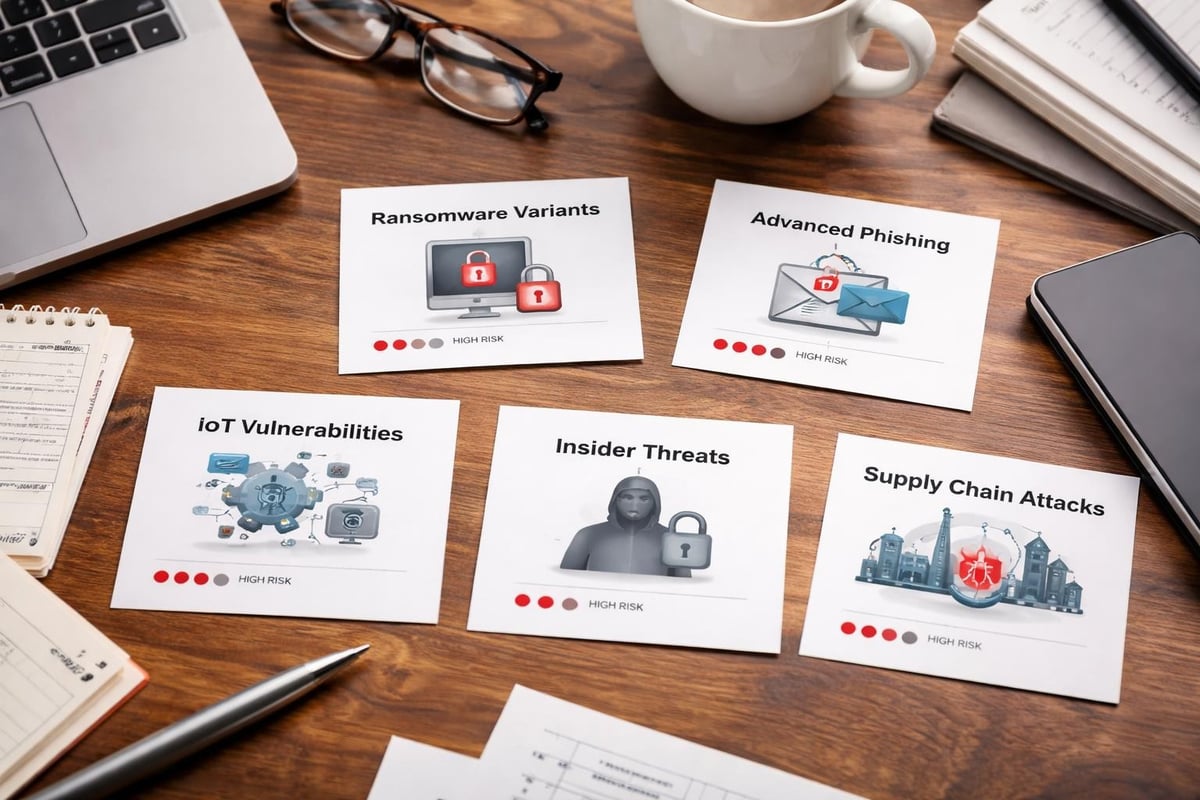
Ransomware remains one of the most devastating security threats in cyber security facing businesses today. These attacks encrypt critical files and demand payment for decryption keys, essentially holding entire operations hostage.
The ransomware business model has matured significantly. Criminals now offer "ransomware-as-a-service" platforms where affiliates launch attacks using pre-built tools, splitting profits with developers. This democratization of cybercrime means even technically unsophisticated actors can deploy devastating attacks.
Modern ransomware variants employ double and triple extortion tactics. Attackers not only encrypt files but also steal sensitive data, threatening to publish it publicly if demands aren't met. Some groups even contact customers directly, pressuring the victim organization from multiple angles.
| Ransomware Evolution | 2024 Approach | 2026 Approach |
|---|---|---|
| Encryption Method | Single-stage encryption | Multi-stage with data exfiltration |
| Target Selection | Broad, automated scanning | Researched, high-value targets |
| Ransom Demands | Fixed cryptocurrency amounts | Negotiated based on revenue |
| Recovery Prevention | Basic backup deletion | AI-driven backup identification |
Defending Against Ransomware Attacks
Protection requires multiple defensive layers working in concert. No single solution provides complete protection against these evolving threats.
Backup systems must be isolated and immutable. Attackers specifically seek out backup systems to destroy, knowing organizations with working backups rarely pay ransoms. Implementing air-gapped backups and following the 3-2-1 rule (three copies, two different media types, one off-site) remains essential.
Network segmentation limits ransomware spread by containing infections within specific zones. When properly implemented, an attack on one segment cannot automatically propagate across the entire infrastructure. This approach buys valuable time for incident response teams to contain threats before they become catastrophic.
Phishing and Social Engineering Attacks
While technology defenses grow stronger, human vulnerabilities remain the weakest link in most security chains. Phishing attacks exploiting human psychology continue to be among the most successful security threats in cyber security.
Criminals craft increasingly convincing messages that impersonate trusted entities. These communications use urgency, authority, and fear to bypass rational thinking and prompt immediate action. Email spoofing, domain typosquatting, and compromised legitimate accounts all contribute to sophisticated phishing campaigns.
Spear phishing targets specific individuals with personalized messages. Attackers research their victims through social media, company websites, and leaked databases to craft highly convincing communications. An executive might receive an email appearing to come from their bank, referencing recent transactions and using familiar terminology that lowers their guard.
Advanced Social Engineering Tactics
Modern attackers combine multiple techniques for maximum effectiveness:
- Reconnaissance phase gathering information about the target organization
- Trust establishment through seemingly legitimate preliminary communications
- Exploitation using the established relationship to request sensitive actions
- Persistence maintaining access through backdoors and credential theft
Voice phishing (vishing) and SMS phishing (smishing) have surged as organizations strengthen email defenses. Criminals call employees pretending to be IT support, requesting passwords or remote access. Text messages impersonate delivery services, banks, or government agencies with malicious links.
Business email compromise (BEC) attacks specifically target financial processes. Attackers impersonate executives or vendors, requesting wire transfers or changing payment information. These attacks succeed because they exploit established business relationships and leverage authority dynamics that discourage verification.

Insider Threats and Credential Compromise
Not all security threats in cyber security originate from external attackers. Insider threats-whether malicious or accidental-pose significant risks that traditional perimeter defenses cannot address.
Disgruntled employees with system access can cause immense damage through data theft, sabotage, or credential sharing. More commonly, well-intentioned staff members accidentally expose sensitive information through misconfigured systems, lost devices, or falling victim to social engineering.
Credential theft transforms outsiders into trusted insiders. When attackers steal legitimate login credentials, they move laterally through networks without triggering alarms designed to detect external intrusions. These compromised credentials might remain active for months before detection.
Monitoring and Access Control
Implementing least-privilege access principles limits potential damage from both malicious insiders and compromised accounts. Users should only access systems and data necessary for their specific job functions.
| Access Control Strategy | Implementation | Risk Mitigation |
|---|---|---|
| Role-Based Access | Permissions tied to job roles | Reduces excessive privileges |
| Multi-Factor Authentication | Secondary verification required | Prevents credential-only access |
| Privileged Access Management | Special controls for admin accounts | Protects critical systems |
| User Behavior Analytics | AI monitoring for anomalies | Detects compromised credentials |
Regular access reviews ensure departing employees lose system access immediately and that permissions remain aligned with current responsibilities. Many breaches exploit accounts of former employees whose credentials remained active long after termination.
Cloud Security Vulnerabilities
As businesses migrate operations to cloud platforms, new security threats in cyber security emerge from misconfigured services and shared responsibility confusion. Cloud security differs fundamentally from traditional on-premises protection.
Misconfigured cloud storage represents one of the most common vulnerabilities. Organizations accidentally expose databases, file storage, and backup systems to public internet access through incorrect permission settings. Automated scanners continuously search for these exposed resources, often exploiting them within hours of misconfiguration.
The shared responsibility model creates confusion about security ownership. Cloud providers secure the infrastructure, but customers must protect their data, applications, and access controls. This division of responsibility often leads to security gaps where each party assumes the other handles specific protections.
Securing Cloud Infrastructure
Proper cloud security requires understanding platform-specific controls and maintaining consistent configurations across services:
- Identity and access management controls defining who can access resources
- Encryption for data at rest and in transit
- Network security groups restricting traffic flow between resources
- Logging and monitoring providing visibility into all activity
- Regular security assessments identifying misconfigurations before exploitation
Multi-cloud and hybrid environments compound complexity by requiring security teams to master multiple platforms' unique security models. Consistent policy enforcement across diverse environments demands sophisticated tooling and expertise.
Internet of Things and Connected Device Risks
The proliferation of IoT devices introduces security threats in cyber security that many organizations overlook. Smart office systems, network printers, security cameras, and environmental controls all connect to business networks with varying security standards.
Many IoT devices ship with default credentials that manufacturers never intended for long-term use. These devices often lack regular security updates, leaving known vulnerabilities permanently exposed. Attackers leverage databases of default credentials to compromise thousands of devices through automated attacks.
Connected devices also provide unexpected entry points into otherwise secure networks. A compromised smart thermostat might seem inconsequential, but it provides authenticated network access that attackers exploit to reach more valuable systems. Network segmentation becomes critical when IoT devices must connect to business infrastructure.
Supply Chain and Third-Party Risks
Organizations face security threats in cyber security not just from direct attacks but through compromised vendors, service providers, and software suppliers. Supply chain attacks target trusted relationships to breach multiple organizations simultaneously.
Software supply chain compromises inject malicious code into legitimate applications during development or distribution. When businesses install compromised software, they unknowingly grant attackers network access. These attacks prove particularly devastating because the malicious code carries the digital signatures and trust of legitimate vendors.
Third-party vendors with network access or data handling responsibilities extend organizational attack surfaces beyond direct control. Managed service providers, payment processors, cloud hosting companies, and support contractors all require security scrutiny proportional to their access levels.
Vendor Risk Management
Evaluating third-party security requires ongoing assessment rather than one-time reviews:
- Security questionnaires assessing vendor security practices and certifications
- Contract provisions defining security requirements and breach notification
- Access limitations restricting vendor permissions to necessary systems only
- Monitoring tracking vendor activities within your environment
- Regular reassessment reviewing vendor security posture annually or after incidents
Organizations should maintain inventories of all third parties with system access or data handling privileges. This inventory enables rapid response if a vendor experiences a breach that might impact your environment.
Advanced Persistent Threats and Targeted Attacks
While opportunistic attacks dominate the threat landscape, some organizations face advanced persistent threats (APTs)-sophisticated, long-term intrusions by skilled attackers pursuing specific objectives. These security threats in cyber security employ advanced techniques that evade standard defenses.
APT groups often work patiently, spending months gathering intelligence before taking action. They establish multiple footholds, create backdoor access methods, and carefully avoid detection while pursuing their objectives. The goal might be intellectual property theft, competitive intelligence, or positioning for future sabotage.
Nation-state actors and organized criminal syndicates typically conduct APT campaigns. Small businesses might encounter these threats when they possess valuable intellectual property, maintain relationships with government contractors, or operate in strategic industries.
The Role of Managed IT Services in Threat Mitigation
Protecting against the full spectrum of security threats in cyber security requires expertise, resources, and continuous vigilance that strain most small business budgets. Organizations in Lethbridge and surrounding areas increasingly turn to managed IT service providers who maintain specialized security capabilities.
Managed security services deliver enterprise-grade protection at predictable fixed rates that small businesses can budget effectively. These services include 24/7 network monitoring, threat detection and response, security patch management, and regular vulnerability assessments. The provider's security team becomes an extension of the business, offering expertise that would be prohibitively expensive to hire in-house.
Professional IT management ensures security updates deploy promptly across all systems, eliminating the window of vulnerability that attackers exploit. Automated monitoring detects anomalous behavior that might indicate compromise, enabling rapid response before minor incidents escalate into major breaches. Regular backup verification and testing ensure recovery capabilities actually work when needed.
| Security Capability | In-House Challenge | Managed Service Advantage |
|---|---|---|
| 24/7 Monitoring | Requires multiple staff shifts | Shared security operations center |
| Threat Intelligence | Subscription costs and analysis time | Aggregated intelligence from multiple sources |
| Incident Response | Limited experience with real attacks | Practiced response procedures and tools |
| Compliance Support | Navigating complex requirements | Specialists familiar with regulations |
Working with Delphi Systems Inc. provides access to comprehensive cybersecurity services designed specifically for small business needs and budgets. Their approach combines proactive threat prevention with rapid incident response capabilities, ensuring IT networks maintain peak operation even as security threats in cyber security continue evolving.
Understanding the diverse security threats in cyber security facing businesses today represents the first step toward effective protection. Small businesses must implement layered defenses, maintain security awareness, and leverage professional expertise to defend against increasingly sophisticated attacks. For organizations seeking comprehensive IT security without the overhead of building in-house capabilities, partnering with experienced managed service providers offers an effective path forward. Delphi Systems Inc. delivers the complete range of cybersecurity services, network monitoring, and data protection solutions that Lethbridge businesses need to operate securely in 2026's challenging threat landscape.

