


In 2026, organizations face an unprecedented surge in cyberattacks, with the average cost of a data breach soaring to $4.45 million, according to the IBM Cost of a Data Breach Report 2025. Network security it is no longer just an IT task; it has become a mission-critical priority for every business leader.
AI-driven attacks, hybrid cloud vulnerabilities, and evolving ransomware tactics are reshaping the threat landscape. This guide will equip you with actionable strategies and expert insights to anticipate, prevent, and respond to these complex challenges.
Explore the latest threats, core security principles, advanced defense techniques, compliance requirements, and future trends. Now is the time to implement modern, proactive network security it strategies to protect your organization.
Understanding the 2026 Network Security Landscape
The network security it landscape in 2026 is facing unprecedented complexity. Organizations must now defend against a surge in sophisticated attacks, while adapting to rapid shifts in technology and regulation. Understanding this environment is crucial for building resilient defenses and ensuring business continuity.

Evolving Cyber Threats and Attack Vectors
Cyber threats have evolved rapidly, making network security it more challenging than ever. Attackers now leverage artificial intelligence to automate and customize malware, increasing both the frequency and sophistication of attacks.
Key trends shaping the threat landscape include:
- AI-driven malware that adapts in real time, evading traditional defenses
- Ransomware attacks have grown, now accounting for 24 percent of all breaches
- Phishing and social engineering schemes target remote and hybrid workers, exploiting human error
- Vulnerabilities in IoT and OT devices have proliferated, expanding the attack surface
- Insider threats, both malicious and accidental, continue to cause significant data leaks
- Supply chain attacks are rising, with third-party risks leading to major breaches
A notable example occurred in 2025 when a high-profile supply chain breach exposed sensitive data across multiple industries. This incident underscored the need for network security it teams to scrutinize vendor relationships and third-party integrations.
Modern Network Architectures and Their Risks
As organizations embrace hybrid and multi-cloud strategies, network security it must adapt to new risks. Expanding digital environments introduce fresh vulnerabilities and make visibility more challenging.
Key architectural risks include:
- Hybrid and multi-cloud adoption increases the number of potential attack surfaces
- Remote access policies, including BYOD, widen the security perimeter
- Heavy reliance on SaaS and cloud-native applications demands new security controls
- Integrating legacy systems with modern platforms can create hidden vulnerabilities
- Effective network segmentation and micro-segmentation are now essential to prevent lateral movement
For instance, a misconfigured hybrid cloud environment in 2025 resulted in sensitive data exposure, highlighting the importance of continuous monitoring and best practices in network security it.
Key Security Statistics and Industry Insights
Data-driven insights are vital for guiding network security it strategies. Recent industry reports reveal the growing impact and complexity of cyber threats.
Key statistics:
| Metric | Value/Insight |
|---|---|
| Average time to identify and contain a breach | 277 days (IBM) |
| Ransomware as a percentage of breaches | 24 percent |
| Organizations adopting zero trust | Over 60 percent (Fortinet) |
| Automation and AI impact | Faster incident response, lower costs |
According to the IBM Cost of a Data Breach Report 2025, the average cost of a data breach reached $4.44 million in 2025, with automation and AI reducing containment times and mitigating losses. These insights reinforce the need for network security it teams to invest in advanced tools and continuous improvement.
Regulatory and Compliance Pressures
Regulatory demands have intensified, adding another layer of complexity to network security it management. Stricter data privacy laws, such as GDPR, CCPA, and new Canadian regulations, require organizations to implement robust controls and maintain detailed documentation.
Industry-specific mandates like HIPAA, PCI DSS, and NIST frameworks are also evolving, driving the need for regular compliance assessments. Penalties for non-compliance have increased, with several organizations facing substantial fines after breaches in 2025.
To stay ahead, network security it leaders must monitor regulatory changes, align security controls with compliance requirements, and foster a culture of accountability throughout the organization.
Core Principles of Modern Network Security
Modern network security it requires a foundation built on proven principles that adapt to a changing threat landscape. These core strategies help organizations defend against sophisticated attacks and ensure resilience in the face of evolving risks.

Defense in Depth: Layered Security Approach
Defense in depth remains a cornerstone of effective network security it. This model uses multiple, overlapping controls across every layer of the IT environment, reducing the chance that a single failure results in compromise.
Organizations combine physical and digital defenses to create redundancy and resilience. For example, a business might implement firewalls at the network edge, intrusion detection and prevention systems (IDS/IPS) within internal segments, and endpoint protection on user devices.
A layered approach helps contain threats and ensures that even if one control is bypassed, others remain active. This strategy also supports compliance, as many regulations require comprehensive safeguards at every level.
Table: Example Layered Controls in Network Security IT
| Layer | Security Control |
|---|---|
| Perimeter | Firewall |
| Network | IDS/IPS |
| Endpoint | Antivirus, EDR |
| Application | Web Application Firewall |
| Data | Encryption, DLP |
| Physical | Access Control Systems |
By integrating and regularly testing these layers, organizations strengthen their network security it posture and improve incident response capability.
Zero Trust Architecture
Zero trust has become essential in network security it, driven by increasingly complex and distributed environments. The principle is simple: never trust, always verify. Every user and device, whether inside or outside the network, must prove its identity and authorization before accessing resources.
Zero trust architectures use micro-segmentation and least privilege access, ensuring users can only reach necessary assets. Continuous authentication and monitoring detect suspicious behavior and limit lateral movement within the network.
According to the Fortinet 2023 State of Zero Trust Report, over 60% of organizations are actively adopting zero trust. This shift is reducing the risk of internal and external breaches.
A real-world example: a company deploying zero trust saw a significant decrease in lateral movement during simulated attacks, helping to contain threats before they could escalate.
Identity and Access Management (IAM)
IAM is a critical pillar of network security it, controlling who can access what within your systems. Multi-factor authentication (MFA) and single sign-on (SSO) make it harder for attackers to compromise credentials.
Privileged access management (PAM) restricts high-level permissions to only those who need them. Role-based access controls (RBAC) ensure employees have access only to resources required for their roles.
For example, enabling MFA can prevent attackers from using stolen passwords, closing a common entry point for breaches. Regularly reviewing access rights and removing unnecessary privileges further reduces risk.
Encryption and Data Protection
Protecting sensitive data is fundamental to network security it. End-to-end encryption safeguards information both in transit and at rest, making intercepted data unreadable.
Key management best practices are vital. Proper rotation, storage, and distribution of keys help prevent unauthorized access. Tokenization and data masking add another layer, obscuring critical details and limiting exposure.
Many regulations now require encryption as a baseline, making it not just a best practice but a compliance necessity. Implementing these controls ensures confidential data remains protected even if other defenses fail.
Security Monitoring and Incident Response
Continuous monitoring is essential for robust network security it. Tools like SIEM, NDR, and XDR provide real-time visibility into activity across the environment, allowing teams to detect and respond to threats quickly.
Automated alerting and response workflows help contain incidents before they cause significant damage. Regular incident response planning and simulated drills ensure staff are prepared for real-world attacks.
For instance, organizations that practice breach simulations can quickly contain threats, reducing recovery time and impact.
Essential Network Security Strategies for 2026
In 2026, organizations face an unprecedented array of threats, making a robust network security it strategy essential for survival and growth. To stay ahead, businesses must implement a multi-layered approach that combines advanced technology, proactive processes, and ongoing education. Below, we explore the core strategies shaping effective network security it for the modern enterprise.

Proactive Threat Detection and Prevention
Proactive threat detection is the backbone of any successful network security it plan. Organizations must integrate real-time threat intelligence into their security operations to identify and mitigate risks before they escalate. AI and machine learning tools can analyze vast amounts of network data, uncovering anomalies that signal emerging attacks.
Automated vulnerability scanning ensures systems are continuously assessed for weaknesses, while patch management tools close gaps before attackers can exploit them. Threat hunting and red teaming exercises simulate real-world breaches, allowing teams to refine their response. For example, AI-powered detection systems have proven effective at stopping zero-day malware, which traditional tools often miss.
According to the IBM Report: Escalating Data Breach Disruption, the cost and disruption of breaches continue to rise, making early detection and prevention more critical than ever. Investing in these proactive measures is not optional for network security it success.
Advanced Endpoint and Device Security
Endpoints are now the front line in network security it. With the proliferation of laptops, smartphones, and IoT devices, unified endpoint management (UEM) is crucial. UEM solutions enable IT teams to monitor, configure, and secure all devices from a single dashboard, ensuring consistent policy enforcement.
Mobile device management (MDM) and bring-your-own-device (BYOD) controls help organizations manage employee devices without compromising security. Endpoint detection and response (EDR), along with next-generation antivirus, provide continuous monitoring and automated threat mitigation.
Securing operational technology (OT) and IoT devices is equally important, as attackers increasingly target these often overlooked assets. For instance, proper segmentation and monitoring can prevent IoT devices from being hijacked into botnets, maintaining the integrity of the network security it environment.
Network Segmentation and Micro-Segmentation
Segmentation is fundamental for reducing risk in network security it. By dividing networks into smaller, isolated zones, businesses can protect sensitive assets and limit the lateral movement of attackers. Micro-segmentation takes this further, applying granular controls at the application or workload level.
Dynamic segmentation enables organizations to secure both cloud and on-premises resources. This flexibility is vital for sectors like healthcare and finance, where regulatory compliance and data privacy are paramount. For example, segmenting patient records from general administrative systems reduces exposure in the event of a breach.
Implementing robust segmentation strategies strengthens overall network security it, making it much harder for threats to spread undetected.
Secure Access Service Edge (SASE) and Remote Access
The shift to distributed workforces demands secure, scalable remote access solutions within network security it. Secure Access Service Edge (SASE) frameworks combine networking and security functions into a single cloud-delivered service, simplifying management and enhancing protection.
SASE integrates tools such as secure web gateways (SWG), cloud access security brokers (CASB), and zero trust network access (ZTNA). These services ensure that remote users, regardless of location, can safely connect to corporate resources.
A well-implemented SASE architecture provides consistent security policies, real-time monitoring, and seamless access for multi-site businesses. This approach is becoming a cornerstone of effective network security it, especially as hybrid work models persist.
Cloud and SaaS Security Posture Management
As organizations migrate more assets to the cloud, maintaining a strong security posture becomes a top priority in network security it. Cloud Security Posture Management (CSPM) tools help organizations identify misconfigurations, enforce compliance, and monitor cloud environments for suspicious activity.
Continuous compliance monitoring ensures that cloud applications meet regulatory requirements. Data Loss Prevention (DLP) solutions help safeguard sensitive information across SaaS platforms.
Understanding the shared responsibility model is essential. For instance, a misconfiguration in AWS or Azure can result in significant data exposure. By leveraging CSPM and DLP tools, organizations can maintain visibility and control, bolstering their network security it posture.
Vulnerability and Patch Management Lifecycle
Managing vulnerabilities is a continuous process in network security it. Regular vulnerability scanning and assessment allow organizations to identify weaknesses before they can be exploited. Automated patch deployment ensures that critical updates are applied promptly, minimizing risk.
Prioritizing vulnerabilities using the Common Vulnerability Scoring System (CVSS) helps IT teams focus on the most severe threats. Managing shadow IT and SaaS sprawl is also essential, as unapproved applications can introduce hidden risks.
A rapid response to emerging threats, such as the Log4Shell vulnerability, demonstrates the value of an agile patch management lifecycle in safeguarding network security it environments.
User Awareness and Security Training
Even the most advanced network security it systems are only as strong as their users. Ongoing employee training is vital to combat phishing, social engineering, and other human-centric attacks. Security awareness programs educate staff on recognizing threats and following best practices.
Simulated phishing campaigns and breach exercises help reinforce learning and build a security-first culture. Human error remains a leading cause of breaches, underscoring the need for continuous training.
Organizations that invest in user education see measurable improvements in their network security it outcomes, reducing the likelihood and impact of costly incidents.
Integrating Managed IT Services for Small Business Network Security
Small businesses face an increasingly complex risk environment, making network security it a top priority. Limited in-house resources, evolving threats, and compliance pressures can quickly overwhelm internal teams. Managed IT services offer a practical way to strengthen defenses, close skills gaps, and ensure business continuity without breaking the bank.
Role of Managed IT Services in Network Security
Managed IT services play a vital role in network security it by bringing specialized knowledge, cutting-edge tools, and 24/7 monitoring to small businesses. Outsourcing security to a managed provider allows organizations to access a broader talent pool, including professionals skilled in AI-driven threat detection and incident response. This is especially important as the cybersecurity skills gap grows, with reports like the Fortinet Annual Report on AI Skillsets emphasizing the need for advanced expertise.
A managed services provider (MSP) offers several advantages:
- Proactive monitoring and rapid response to threats
- Predictable budgeting with fixed-rate agreements
- Reduced downtime and faster recovery from incidents
- Access to enterprise-grade security solutions
For example, a small business that partners with an MSP can avoid costly disruptions, maintain regulatory compliance, and focus on growth, all while knowing their network security it is in expert hands.
Delphi Systems Inc.: Secure IT Solutions for Small Businesses
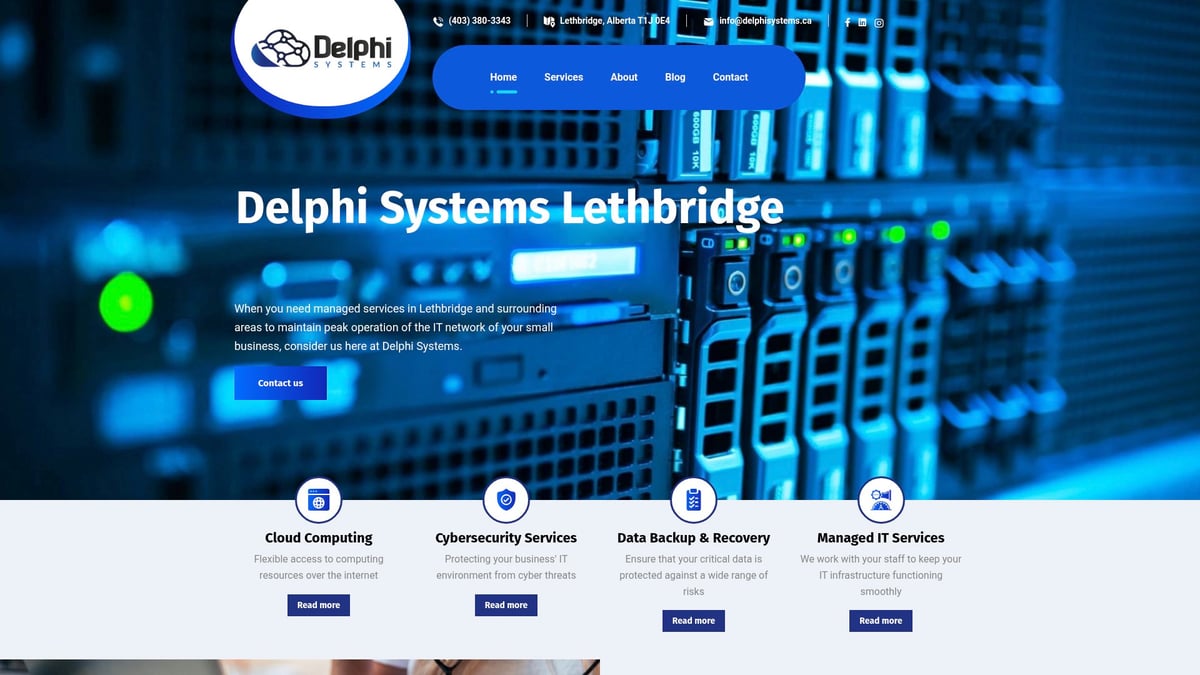
Delphi Systems Inc. stands out as a local leader in managed IT services, offering tailored network security it solutions for small businesses in Lethbridge and the surrounding area. Their services are designed to address the unique challenges faced by smaller organizations, from proactive network monitoring to comprehensive cybersecurity, data backup, and responsive IT support.
Key features of Delphi Systems Inc.'s approach include:
- Fixed-rate pricing for easier budgeting
- Business continuity planning and disaster recovery
- Strong vendor partnerships with leading technology providers
- Personalized support and direct access to local experts
Local businesses have reported improved security postures and increased productivity after partnering with Delphi Systems Inc. Their commitment to network security it and personalized service helps clients stay resilient in the face of evolving digital threats.
Selecting and Partnering with a Managed IT Provider
Choosing the right managed IT partner is crucial for effective network security it. Organizations should evaluate providers based on experience, industry certifications, range of services, and local expertise. It is also essential to assess their incident response capabilities and disaster recovery planning to ensure preparedness for any situation.
Consider these key criteria:
- Transparent communication and tailored solutions
- Proven success in improving regulatory compliance and uptime
- Strong vendor relationships with companies like Dell, Bitdefender, and Microsoft
- Willingness to answer detailed questions about monitoring, support, and escalation processes
A successful partnership can transform a small business's approach to network security it, delivering peace of mind and enabling staff to focus on core operations while experts handle evolving security challenges.
Regulatory Compliance and Security Frameworks for 2026
Regulatory compliance is a foundational pillar for any network security it program in 2026. As cyber threats grow and privacy expectations rise, organizations face mounting pressure to align their security strategies with evolving legal and industry standards. Understanding the current landscape is crucial for minimizing risk and ensuring uninterrupted operations.
Navigating Evolving Compliance Requirements
The regulatory environment for network security it continues to evolve rapidly. Key standards like GDPR, CCPA, HIPAA, PCI DSS, and NIST set the baseline for data protection, but 2026 introduces new rules. For example, stricter Canadian privacy regulations and updated global mandates now address data residency, cross-border transfers, and cloud storage.
Organizations must understand where their data resides and how it moves. Failure to comply can result in significant penalties. According to IBM, the average cost of non-compliance is $5.87 million, making robust compliance practices a business imperative for network security it.
A summary of major regulations:
| Regulation | Focus | Penalty Risk |
|---|---|---|
| GDPR | Data privacy (EU) | Up to €20M or 4% of revenue |
| CCPA | Consumer data (CA) | $2,500–$7,500 per violation |
| HIPAA | Healthcare data (US) | Up to $1.5M/year |
Staying current with these requirements is essential for network security it teams.
Implementing Security Frameworks and Best Practices
Security frameworks provide the blueprint for effective network security it and compliance alignment. Industry-recognized models include the NIST Cybersecurity Framework, CIS Controls, and ISO 27001. These frameworks guide organizations in establishing, implementing, and continuously improving their security posture.
Mapping controls from these frameworks to regulatory requirements helps streamline audits and reduce compliance gaps. For instance, using CIS Benchmarks for configuration hardening supports both technical security and regulatory mandates.
Regular security assessments and audits are vital. They help network security it teams identify weaknesses, validate controls, and prepare for external reviews. By leveraging these frameworks, organizations can build resilient, compliant infrastructures.
Automating Compliance and Reporting
Automation is transforming compliance management in network security it. Modern tools can conduct automated compliance checks, generate real-time reports, and integrate with SIEM systems for continuous monitoring. This approach reduces manual workload, increases accuracy, and keeps organizations audit-ready.
Compliance dashboards provide instant visibility into the current state of network security it controls. Integrating these tools ensures swift identification of issues and supports proactive remediation efforts.
Building a Culture of Compliance
Fostering a culture of compliance is essential for sustained network security it success. Leadership must champion both security and compliance objectives, ensuring that all employees understand their roles. Ongoing training, clear communication, and regular updates keep compliance top of mind.
A strong compliance culture enhances audit performance and reduces the risk of violations. Organizations that prioritize culture see measurable improvements in network security it and regulatory outcomes.
The Future of Network Security: Trends and Innovations
The future of network security it is shaped by rapid advancements and emerging threats. As digital transformation accelerates, organizations must embrace new technologies and strategies to stay ahead. The coming years will see a shift in how businesses approach risk, automation, privacy, and collaboration.
AI and Automation in Security Operations
Artificial intelligence is revolutionizing network security it by enabling faster, smarter threat detection and response. AI-driven systems analyze massive data sets in real time, flagging unusual activity that could indicate a breach.
Key benefits include:
- Automated incident triage and response, reducing manual workload
- Intelligent filtering to minimize false positives and alert fatigue
- Adaptive defenses that learn from new attack patterns
For example, security operations centers using AI have reported up to 80 percent faster response times. This efficiency allows teams to focus on critical risks. As attackers also leverage AI, staying ahead requires ongoing investment in automation within network security it.
Quantum Computing and Post-Quantum Cryptography
Quantum computing poses new risks to network security it. Quantum machines can potentially break many traditional encryption methods, making sensitive data vulnerable.
Preparing for this shift is essential:
- Research into post-quantum cryptography is accelerating
- Organizations should monitor industry standards and timelines
- Early adoption of quantum-safe algorithms will help future-proof network security it
While true quantum attacks are not yet widespread, forward-thinking organizations are already planning for this disruptive technology.
Secure Integration of IoT, OT, and Edge Computing
The expansion of IoT, operational technology (OT), and edge computing creates a vast new attack surface for network security it. Connected devices in smart factories, healthcare, and critical infrastructure require robust protection.
Best practices include:
- Applying zero trust principles to all devices and workloads
- Segmenting networks to isolate sensitive systems
- Continuous monitoring for anomalous device behavior
Securing these environments is complex, but essential as IoT and edge adoption grows. Effective network security it strategies ensure resilience against both external and insider threats.
Privacy-Enhancing Technologies and Confidential Computing
Protecting data privacy is a top priority in network security it. Privacy-enhancing technologies are gaining traction as regulatory requirements tighten and organizations handle more sensitive information.
Innovative approaches include:
- Homomorphic encryption for secure data analysis
- Data masking and tokenization to minimize exposure
- Confidential computing to protect data during processing
These technologies help meet compliance obligations and build trust with customers. By integrating privacy into network security it, organizations can mitigate risks and enable secure innovation.
Anticipating the Next Wave: Proactive Security Planning
Future-focused network security it depends on strategic planning and collaboration. Proactive organizations leverage threat intelligence sharing, scenario planning, and adaptive architectures.
Key steps:
- Participate in industry threat intelligence networks
- Conduct tabletop exercises to test incident response
- Invest in scalable, flexible security frameworks
By anticipating emerging threats and adapting quickly, organizations position themselves for long-term success in network security it.
As you look ahead to 2026, protecting your network isn’t just about keeping up with technology—it’s about staying one step ahead of evolving cyber threats and compliance demands. You deserve peace of mind knowing your business’s data, productivity, and reputation are secure. At Delphi Systems Inc., our team is dedicated to helping small businesses in Lethbridge thrive with reliable, proactive IT solutions tailored to your needs. If you’re ready to strengthen your network security and let experts handle the complexity, let’s talk about how we can support your goals.
Call us now

