
In today’s rapidly shifting digital world, a managed IT service business faces more pressure than ever to stay ahead of relentless technological change. As companies of all sizes embrace new tools and face mounting security threats, only the most adaptable managed IT service business models will succeed.
This article reveals seven innovative approaches that can help a managed IT service business thrive in 2026. Explore the latest in automation, cybersecurity, AI, cloud solutions, customer experience, data-driven strategy, and workforce development to ensure your business remains competitive and future-ready.
The Changing Landscape of Managed IT Services in 2026
The world of managed IT service business is shifting rapidly. Organizations of all sizes are turning to MSPs for expert guidance, security, and strategic technology management. As the digital environment grows more complex, the role of MSPs is evolving from technical support to essential business partners.

The Role of Managed IT Services in Modern Business
A managed IT service business is now fundamental for both SMBs and enterprises. These businesses handle everything from network security to cloud migrations, ensuring that clients remain productive and resilient.
With 87.5% of SMBs currently using or considering MSPs (JumpCloud, 2022), demand is at an all-time high. Small businesses increasingly rely on managed IT service business models for full management or as co-managed partners to supplement internal teams.
MSPs are no longer seen as just technical fixers. Instead, they are strategic partners helping organizations navigate a complex digital landscape. For a deeper dive into industry trends and growth, see this Managed IT Services Market Analysis 2025–2035.
Key Drivers of Transformation in 2026
Several factors are accelerating changes in the managed IT service business sector. Digital transformation efforts have intensified since the pandemic, with organizations prioritizing flexibility and resilience.
The rise of remote and hybrid work has forced MSPs to rethink security and access. Cybersecurity threats are more sophisticated, and compliance requirements are stricter. AI, automation, and data analytics are becoming essential for effective IT management.
Clients now expect proactive, personalized service from their managed IT service business, rather than just reactive support. These drivers are setting the stage for a new era in managed IT services.
Challenges Facing Managed IT Service Providers
Despite opportunities, every managed IT service business faces significant challenges. Finding and retaining skilled talent is difficult, especially as demand for advanced expertise in AI, cloud, and security rises.
Clients want more value at predictable costs, putting pressure on MSPs to innovate without sacrificing profitability. Managing multiple vendors and technology platforms can create complexity and risk.
Keeping service quality high while adapting to rapid technological change is a daily struggle. For example, balancing robust cybersecurity with seamless user experience is a common challenge for any managed IT service business.
Opportunities for Growth and Innovation
The future holds many opportunities for a managed IT service business ready to innovate. Expanding into new industries or regions can unlock fresh revenue streams. Offering advanced, value-added services like strategic consulting, cloud optimization, and compliance management sets MSPs apart.
Building strong partnerships with cloud and security vendors gives access to the latest technology and support. Subscription models and bundled offerings help drive predictable, recurring revenue.
Some MSPs are moving toward consultative roles, such as virtual CIO or vCISO, to provide clients with business-focused technology leadership. This evolution positions the managed IT service business as a true driver of client success.
7 Ways a Managed IT Service Business Can Transform in 2026
Transformation in the managed it service business is not just a trend, it is a necessity for survival and growth in 2026. As technology and client expectations evolve rapidly, businesses must rethink their core strategies, adopt new tools, and deliver greater value. Today, we explore seven actionable ways a managed it service business can innovate, compete, and lead in this dynamic environment. These insights are shaped by industry research and future trends in managed IT services, helping you stay ahead of the curve.

1. Embracing Automation and AI-Driven Operations
For any managed it service business, automation and AI are the cornerstones of transformation. By integrating AI-powered monitoring, businesses can predict system failures, detect threats, and minimize downtime before issues escalate. Predictive analytics not only improve service reliability but also optimize resource allocation.
Routine IT tasks such as patch management, backups, ticket triage, and user provisioning can be automated. This shift reduces human error, ensures consistency, and allows technical teams to focus on higher-value projects. For example, AI-driven chatbots now handle Level 1 support tickets, delivering instant responses and freeing up staff for complex challenges.
The results are compelling. According to IDC, 80 percent of SMBs have experienced IT downtime, yet automation significantly lowers such incidents. Automation tools also facilitate compliance checks, inventory management, and software updates, providing a holistic approach to IT management.
However, integrating automation and AI comes with challenges, including legacy system compatibility and ensuring transparency in decision-making. The managed it service business must invest in robust training and change management for successful adoption.
Ultimately, leveraging automation and AI sets a managed it service business apart, enabling scalability, operational efficiency, and a more responsive client experience.
2. Elevating Cybersecurity and Compliance Offerings
Cybersecurity is at the heart of any managed it service business transformation. With sophisticated attacks on the rise, proactive threat detection and response are critical. Managed Detection and Response (MDR), regular vulnerability assessments, and zero trust frameworks are becoming industry standards.
MSPs now offer comprehensive security training for clients, focusing on phishing and ransomware prevention. Automated compliance monitoring ensures adherence to evolving regulations such as GDPR, HIPAA, and CMMC. Cybersecurity tools like dark web monitoring and password management solutions add extra layers of protection.
Data from the Untangle survey highlights that phishing (84 percent) and ransomware (63 percent) are the top threats facing SMBs. To address these risks, the managed it service business must make security a core value proposition, not just an add-on. Regular security reviews, incident response planning, and user education are essential.
Yet, staying ahead of ever-changing attack methods and compliance requirements remains a challenge. Continuous investment in staff training and advanced security solutions is vital.
A managed it service business that prioritizes cybersecurity and compliance builds trust, reduces risk, and creates long-term client relationships.
3. Expanding Cloud-First and Hybrid IT Solutions
Cloud adoption is fundamental for a managed it service business seeking growth in 2026. Clients increasingly demand multi-cloud and hybrid environments that boost agility, scalability, and resilience. Designing, migrating, and managing complex cloud infrastructures is now a core MSP service.
Supporting SaaS, IaaS, and PaaS platforms allows clients to access the latest technologies while controlling costs. Migration of legacy applications to the cloud enhances business continuity and disaster recovery capabilities. Managed it service business providers often deliver specialized services for platforms such as Microsoft 365, Azure, and AWS.
The surge in remote and hybrid work has further accelerated demand for secure cloud solutions, enabling seamless collaboration and data access from anywhere. However, managing cloud security, controlling costs, and avoiding vendor lock-in are ongoing challenges.
For a managed it service business, cloud expertise is now non-negotiable. Developing in-house skills and strong vendor relationships ensures clients receive tailored, future-ready solutions.
Cloud-first strategies transform operations, drive innovation, and position the managed it service business as a leader in the digital future.
4. Enhancing Customer Experience with Proactive Support
A modern managed it service business must go beyond reactive support to deliver proactive, client-focused experiences. The shift from traditional break-fix models to continuous IT management adds measurable value for clients.
Providing 24/7 multichannel support—via chat, phone, email, and client portals—ensures rapid response to issues around the clock. Regular technology reviews, strategic planning, and vCIO services help align IT with business goals. Managed it service business providers that integrate user feedback and Net Promoter Score (NPS) measurements continuously improve their service delivery.
Proactive communication and transparent reporting foster trust and clarity. Documented IT roadmaps and regular check-ins empower clients to make informed decisions.
As client bases grow, scaling personalized service becomes challenging. Leveraging automation and standardized processes helps maintain high-quality support.
By focusing on proactive engagement and strategic guidance, a managed it service business differentiates itself and drives stronger business outcomes.
5. Leveraging Data Analytics for Business Insights
Data analytics is a game changer for any managed it service business. Real-time monitoring of network health, security incidents, and user behavior enables faster problem resolution and smarter resource allocation.
By offering clients actionable dashboards and predictive insights, managed it service business providers help optimize IT performance and align technology investments with business objectives. Predictive analytics can identify potential downtime risks, improve capacity planning, and enhance security postures.
Internally, data-driven decision making empowers MSPs to refine service offerings, improve operational efficiency, and drive growth. A managed it service business that embraces analytics not only delivers superior client value, but also gains a competitive edge.
Challenges include ensuring data privacy, integrating disparate data sources, and building a culture that values data-driven insights. With the right tools and training, these barriers can be overcome.
Ultimately, data analytics transforms both the internal operations and client services of a managed it service business.
6. Developing Next-Gen Workforce and Skills
The foundation of any successful managed it service business is its people. Upskilling staff in areas like AI, cybersecurity, automation, and cloud management is crucial for delivering advanced services.
Talent shortages remain a major challenge. To attract and retain top talent, managed it service business leaders are creating internal academies, offering ongoing training, and partnering with specialized tech education providers.
Fostering a culture of continuous learning and innovation ensures teams stay ahead of industry changes. A managed it service business that invests in its workforce can offer more sophisticated solutions and adapt quickly to new client needs.
Balancing daily operations with training initiatives requires effective leadership and resource planning. However, the long-term benefits—greater expertise, employee satisfaction, and improved client outcomes—make this investment essential.
A skilled, motivated workforce is the backbone of any forward-thinking managed it service business.
7. Building Strategic Partnerships and Ecosystems
Strategic partnerships are vital for a managed it service business aiming to deliver comprehensive, cutting-edge solutions. Collaborating with top vendors in cloud, security, and hardware provides clients with best-in-class technology and support.
Forming alliances with complementary MSPs expands service offerings, enabling entry into new markets and verticals. Participation in industry groups and certification programs keeps managed it service business providers informed about emerging standards and best practices.
Examples include partnerships with Microsoft, Dell, Meraki, and Bitdefender, which offer exclusive resources and training. These relationships also facilitate access to the latest innovations and support services.
Managing multiple partnerships requires clear communication and alignment of goals. Avoiding conflicts of interest is key to maintaining trust and delivering seamless solutions.
By building a robust partner ecosystem, a managed it service business enhances agility, scales efficiently, and stays at the forefront of industry change.
The Role of Local Expertise: Spotlight on Lethbridge’s Managed IT Providers
Local expertise is a powerful differentiator for any managed it service business, especially in communities like Lethbridge. When small businesses seek trusted IT guidance, having a provider who understands the local landscape and unique challenges can make all the difference.
How Delphi Systems Inc. Empowers Small Businesses in Lethbridge
Delphi Systems Inc. stands out as a leading managed it service business in Lethbridge and the surrounding region. Their approach centers on proactive IT management, robust cybersecurity, seamless cloud computing, and reliable data backup, all tailored for small business needs.
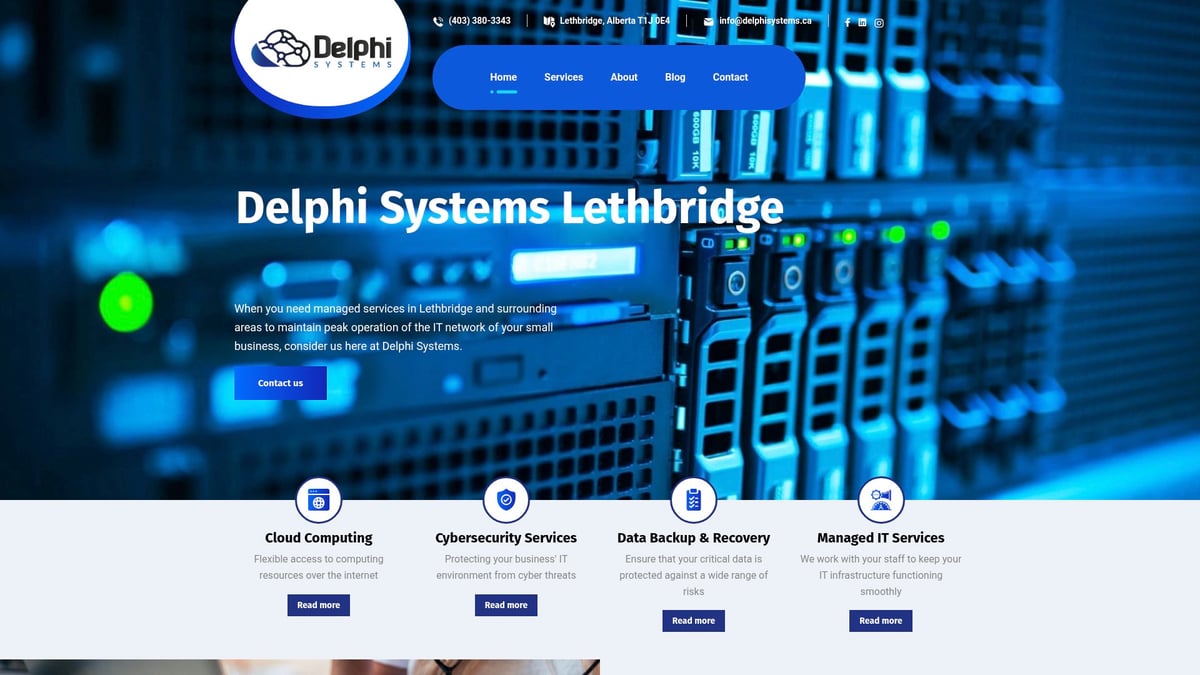
Clients benefit from fixed-rate, all-inclusive pricing, making budgeting for IT simple and predictable. Delphi Systems Inc. leverages strong partnerships with major vendors such as Dell, Meraki, Bitdefender, and Microsoft, ensuring clients receive best-in-class solutions.
A managed it service business like Delphi Systems Inc. brings measurable impact to local organizations in healthcare, environmental services, and professional fields. Their expertise leads to increased productivity, reduced downtime, and greater peace of mind for business owners.
What sets them apart?
- Proactive support and 24/7 monitoring
- Business continuity planning and disaster recovery
- Strategic IT consulting for growth and compliance
Clients regularly praise the team for their prompt, thorough, and friendly service. As one client shares, "Delphi Systems is always there when we need them, offering solutions before issues become problems."
For small businesses in Lethbridge seeking a reliable partner, connecting with Delphi Systems Inc. is the first step toward secure, efficient IT that drives business success.
Future Trends and Predictions for Managed IT Service Businesses
The pace of change in the managed it service business is accelerating, driven by technological breakthroughs, shifting client expectations, and regulatory evolution. To remain competitive, leaders must anticipate what is coming and prepare their strategies accordingly.

Evolving Technologies Shaping the Industry
Emerging technologies are set to redefine the managed it service business landscape by 2026. Edge computing is gaining traction as organizations demand real-time data processing at distributed sites, while IoT device management becomes essential for seamless operations.
Quantum computing, though still in its infancy, is already influencing encryption standards and security protocols. This shift requires providers to stay ahead of potential threats and adapt quickly as quantum capabilities mature. Automation is also advancing, particularly in incident response and the development of self-healing networks that can identify and resolve issues in real time.
The adoption of artificial intelligence and cloud-based solutions is fueling sector growth. According to Global IT Managed Services Market Growth, the market is expanding rapidly as businesses invest in AI-driven monitoring, scalable cloud platforms, and integrated analytics. Early adopters are leveraging AI-powered Network Operations Centers (NOCs) to proactively manage performance and security, setting a new standard for efficiency in the managed it service business.
| Technology | Impact on MSPs | Strategic Value |
|---|---|---|
| Edge Computing | Real-time data, IoT | Faster decision-making |
| Quantum Security | New encryption needs | Enhanced client trust |
| AI/Automation | Predictive maintenance | Lower costs, better outcomes |
The Shift Toward Outcome-Based Services
A significant trend in the managed it service business is the move from traditional SLA-based contracts to outcome-based service models. Instead of focusing solely on metrics like uptime or response times, providers are now being measured by the actual business results delivered to clients.
These outcome-based agreements may include guarantees of increased productivity, reduced costs, or specific improvements in security posture. For example, some MSPs bundle services that directly support client goals, such as revenue growth or operational efficiency. This approach positions the managed it service business as a true business enabler, not just a technical support resource.
Clients benefit from greater alignment between IT investments and business outcomes, while providers can differentiate themselves in a crowded market by delivering measurable value.
Regulatory and Ethical Considerations
Regulatory scrutiny is intensifying for the managed it service business, especially in sectors handling sensitive data. Privacy, data sovereignty, and ethical use of AI are taking center stage as governments introduce new compliance requirements and clients demand greater transparency.
Compliance is now viewed as an ongoing process, with automated tools monitoring adherence to frameworks like GDPR, HIPAA, and CMMC. The need for robust cybersecurity is more urgent than ever. According to Cybersecurity Spending Projections for 2025, organizations are significantly increasing their investment in security, driving MSPs to enhance their offerings.
Managed it service business leaders must also address ethical questions around AI, ensuring algorithms are fair, explainable, and free from bias. By proactively embracing compliance and ethics, MSPs can build trust and long-term partnerships.
The Expanding Role of MSPs in Digital Transformation
The managed it service business is evolving beyond technical support, with providers becoming strategic advisors in digital transformation initiatives. As businesses seek to adopt AI, automation, advanced cloud solutions, and modern security frameworks, MSPs are stepping into roles such as virtual CIOs and vCISOs.
Co-managed IT models are rising in popularity, enabling organizations to blend internal expertise with external innovation. This approach fosters collaboration and accelerates the adoption of transformative technologies.
Recent data shows that 37.9% of SMBs use MSPs to complement their in-house teams, highlighting the expanding advisory role within the managed it service business. By guiding clients through complex technology landscapes, MSPs are helping drive innovation, agility, and resilience for the future.
As you think about the future of managed IT services, it’s clear that staying ahead means embracing innovation—whether that’s adopting AI, elevating cybersecurity, or building deeper partnerships. With all the changes coming in 2026, having a proactive partner like Delphi Systems Inc. can give your business the confidence to focus on what you do best while your IT runs smoothly and securely. If you’re ready to see how tailored, expert support can drive productivity and peace of mind for your team, let’s talk about your goals and challenges.
Call us now

