

Small businesses face an increasingly complex landscape of data security issues that threaten their operations, customer trust, and financial stability. As organizations adopt cloud services, remote work technologies, and digital transformation initiatives, they simultaneously expand their attack surface and create new vulnerabilities that cybercriminals actively exploit. Understanding these threats and implementing comprehensive protection strategies has become essential for survival in the modern business environment, particularly for companies that manage sensitive client information and critical business data.
The Evolving Landscape of Data Security Threats
The cybersecurity environment in 2026 presents unprecedented challenges for businesses of all sizes. Data security issues have evolved far beyond simple virus infections and spam emails to encompass sophisticated, multi-vector attacks that target both technical vulnerabilities and human weaknesses.
Ransomware and Malware Evolution
Ransomware attacks have become increasingly targeted and destructive. Modern ransomware variants don't just encrypt files; they exfiltrate sensitive data before encryption, creating a double-extortion scenario where attackers threaten to release confidential information if demands aren't met. According to comprehensive data breach analysis, these attacks can cost businesses millions in downtime, recovery expenses, and reputational damage.
Key ransomware characteristics in 2026 include:
- Automated targeting systems that identify vulnerable networks
- Living-off-the-land techniques that use legitimate system tools
- AI-enhanced social engineering for initial access
- Rapid lateral movement across network segments
- Targeted attacks on backup systems to prevent recovery
Small businesses often lack dedicated security teams, making them attractive targets for automated ransomware campaigns that exploit common vulnerabilities.
Cloud Security Vulnerabilities
The migration to cloud computing has introduced specific data security issues that differ significantly from traditional on-premises infrastructure concerns. Misconfigured cloud storage buckets, inadequate access controls, and shared responsibility model misunderstandings create exploitable gaps.
| Cloud Security Risk | Business Impact | Prevention Strategy |
|---|---|---|
| Misconfigured storage | Public data exposure | Regular audits and automation |
| Weak authentication | Unauthorized access | Multi-factor authentication |
| Shadow IT services | Compliance violations | Centralized management |
| Inadequate encryption | Data interception | End-to-end encryption |
Research shows that misconfigured databases are a primary source of data leaks, often resulting from human error rather than sophisticated attacks. These configuration mistakes can expose customer records, financial data, and proprietary business information to public access.

Human Factors in Data Security Issues
Technology solutions alone cannot address the full spectrum of data security issues. Human behavior, both malicious and accidental, remains the weakest link in most security frameworks.
Insider Threats and Employee Negligence
Insider threats encompass both intentional malicious activity and unintentional mistakes that compromise security. Disgruntled employees may steal data, while well-meaning staff might accidentally expose sensitive information through careless handling.
Organizations face these common human-related risks:
- Password reuse across multiple platforms creating cascading breach scenarios
- Phishing susceptibility despite training programs and awareness campaigns
- Improper data disposal leaving sensitive information in accessible locations
- Unauthorized software installations bypassing security controls and creating vulnerabilities
- Mobile device carelessness losing or improperly securing devices containing business data
Employee training programs must evolve continuously to address emerging social engineering tactics and maintain security awareness as a core component of organizational culture.
Social Engineering Sophistication
Modern social engineering attacks leverage psychological manipulation, publicly available information, and AI-generated content to create highly convincing deception campaigns. Attackers research targets thoroughly, crafting personalized messages that bypass traditional security awareness red flags.
Business email compromise (BEC) attacks represent a particularly costly category, where attackers impersonate executives or vendors to authorize fraudulent wire transfers or data disclosures. These attacks exploit trust relationships rather than technical vulnerabilities, making them difficult to prevent through technological controls alone.
Infrastructure and Network Vulnerabilities
The technical foundation of business operations creates numerous potential entry points for attackers seeking to exploit data security issues within organizational networks.
Legacy System Risks
Many small businesses continue operating legacy systems that no longer receive security updates or vendor support. These systems create permanent vulnerabilities that attackers can exploit using well-documented techniques.
Legacy system challenges include:
- Incompatibility with modern security tools
- Unpatched vulnerabilities with public exploits
- Integration difficulties with secure alternatives
- High replacement costs creating delayed upgrades
- Specialized knowledge requirements for maintenance
The healthcare sector provides a stark example, with recent breaches affecting millions of patients due to vulnerabilities in outdated healthcare management systems.
Network Architecture Weaknesses
Flat network architectures without proper segmentation allow attackers who gain initial access to move laterally throughout the entire infrastructure. Proper network design incorporates defense-in-depth principles with multiple security layers.
Organizations should implement network segmentation that separates:
- Guest wireless networks from internal business systems
- Financial systems from general employee access
- Sensitive customer data repositories from public-facing applications
- Development environments from production systems
- Administrative access paths from regular user traffic

Data Sprawl and Management Challenges
The proliferation of data across multiple platforms, devices, and storage locations creates management complexity that introduces significant data security issues for modern organizations.
Shadow IT and Unmanaged Devices
Employees frequently adopt unauthorized cloud services and personal devices for work tasks, creating shadow IT ecosystems that bypass centralized security controls. This data sprawl has become a critical headache for security teams, particularly in hybrid work environments where traditional network perimeters no longer exist.
The challenges multiply as organizations struggle to:
- Maintain visibility into where sensitive data resides
- Apply consistent security policies across disparate systems
- Monitor access and usage patterns effectively
- Respond to security incidents spanning multiple platforms
- Maintain compliance with data protection regulations
Backup and Recovery Vulnerabilities
While backups serve as critical protection against ransomware and data loss, poorly secured backup systems themselves represent attractive targets. Attackers increasingly target backup infrastructure to prevent recovery, forcing victims toward ransom payment.
| Backup Security Element | Best Practice | Common Vulnerability |
|---|---|---|
| Storage location | Offline or immutable copies | Network-attached and accessible |
| Access controls | Restricted, monitored access | Shared administrator credentials |
| Encryption | At-rest and in-transit | Unencrypted backup files |
| Testing frequency | Monthly restoration drills | Untested backup integrity |
| Retention policies | Multiple version history | Single backup version only |
Organizations must treat backup security with the same rigor as production system protection, implementing the 3-2-1 backup rule with security enhancements appropriate for the current threat landscape.
Compliance and Regulatory Considerations
Data security issues carry legal and regulatory implications that extend far beyond technical concerns, creating potential liability for organizations that fail to meet industry standards and legal requirements.
Regulatory Framework Complexity
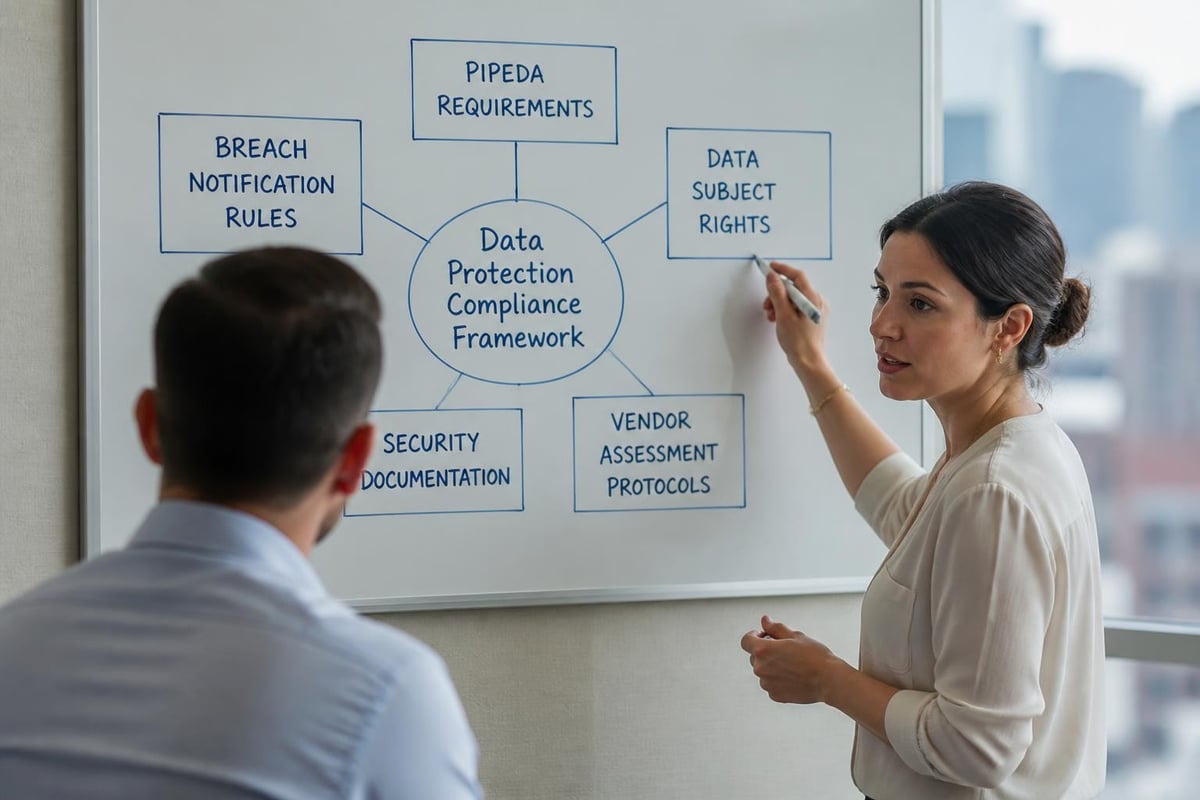
Businesses must navigate an increasingly complex web of data protection regulations spanning different jurisdictions and industries. Canadian privacy laws, including PIPEDA, impose specific requirements for personal information handling, while industry-specific regulations add additional layers of compliance obligations.
Key regulatory considerations include:
- Data residency requirements specifying where information can be stored
- Breach notification timelines requiring rapid incident response
- Data subject rights enabling customer information requests
- Security control documentation demonstrating due diligence
- Third-party vendor assessment ensuring supply chain security
The legal landscape continues evolving, with increasing difficulty in holding companies accountable for data breaches despite rising incident frequency.
Liability and Financial Consequences
Data security issues translate directly into financial risk through multiple channels. Direct costs include incident response, forensic investigation, legal fees, regulatory fines, and customer notification expenses. Indirect costs encompass business interruption, reputation damage, customer churn, and increased insurance premiums.
Small businesses face particular vulnerability because a single significant breach can represent an existential threat. Unlike large enterprises with substantial financial reserves, small organizations may struggle to absorb the combined costs of breach response and business disruption.
Emerging Threats and Future Considerations
The data security landscape continues evolving as new technologies create fresh attack vectors and threat actors develop increasingly sophisticated techniques.
AI-Driven Security Challenges
Artificial intelligence presents a double-edged sword in cybersecurity. While defensive AI tools enhance threat detection capabilities, attackers leverage the same technologies to create more convincing phishing campaigns, automate vulnerability discovery, and develop adaptive malware.
Organizations face an AI security illusion where they overestimate their protection capabilities while underestimating evolving threats. The integration of data security posture management, data loss prevention, and privacy controls requires sophisticated coordination that many small businesses struggle to implement effectively.
Physical Infrastructure Targeting
Cyber threats increasingly extend beyond data theft to target physical operational technology and critical infrastructure. Attacks on data center equipment and power systems demonstrate how cybersecurity failures can create real-world safety hazards and catastrophic operational disruption.
This convergence of digital and physical security requires businesses to consider:
- Environmental control system vulnerabilities
- Building access system network connections
- Industrial equipment with embedded computing
- Power management and backup systems
- Physical security camera network isolation
Practical Protection Strategies
Addressing data security issues requires a comprehensive, layered approach that combines technology, processes, and people-focused initiatives tailored to organizational needs and risk profiles.
Essential Security Controls
Every organization should implement fundamental security controls as baseline protection against common threats. These foundational elements create significant barriers to successful attacks while remaining accessible for businesses with limited resources.
Core security controls include:
- Next-generation firewalls with intrusion prevention and application awareness
- Endpoint detection and response providing advanced threat monitoring
- Email security gateways filtering phishing and malicious attachments
- Patch management systems ensuring timely vulnerability remediation
- Access control frameworks limiting permissions to necessary functions
Organizations should prioritize security investments based on risk assessment outcomes, focusing resources on protecting the most critical assets and addressing the most probable threats.
Monitoring and Incident Response
Proactive monitoring enables early threat detection before minor security events escalate into major breaches. Effective monitoring programs combine automated tools with human analysis to identify suspicious patterns and anomalous behavior.
Organizations need documented incident response plans that specify:
- Detection and analysis procedures for identifying security events
- Containment strategies to limit breach scope and prevent spread
- Eradication steps removing attacker access and malicious artifacts
- Recovery processes restoring normal operations and verifying integrity
- Post-incident review conducting lessons learned and improvement identification
Regular tabletop exercises test incident response capabilities without the pressure of actual security events, identifying gaps in plans and improving team coordination.
Third-Party Risk Management
Supply chain vulnerabilities represent a growing source of data security issues as organizations increasingly rely on external vendors for critical business functions. Understanding comprehensive data security risks requires evaluating the entire ecosystem of business relationships and data flows.
Vendor assessment should evaluate:
- Security certifications and compliance attestations
- Data handling and protection practices
- Incident response capabilities and notification procedures
- Subcontractor and fourth-party relationships
- Business continuity and disaster recovery planning
Contractual agreements must clearly define security responsibilities, breach notification requirements, and liability allocation to protect organizational interests throughout the vendor relationship lifecycle.
Building Security-Conscious Organizational Culture
Technology and processes alone cannot fully address data security issues without cultural commitment to security awareness and accountability throughout the organization.
Continuous Security Education
Security training must extend beyond annual compliance sessions to create ongoing awareness that adapts to emerging threats. Effective programs incorporate:
- Monthly security newsletters highlighting current threats
- Simulated phishing campaigns testing and reinforcing vigilance
- Role-specific training addressing unique departmental risks
- New hire onboarding emphasizing security responsibilities
- Executive briefings maintaining leadership engagement
Organizations that treat security as everyone's responsibility rather than solely an IT concern achieve significantly better outcomes in preventing breaches and responding effectively to incidents.
Security Metrics and Accountability
Measuring security program effectiveness requires tracking meaningful metrics that demonstrate progress and identify areas needing improvement. Useful metrics include vulnerability remediation timeframes, phishing simulation click rates, incident detection times, and security awareness training completion rates.
Leadership accountability ensures security receives appropriate priority and resource allocation. Executives should receive regular briefings on security posture, emerging threats, and program effectiveness to make informed decisions about risk acceptance and mitigation investments.
Data security issues present complex, evolving challenges that require comprehensive strategies combining technology, processes, and organizational culture to protect business operations and customer trust. Small businesses face particular vulnerability due to resource constraints and sophisticated threat actors who increasingly target organizations lacking dedicated security teams. Delphi Systems Inc. provides managed IT services specifically designed to address these challenges for small businesses in Lethbridge and surrounding areas, offering comprehensive cybersecurity, network monitoring, and data backup solutions that maintain security while allowing organizations to focus on their core business activities.

