

Cloud adoption has transformed how small businesses operate, offering scalability, flexibility, and cost savings that were once exclusive to enterprise organizations. However, this digital transformation brings significant security challenges that require careful attention and strategic planning. Understanding cloud technology security is no longer optional for businesses that rely on cloud-based systems to store sensitive data, run critical applications, and maintain operational continuity. For small businesses in Lethbridge and surrounding areas, implementing robust security measures ensures that cloud investments deliver value without exposing organizations to preventable risks.
Understanding the Cloud Security Landscape in 2026
The cloud security environment has evolved significantly over the past few years, with threat actors becoming increasingly sophisticated in their attack methods. Cloud technology security encompasses the policies, technologies, controls, and procedures that work together to protect cloud-based systems, data, and infrastructure from unauthorized access, data breaches, and service disruptions.
Modern cloud environments present unique challenges compared to traditional on-premises infrastructure. The distributed nature of cloud computing means that data and applications exist across multiple locations and platforms, creating a broader attack surface. Additionally, the shared responsibility model in cloud security defines distinct obligations between cloud service providers and their customers, making it critical for businesses to understand exactly which security measures fall under their purview.

The Shared Responsibility Framework
Understanding who is responsible for what security measures forms the foundation of effective cloud technology security. Cloud service providers manage the security of the cloud, which includes physical infrastructure, networking hardware, and the hypervisor layer. Businesses remain responsible for security in the cloud, covering data protection, identity management, application security, and access controls.
This division varies based on the cloud service model:
- Infrastructure as a Service (IaaS): Customers manage operating systems, applications, and data
- Platform as a Service (PaaS): Provider manages more infrastructure, customers focus on applications and data
- Software as a Service (SaaS): Provider handles most security, customers manage user access and data governance
Misunderstanding these responsibilities creates security gaps that attackers readily exploit. Small businesses often assume their cloud provider handles all security aspects, leaving critical vulnerabilities unaddressed.
Essential Security Practices for Cloud Environments
Implementing comprehensive security measures requires a multi-layered approach that addresses various threat vectors and vulnerability points. The following practices form the cornerstone of effective cloud technology security strategies.
Identity and Access Management
Strong identity verification stands as the first line of defense in cloud security. Multi-factor authentication (MFA) should be mandatory for all users accessing cloud resources, adding an extra verification layer beyond simple passwords. Role-based access control (RBAC) ensures that employees only access the data and applications necessary for their specific job functions.
Key identity management practices include:
- Implement multi-factor authentication across all cloud services and applications
- Enforce strong password policies with complexity requirements and regular rotation schedules
- Use privileged access management for administrative accounts with elevated permissions
- Conduct regular access reviews to remove unnecessary permissions and deactivate former employee accounts
- Deploy single sign-on solutions to simplify user experience while maintaining security
Regular audits of user permissions help identify privilege creep, where employees accumulate access rights over time that exceed their current role requirements. Automated tools can flag unusual access patterns or suspicious login attempts, enabling rapid response to potential security incidents.
Data Encryption Strategies
Encryption protects data confidentiality by rendering information unreadable without the proper decryption keys. Best practices for securing data in cloud services emphasize the importance of encrypting data both at rest and in transit.
| Encryption Type | Purpose | Implementation |
|---|---|---|
| At Rest | Protects stored data | Database encryption, encrypted storage volumes |
| In Transit | Secures data movement | TLS/SSL protocols, VPN connections |
| In Use | Protects active data | Secure enclaves, confidential computing |
Businesses should maintain control over their encryption keys rather than relying solely on cloud provider key management. This approach ensures that even if a provider experiences a breach, encrypted data remains protected. Regular key rotation and secure key storage practices prevent unauthorized decryption attempts.
Network Security and Segmentation
Network segmentation divides cloud environments into isolated zones, limiting lateral movement if attackers gain initial access. Virtual private clouds (VPCs) create logically isolated sections within the broader cloud infrastructure, allowing granular control over network traffic and access patterns.
Effective network security includes:
- Configuring firewalls and security groups to restrict traffic between network segments
- Implementing intrusion detection and prevention systems to identify suspicious activity
- Using virtual private networks for remote access to cloud resources
- Deploying web application firewalls to protect internet-facing applications
- Monitoring network traffic patterns for anomalies and potential threats

Advanced Security Measures and Monitoring
Beyond foundational practices, organizations must implement continuous monitoring and advanced security controls to detect and respond to emerging threats in real time.
Continuous Monitoring and Threat Detection
Cloud environments change rapidly, with new resources deployed and configurations modified constantly. Comprehensive monitoring and regular audits enable organizations to detect security incidents quickly and minimize their impact.
Security information and event management (SIEM) systems aggregate logs from multiple cloud services, applications, and security tools, providing a centralized view of the security posture. Machine learning algorithms identify patterns that indicate potential security incidents, from unusual data access patterns to failed authentication attempts that suggest credential stuffing attacks.
Real-time alerting ensures that security teams receive immediate notification of critical events, enabling rapid response before minor incidents escalate into major breaches. Automated response playbooks can execute predefined actions when specific conditions are met, such as isolating compromised systems or revoking suspicious user credentials.
Zero Trust Architecture
Traditional security models assume that users and devices inside the network perimeter are trustworthy, but cloud environments blur these boundaries. Zero trust architecture operates on the principle of "never trust, always verify," requiring continuous authentication and authorization for every access request.
Implementing zero trust involves:
- Verifying user identity for every access request
- Validating device health and security posture
- Enforcing least-privilege access principles
- Inspecting and logging all traffic
- Assuming breach and limiting blast radius
This approach significantly reduces the risk of unauthorized access and lateral movement within cloud environments. Even if attackers compromise user credentials, zero trust controls limit their ability to access additional resources or move freely across the network.
Compliance and Governance Frameworks
Regulatory compliance shapes cloud technology security requirements for many industries, from healthcare organizations managing protected health information to financial institutions handling sensitive financial data. Understanding applicable regulations and implementing appropriate controls ensures legal compliance while strengthening overall security posture.
Common Compliance Standards
| Standard | Industry | Key Requirements |
|---|---|---|
| PIPEDA | Canadian businesses | Personal information protection and privacy |
| PCI DSS | Payment processing | Credit card data security standards |
| SOC 2 | Service providers | Security, availability, confidentiality controls |
| ISO 27001 | General | Information security management systems |
Cloud service providers typically offer compliance certifications for their infrastructure, but businesses remain responsible for how they configure and use cloud services. Regular compliance audits verify that security controls meet regulatory requirements and organizational policies.
Data Governance and Classification
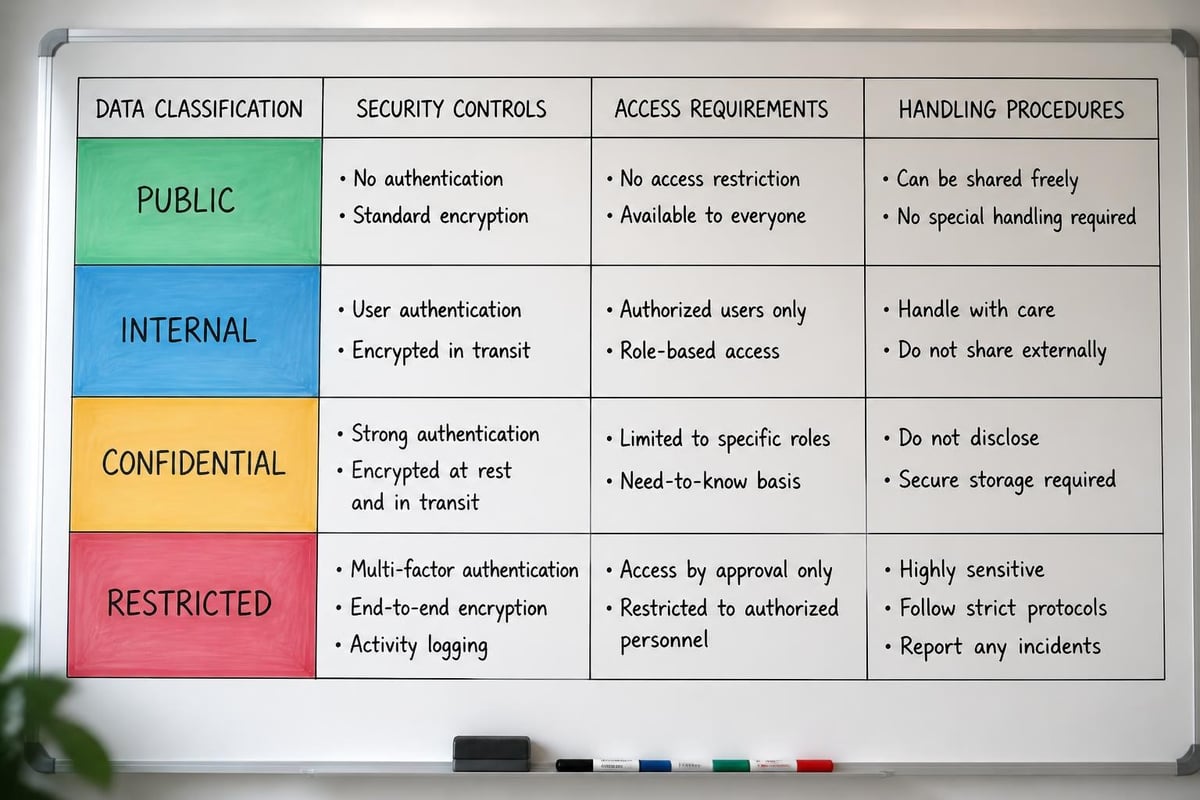
Data classification systems categorize information based on sensitivity and regulatory requirements, enabling appropriate security controls for each data type. Public information requires minimal protection, while confidential business data and personally identifiable information demand strict access controls and encryption.
Effective governance includes:
- Defining clear data classification levels and handling requirements
- Implementing data loss prevention tools to prevent unauthorized data exfiltration
- Establishing data retention and deletion policies aligned with regulatory requirements
- Documenting data flows and processing activities
- Conducting regular privacy impact assessments
Backup and Disaster Recovery Planning
Cloud technology security extends beyond preventing unauthorized access to ensuring business continuity when incidents occur. Comprehensive backup strategies protect against data loss from ransomware attacks, accidental deletion, or system failures.
Backup Best Practices
The 3-2-1 backup rule remains relevant in cloud environments: maintain three copies of data, store backups on two different media types, and keep one copy offsite. Cloud storage naturally satisfies the offsite requirement, but organizations should implement additional protection measures.
Critical backup considerations include:
- Automating backup schedules to ensure consistent data protection
- Encrypting backup data to prevent unauthorized access
- Testing restoration procedures regularly to verify backup integrity
- Storing backups in different geographic regions for disaster recovery
- Implementing immutable backups that cannot be modified or deleted by ransomware
Recovery time objectives (RTO) and recovery point objectives (RPO) define how quickly systems must be restored and how much data loss is acceptable. These metrics guide backup frequency and disaster recovery planning, ensuring that recovery capabilities align with business requirements.
Incident Response Preparation
Despite best prevention efforts, security incidents may still occur. Cloud security best practices include developing detailed incident response plans that outline roles, responsibilities, and procedures for containing and recovering from security events.
Response plans should address:
- Incident detection and initial assessment procedures
- Communication protocols for notifying stakeholders and authorities
- Containment strategies to prevent incident escalation
- Evidence preservation for forensic analysis
- Recovery and restoration procedures
- Post-incident review and lessons learned
Regular tabletop exercises test incident response plans, identifying gaps and ensuring team members understand their roles during actual incidents. These simulations improve response effectiveness and reduce recovery time when real incidents occur.
Vendor Management and Third-Party Risk
Cloud technology security extends to managing risks from third-party vendors and service providers who access business systems or handle sensitive data. Vendor risk management programs evaluate security practices of cloud providers, software vendors, and other service partners.
Evaluating Cloud Providers
Selecting a reliable cloud provider forms the foundation of secure cloud operations. Evaluation criteria should include:
- Security certifications and compliance attestations
- Data center physical security and redundancy
- Encryption capabilities and key management options
- Incident response track record and notification procedures
- Service level agreements for availability and security
- Data sovereignty and geographic storage locations
Due diligence reviews assess whether providers meet security requirements and maintain appropriate controls. Contract negotiations should clearly define security responsibilities, data ownership, and breach notification requirements.
Ongoing Vendor Monitoring
Security posture changes over time, making continuous monitoring essential. Regular vendor assessments verify that providers maintain security standards and promptly address vulnerabilities. Security questionnaires, third-party audits, and vendor-supplied compliance reports provide ongoing assurance.
When vendors experience security incidents, rapid communication enables businesses to assess potential impact and implement protective measures. Contractual requirements for timely breach notification protect organizations from delayed incident response.
Employee Training and Security Awareness
Human factors represent one of the most significant cloud technology security vulnerabilities. Phishing attacks, weak passwords, and inadvertent data exposure often result from insufficient security awareness rather than technical failures.
Comprehensive security training programs should cover:
- Recognizing phishing attempts and social engineering tactics
- Creating and managing strong passwords
- Properly handling sensitive data in cloud applications
- Reporting suspicious activities or potential security incidents
- Understanding security policies and acceptable use requirements
Regular training refreshers keep security awareness top of mind, while simulated phishing exercises test employee vigilance and identify areas requiring additional education. Security champions within different departments can promote security awareness and serve as resources for their colleagues.
Configuration Management and Security Hardening
Misconfigurations account for a substantial portion of cloud security incidents, from publicly accessible storage buckets to overly permissive access controls. Systematic configuration management prevents security gaps that attackers exploit.
Security hardening involves:
- Disabling unnecessary services and features that expand attack surface
- Applying security patches and updates promptly
- Configuring secure defaults for all cloud resources
- Removing default credentials and sample applications
- Implementing configuration baselines aligned with security standards
Infrastructure as code practices bring version control and review processes to cloud configurations, reducing manual errors and enabling rapid identification of unauthorized changes. Automated scanning tools continuously assess cloud configurations against security benchmarks, flagging deviations for remediation.
Future Trends in Cloud Security
The cloud technology security landscape continues evolving as new technologies emerge and threat actors develop more sophisticated attack methods. Artificial intelligence and machine learning increasingly power security tools, enabling faster threat detection and automated response to common security events.
Emerging security considerations include:
- Securing containerized applications and Kubernetes environments
- Protecting serverless computing functions and microservices architectures
- Managing security in multi-cloud and hybrid cloud deployments
- Addressing quantum computing threats to current encryption methods
- Implementing privacy-enhancing technologies for data protection
Staying informed about emerging threats and evolving security practices ensures that cloud security strategies remain effective against new attack vectors. Professional security advisors help small businesses navigate complex security requirements and implement appropriate controls without requiring extensive in-house security expertise.
Protecting cloud environments requires ongoing attention to evolving threats, comprehensive security controls, and clear understanding of shared security responsibilities. Small businesses must balance security requirements with operational efficiency, implementing robust protections without impeding productivity. Delphi Systems Inc. helps Lethbridge businesses navigate cloud technology security challenges with expert guidance, proactive monitoring, and comprehensive managed IT services. Our fixed-rate fee structure and focus on maintaining peak IT operations enable you to leverage cloud benefits securely while concentrating on core business activities.

