
Finding reliable managed IT solutions near me has become a critical priority for small businesses navigating an increasingly complex technology landscape. As companies in Lethbridge and surrounding areas face mounting cybersecurity threats, cloud migration challenges, and the constant pressure to maximize operational efficiency, partnering with a local managed service provider offers distinct advantages over traditional break-fix IT support. The right local provider brings not only technical expertise but also an understanding of regional business needs, rapid response times, and personalized service that national providers often cannot match.
Understanding Managed IT Services for Local Businesses
Managed IT services represent a fundamental shift in how businesses approach technology infrastructure. Rather than responding to problems after they occur, managed IT service providers deliver proactive monitoring and maintenance that keeps systems running smoothly. This approach transforms IT from a cost center into a strategic asset.
For small businesses, managed IT solutions typically include:
- 24/7 network monitoring and maintenance
- Cybersecurity protection and threat management
- Cloud computing services and migration support
- Data backup and disaster recovery planning
- Help desk support for end users
- Strategic IT planning and consulting
The managed services model operates on a predictable, fixed-rate fee structure. This financial predictability allows businesses to budget accurately while eliminating the unpredictable costs associated with emergency repairs and system failures.
Why Location Matters When Searching for Managed IT Solutions
When business owners search for managed it solutions near me, proximity offers tangible benefits beyond convenience. Local providers understand regional infrastructure challenges, comply with local regulations, and can provide on-site support when remote troubleshooting proves insufficient.
Response time becomes critical during IT emergencies. A provider based in your community can dispatch technicians within hours rather than days. This accessibility proves invaluable when network outages threaten business continuity or security breaches require immediate physical intervention.

Key Services to Expect from Local Managed IT Providers
Modern managed IT solutions encompass far more than basic help desk support. The most effective providers deliver comprehensive technology management that addresses every aspect of your IT infrastructure.
Network Monitoring and Maintenance
Continuous network monitoring forms the foundation of proactive IT management. Advanced monitoring tools detect anomalies, performance degradation, and potential failures before they impact operations. This surveillance extends across servers, workstations, network devices, and cloud resources.
Regular maintenance includes patch management, software updates, and performance optimization. These routine tasks prevent vulnerabilities from developing while ensuring systems operate at peak efficiency. Implementing best practices for managed IT services requires robust security plans and systematic risk assessments.
Cybersecurity and Threat Protection
Cybersecurity represents perhaps the most critical component of managed it solutions near me for small businesses. The threat landscape evolves constantly, with ransomware, phishing attacks, and data breaches targeting organizations of all sizes.
| Security Layer | Protection Provided | Business Impact |
|---|---|---|
| Firewall Management | Network perimeter defense | Blocks unauthorized access |
| Endpoint Protection | Device-level security | Prevents malware infections |
| Email Security | Spam and phishing filtering | Reduces social engineering risks |
| Security Awareness Training | Employee education | Minimizes human error vulnerabilities |
| Vulnerability Assessments | Proactive risk identification | Addresses weaknesses before exploitation |
Comprehensive cybersecurity extends beyond technology to include policy development, compliance management, and incident response planning. Local providers familiar with regional compliance requirements can ensure your business meets industry-specific regulations.
Cloud Computing and Migration Services
Cloud adoption has accelerated dramatically, with businesses leveraging cloud infrastructure for enhanced flexibility, scalability, and cost efficiency. Managed IT providers guide organizations through cloud migration, helping select appropriate platforms and execute smooth transitions.
Cloud services managed by local providers include:
- Infrastructure assessment to determine cloud readiness
- Platform selection based on business requirements
- Migration planning to minimize disruption
- Ongoing cloud management for optimization
- Hybrid cloud integration connecting on-premises and cloud resources
The strategic value of cloud computing extends beyond technology to business agility. Organizations can scale resources dynamically, support remote work arrangements, and access enterprise-grade infrastructure without capital investments.
Evaluating Managed IT Solutions in Your Area
Selecting the right provider requires careful evaluation of capabilities, service levels, and business alignment. Not all managed IT solutions near me offer equivalent value or expertise.
Technical Capabilities and Certifications
Professional certifications validate technical expertise and commitment to industry standards. Look for providers whose technicians hold certifications from major vendors like Microsoft, Cisco, and CompTIA. These credentials demonstrate current knowledge and specialized skills.
The provider's technology stack matters significantly. Modern managed service providers utilize advanced monitoring platforms, automation tools, and integrated security solutions. Platform consolidation helps MSPs manage complexity while delivering superior service to clients.
Service Level Agreements and Response Times
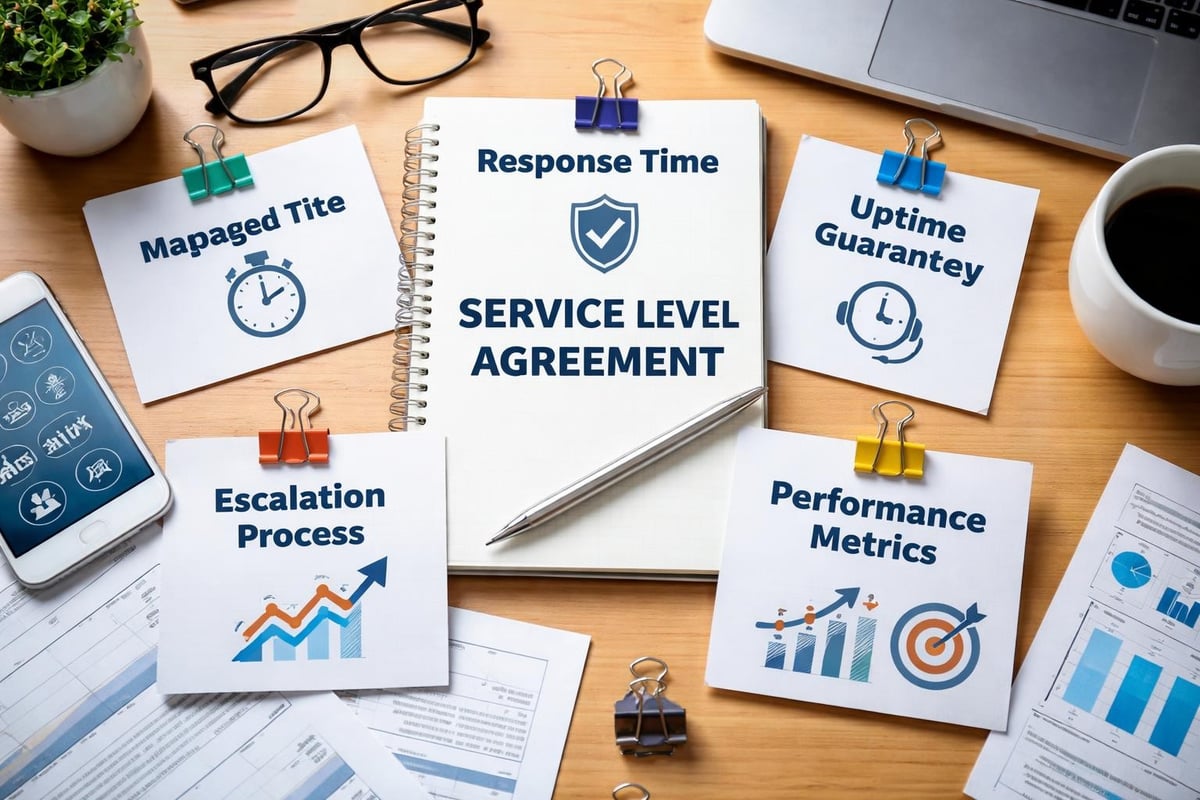
Service Level Agreements (SLAs) define performance expectations and provider commitments. These contracts specify response times, resolution targets, and available support hours.
Critical SLA components include:
- Initial response time for different priority levels
- Resolution time objectives
- System uptime guarantees
- Support availability (business hours vs. 24/7)
- Escalation procedures
- Performance reporting requirements
Review SLAs carefully to ensure they align with your business needs. A provider offering 24/7 monitoring with rapid response times delivers superior value for businesses where downtime directly impacts revenue.
Cost Structure and Value Assessment
Fixed-rate pricing eliminates financial uncertainty while incentivizing providers to prevent problems rather than profit from repairs. Monthly fees typically scale based on user count, device numbers, or service tier selected.
| Pricing Model | Structure | Best For |
|---|---|---|
| Per User | Monthly fee per employee | Growing teams with varying headcount |
| Per Device | Fee for each managed endpoint | Organizations with diverse device types |
| Tiered Service | Bronze/Silver/Gold packages | Businesses wanting service level flexibility |
| Custom | Negotiated based on specific needs | Complex environments with unique requirements |
Total cost of ownership extends beyond monthly fees. Factor in reduced downtime, improved productivity, enhanced security, and eliminated emergency repair costs when evaluating value.
The Business Impact of Local Managed IT Solutions
Partnering with managed it solutions near me creates measurable business benefits that extend across operations, security, and strategic planning.
Increased Operational Efficiency
IT management consumes significant time and resources when handled internally by non-specialists. Business owners and staff diverted to technology troubleshooting cannot focus on core revenue-generating activities.
Managed services restore this focus. With expert technicians handling infrastructure management, employees concentrate on their primary responsibilities. Help desk support resolves user issues quickly, minimizing productivity losses from technical problems.
Proactive maintenance prevents the disruptions that plague reactive IT environments. Following good managed services practices ensures stable operations through systematic monitoring and preventive care.
Enhanced Security Posture
Small businesses increasingly face sophisticated cyber threats previously targeting only large enterprises. Attackers recognize that smaller organizations often lack robust defenses, making them attractive targets.
Professional security management provides enterprise-grade protection scaled for small business needs. Continuous monitoring detects threats in real-time, while layered defenses create multiple barriers against attack. Regular security assessments identify vulnerabilities before exploitation occurs.
The managed services industry continues expanding rapidly, with projections indicating significant growth driven by cybersecurity demands and efficient IT solution requirements across all business sizes.
Strategic Technology Planning
Beyond day-to-day management, effective managed IT providers serve as strategic technology advisors. They help businesses align IT investments with growth objectives, recommend solutions for emerging challenges, and plan infrastructure evolution.
This strategic partnership proves particularly valuable as technology complexity increases. Modern IT management requires moving away from fragmentation toward integrated approaches that deliver seamless operations and robust security simultaneously.
Choosing the Right Provider for Your Business
The process of selecting managed it solutions near me demands thoughtful consideration of multiple factors beyond technical capabilities.
Assessing Provider Experience and Reputation
Longevity in the managed services industry indicates stability and expertise. Providers serving the community for years have developed deep technical knowledge and refined service delivery processes.
Client references offer invaluable insights into actual service quality. Request contacts for businesses similar to yours in size and industry. Ask about responsiveness, problem resolution effectiveness, and overall satisfaction.
Key questions for references:
- How quickly does the provider respond to urgent issues?
- Has the provider successfully prevented major outages or security incidents?
- Do they proactively recommend improvements and upgrades?
- How effective is their communication during normal operations and emergencies?
- Would you recommend them to other businesses?
Online reviews and testimonials provide additional perspective, though personal references carry greater weight for business-critical decisions.
Understanding Service Scope and Flexibility
Business needs evolve over time. The ideal provider offers scalable services that grow with your organization. Rigid service packages that cannot accommodate expansion or changing requirements create friction as businesses develop.
Discuss how the provider handles scope changes, service additions, and scaling. Flexible providers adjust services smoothly without lengthy contract renegotiations or service disruptions.

Evaluating Communication and Support Culture
Technical expertise matters little if communication breaks down during critical moments. The provider's support culture determines how effectively they serve your business.
During initial consultations, assess communication style and responsiveness. Do they explain technical concepts clearly? Do they listen to your concerns and ask relevant questions about your business? Do they respond promptly to inquiries?
Support culture extends to the entire technical team. Meet the technicians who will actually manage your systems. Their professionalism, communication skills, and customer service orientation directly impact your experience.
Making the Transition to Managed IT Services
Organizations moving from internal IT management or break-fix support to managed it solutions near me should expect a structured onboarding process.
Initial Assessment and Planning
Reputable providers begin with comprehensive network assessments documenting current infrastructure, identifying vulnerabilities, and establishing performance baselines. This discovery phase creates the foundation for effective management.
The assessment typically includes:
- Network topology mapping
- Hardware and software inventory
- Security posture evaluation
- Performance analysis
- Compliance review
- User support requirements assessment
Following assessment, the provider develops a transition plan outlining migration steps, timeline, and success criteria. Clear planning minimizes disruption while ensuring nothing falls through gaps during the handoff.
Implementation and Integration
Implementation proceeds systematically through monitoring tool deployment, security enhancement, documentation creation, and team training. The provider's technicians work closely with your staff to ensure smooth integration.
Expect an adjustment period as systems come under new management. Initial optimization may reveal issues previously hidden by inadequate monitoring. Address these discoveries as opportunities for improvement rather than failures.
Ongoing Partnership Development
The relationship with your managed IT provider should deepen over time. Regular business reviews assess service performance, discuss technology roadmaps, and align IT strategy with business objectives.
Best practices for managed services emphasize proactive communication and continuous improvement. Strong providers actively seek feedback and adjust services to better serve evolving needs.
Technology Trends Shaping Local Managed IT Services
The managed services landscape evolves rapidly as new technologies emerge and business requirements change. Understanding current trends helps businesses make informed provider selections.
Artificial Intelligence and Automation
AI-powered tools increasingly automate routine IT tasks, from ticket routing to threat detection. These technologies enhance service delivery efficiency while reducing human error. Providers leveraging AI can offer superior monitoring, faster issue resolution, and more accurate predictive maintenance.
Automation extends beyond operations to strategic planning. Advanced analytics identify patterns in system performance, user behavior, and security events that inform optimization recommendations.
Security-First Approaches
The escalating threat landscape drives security to the forefront of managed IT services. Modern providers integrate security considerations across all service components rather than treating it as a separate function.
Zero-trust security models, which verify every access request regardless of source, gain adoption. Multi-factor authentication becomes standard. Security awareness training evolves from annual checkbox exercises to ongoing programs that adapt to emerging threats.
Hybrid and Multi-Cloud Management
Few businesses operate purely on-premises or entirely in the cloud. Hybrid environments combining both approaches create management complexity requiring specialized expertise.
Managed IT providers increasingly offer hybrid cloud management that seamlessly integrates on-premises infrastructure with public cloud services. This capability proves essential as organizations optimize workload placement across environments for cost, performance, and compliance.
Regional Considerations for Lethbridge Area Businesses
Businesses searching for managed it solutions near me in the Lethbridge region face unique considerations shaped by local infrastructure, economic factors, and community characteristics.
Internet Connectivity and Infrastructure
Remote monitoring and cloud services depend on reliable internet connectivity. Local providers understand regional connectivity options, carrier reliability, and bandwidth availability. They can recommend appropriate internet services and design redundant connectivity for business continuity.
Geographic factors affecting connectivity include proximity to fiber infrastructure, wireless coverage areas, and backup connection options. Experienced local providers navigate these factors effectively.
Supporting Local Economic Growth
Partnering with local managed IT providers contributes to regional economic development. Funds remain within the community, supporting local jobs and business growth. This economic impact creates positive ripple effects across the region.
Local providers also develop deeper relationships with other regional businesses, creating networking opportunities and potential partnerships. These connections prove valuable beyond technology services.
Understanding Regional Business Challenges
Lethbridge area businesses face specific operational challenges shaped by regional economic conditions, seasonal factors, and industry concentrations. Local managed IT providers understand these dynamics and tailor solutions accordingly.
Agriculture-related businesses may require specialized software support and seasonal scaling. Retail operations need robust point-of-sale systems and inventory management. Professional services demand secure client data handling and compliance management. Providers familiar with regional business composition deliver more relevant solutions.
Maximizing Value from Your Managed IT Partnership
Simply engaging managed it solutions near me does not guarantee optimal results. Active partnership development maximizes the value derived from these relationships.
Establishing Clear Expectations
Document business requirements, priorities, and success criteria clearly from the beginning. When both parties understand expectations, service delivery aligns more effectively with actual needs.
Communicate changes in business operations, growth plans, or technology requirements promptly. Providers cannot proactively address needs they don't know exist. Regular check-ins maintain alignment between services and requirements.
Leveraging Strategic Consulting
The best managed IT providers offer strategic technology consulting beyond operational support. Engage this expertise when planning expansions, evaluating new software, or considering technology investments.
Technology decisions carry long-term implications. Professional guidance helps avoid costly mistakes while identifying opportunities that improve competitiveness. Treat your provider as a trusted advisor rather than merely a vendor.
Investing in User Training
Even the most robust IT infrastructure delivers limited value if users cannot leverage it effectively. Work with your provider to develop training programs that improve staff technology proficiency.
Training reduces support tickets, improves productivity, and enhances security by teaching safe computing practices. Many providers include training resources as part of their service packages.
Local managed IT solutions deliver transformative benefits for small businesses ready to elevate their technology infrastructure beyond reactive break-fix approaches. By partnering with experienced providers who understand regional needs and deliver proactive support, organizations increase operational efficiency, strengthen security postures, and position themselves for sustainable growth. Delphi Systems Inc. brings this expertise to Lethbridge and surrounding areas with comprehensive managed IT services, fixed-rate pricing, and a commitment to keeping your technology running at peak performance so you can focus on growing your business.

