
Modern businesses face an overwhelming challenge: maintaining reliable, secure technology infrastructure while focusing on core operations and growth. For small businesses in particular, the complexity of IT management has reached a tipping point where internal resources alone cannot sustain the security, efficiency, and innovation required to compete effectively. This reality has driven unprecedented demand for managed IT consulting services, which combine strategic expertise with hands-on technical management to keep businesses running smoothly. Understanding what these services deliver and how to select the right provider can transform your technology from a source of frustration into a powerful competitive advantage.
What Managed IT Consulting Services Actually Include
Managed IT consulting services represent a comprehensive approach to technology management that goes far beyond basic troubleshooting. These services combine strategic planning, proactive monitoring, security management, and ongoing optimization into a single partnership model.
Core Service Components
The foundation of managed IT consulting services typically includes several essential elements. Network monitoring operates around the clock to identify potential issues before they cause disruptions. This proactive approach means businesses experience fewer unexpected outages and can plan maintenance during off-peak hours.
Infrastructure management ensures servers, workstations, and networking equipment function optimally. Regular updates, patch management, and performance tuning keep systems running efficiently. Many providers also handle vendor relationships, eliminating the hassle of coordinating with multiple technology companies.

Security services have become non-negotiable in 2026's threat landscape. Managed providers implement multi-layered security frameworks including firewalls, intrusion detection, antivirus solutions, and employee training programs. According to comprehensive guides on managed IT consulting, this security-first approach prevents most cyber incidents before they impact operations.
- Data backup and disaster recovery ensuring business continuity
- Cloud services management optimizing hybrid and cloud-only environments
- Help desk support providing immediate assistance for user issues
- Strategic IT planning aligning technology with business objectives
- Compliance management meeting industry-specific regulatory requirements
The Strategic Value Beyond Technical Support
While technical management forms the foundation, the consulting dimension of managed IT consulting services delivers transformative strategic value. This aspect often distinguishes exceptional providers from basic service vendors.
Technology Roadmapping
Strategic consultants work with business leadership to develop multi-year technology roadmaps. These plans align IT investments with business growth objectives, ensuring every technology decision supports broader organizational goals. Small businesses particularly benefit from this guidance, as they gain access to enterprise-level strategic thinking without maintaining a full internal IT department.
The benefits of hiring a managed consulting service extend to budget optimization, where providers help businesses avoid unnecessary spending while investing appropriately in critical areas. This balanced approach prevents both under-investment that creates security risks and over-investment in unnecessary solutions.
Scalability Planning
Growth creates unique technology challenges. Managed IT consulting services address these through scalable infrastructure design. Providers architect systems that accommodate expansion without requiring complete replacements, protecting technology investments over time.
| Growth Stage | Technology Needs | Managed Service Response |
|---|---|---|
| Startup (1-10 employees) | Basic infrastructure, cloud email, file sharing | Cloud-first solutions, minimal hardware investment |
| Small Business (11-50 employees) | Network security, data backup, collaboration tools | Hybrid infrastructure, comprehensive security |
| Mid-Size (51-200 employees) | Advanced security, compliance, custom applications | Enterprise-grade solutions, strategic planning |
How Fixed-Rate Models Transform IT Budgeting
Traditional IT support operated on unpredictable break-fix models where businesses paid hourly rates for emergency repairs. This approach created perverse incentives where providers benefited from problems rather than prevention. Managed IT consulting services typically employ fixed-rate fee structures that fundamentally change this dynamic.
Predictable Operational Expenses
Fixed monthly fees convert IT from an unpredictable capital and emergency expense into a consistent operational cost. Businesses can budget accurately, knowing exactly what technology management will cost each month. This predictability enables better financial planning and removes the anxiety of unexpected IT emergencies depleting operating capital.
The model aligns provider incentives with client success. Since revenue remains constant, providers profit by preventing problems rather than billing for fixes. This shift drives proactive monitoring, preventive maintenance, and strategic optimization that reduces overall issues.
Comprehensive Coverage Without Surprises
Most fixed-rate agreements include all standard services within the monthly fee. Updates, patches, monitoring, help desk support, and routine maintenance occur without additional charges. Businesses receive consistent, high-quality service without worrying about running up hourly bills.

Emergency situations receive the same priority response as routine requests because the provider's reputation and client retention depend on consistent service quality. This creates a partnership mentality where both parties benefit from smooth operations and minimal disruptions.
Critical Selection Criteria for Managed IT Providers
Choosing the right managed IT consulting services provider represents one of the most important business decisions small companies make. The wrong choice leads to ongoing frustration, security vulnerabilities, and wasted resources. Several key factors separate exceptional providers from mediocre ones.
Technical Expertise and Certifications
Verify that potential providers maintain current certifications from major technology vendors. Microsoft, Cisco, CompTIA, and industry-specific certifications demonstrate technical competence and commitment to ongoing education. In 2026's rapidly evolving technology landscape, providers must continuously update skills to address emerging threats and opportunities.
Experience with your specific industry offers significant advantages. Providers familiar with healthcare, legal, financial, or manufacturing sectors understand unique compliance requirements, workflow patterns, and technology challenges. This strategic consulting capability accelerates implementation and reduces costly mistakes.
Response Times and Service Level Agreements
Service Level Agreements (SLAs) define exactly what you can expect from your provider. These contractual commitments specify response times for different priority levels, uptime guarantees, and remediation procedures. Strong SLAs demonstrate confidence and accountability.
- Critical issues (complete system outages) should receive response within 1 hour
- High-priority issues (significant functionality impaired) within 4 hours
- Medium-priority issues (minor functionality problems) within 8 business hours
- Low-priority requests (questions, enhancement requests) within 24 business hours
Security Posture and Compliance Experience
Cybersecurity expertise has transitioned from optional to essential. Evaluate providers based on their security frameworks, incident response capabilities, and track record. Request references from clients in similar industries and inquire about their security incident history.
Compliance requirements vary by industry, but most businesses face some regulatory obligations. HIPAA, PCI-DSS, GDPR, and other frameworks require specific technical controls and documentation. Providers with compliance experience implement proper controls from the beginning rather than scrambling to achieve compliance later.
The Role of Proactive Monitoring in Business Continuity
Traditional IT support waited for users to report problems before taking action. Modern managed IT consulting services flip this model through comprehensive proactive monitoring that identifies and resolves issues before users notice them.
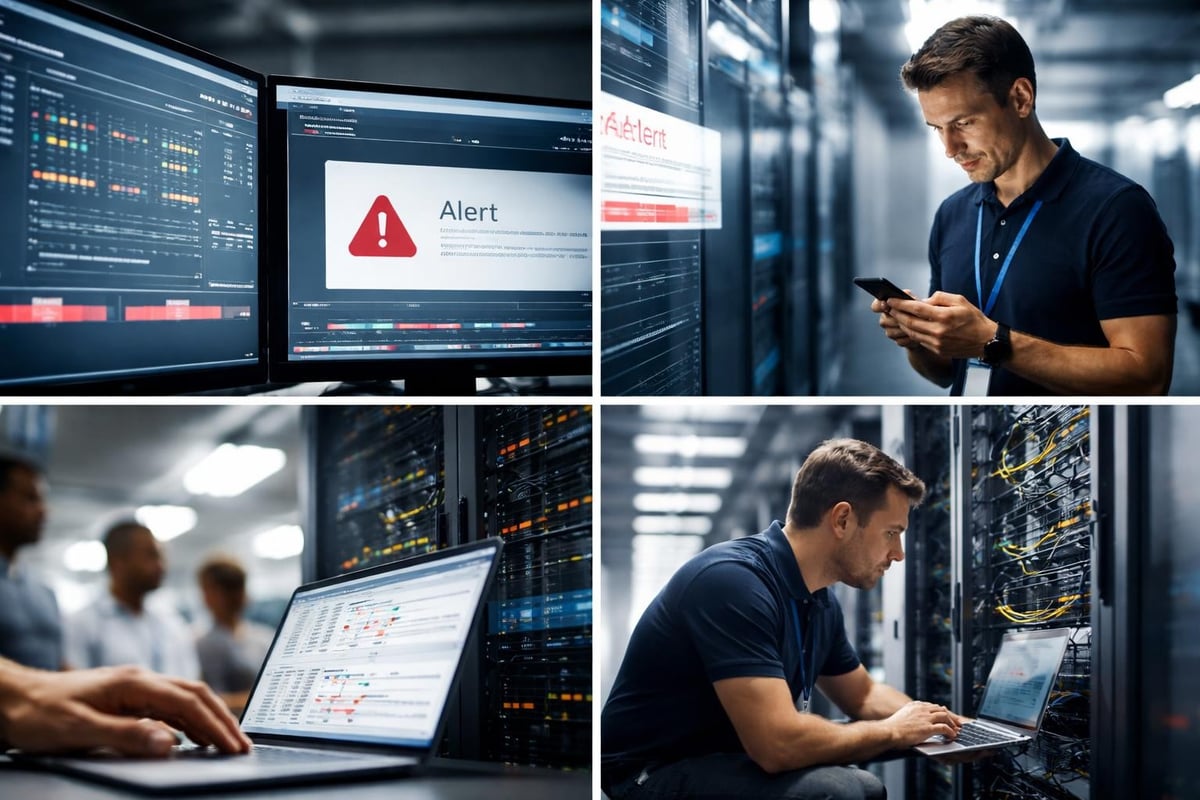
Automated Alert Systems
Advanced monitoring tools track hundreds of metrics across your infrastructure. Server performance, network bandwidth utilization, security events, backup completion, and application responsiveness all generate data streams that intelligent systems analyze continuously.
When metrics drift outside normal parameters, automated alerts notify technicians who investigate and resolve issues. A server running hot due to dust accumulation gets cleaned before it fails. Network congestion patterns trigger capacity planning discussions before slowdowns impact productivity. Failed backup jobs get corrected immediately rather than discovered during a disaster recovery scenario.
Predictive Maintenance Capabilities
Machine learning algorithms now analyze historical performance data to predict potential failures before they occur. Hard drives showing early warning signs get replaced proactively. Aging network equipment gets scheduled for replacement during planned maintenance windows rather than failing unexpectedly.
This predictive approach minimizes unplanned downtime, which represents the most expensive IT problem businesses face. According to research on managed services, proactive monitoring reduces downtime by 60-80% compared to reactive support models.
The productivity gains extend beyond avoiding disruptions. Employees work more efficiently when technology consistently performs well. Frustration decreases, satisfaction improves, and staff can focus on productive work rather than IT workarounds.
Cloud Services and Infrastructure Optimization
Cloud computing has matured from an emerging trend to a fundamental infrastructure component. Managed IT consulting services help businesses navigate the complex cloud landscape, optimizing workload placement and cost management.
Hybrid Infrastructure Strategy
Few businesses operate entirely in the cloud or completely on-premises. Most benefit from hybrid approaches where certain applications and data reside in cloud environments while others remain local. Determining optimal workload placement requires expertise in application architecture, compliance requirements, performance needs, and cost modeling.
Email and collaboration tools typically migrate to cloud platforms like Microsoft 365, where providers manage underlying infrastructure and deliver continuous updates. This shift eliminates server maintenance while improving accessibility and disaster recovery capabilities.
Specialized applications, databases with specific performance requirements, or systems with compliance restrictions often remain on-premises or in private cloud environments. Managed providers architect these hybrid solutions ensuring seamless integration and consistent security across all environments.
Cost Optimization and License Management
Cloud services offer tremendous flexibility but can become expensive without proper management. Managed IT consulting services include ongoing cost optimization where providers analyze usage patterns, right-size resources, and eliminate waste.
License management represents another area where expertise delivers significant value. Microsoft, Adobe, and other major software vendors offer complex licensing models with various options and compliance requirements. Providers ensure businesses purchase appropriate licenses, maintain compliance, and avoid both over-licensing that wastes money and under-licensing that creates legal risks.
Cybersecurity Integration Throughout IT Operations
The comprehensive nature of IT consulting services in 2026 means security considerations permeate every aspect of technology management rather than existing as a separate function.
Multi-Layered Security Frameworks
Effective security employs multiple defensive layers so that if one fails, others prevent breaches. Network firewalls filter incoming traffic, intrusion detection systems identify suspicious patterns, endpoint protection secures individual devices, and email filtering blocks phishing attempts.
| Security Layer | Primary Function | Example Technologies |
|---|---|---|
| Perimeter | Block external threats | Firewall, IPS/IDS |
| Network | Segment and monitor internal traffic | VLANs, network monitoring |
| Endpoint | Protect individual devices | Antivirus, EDR solutions |
| Application | Secure software and data access | Authentication, encryption |
| Data | Protect information at rest and in transit | Encryption, DLP tools |
| Human | Train users to recognize threats | Security awareness training |
User training addresses the human element, which remains the weakest link in most security frameworks. Regular training helps employees recognize phishing emails, use strong passwords, and follow security policies. Simulated phishing campaigns test awareness and provide targeted education for vulnerable users.
Incident Response and Recovery
Despite best efforts, security incidents still occur. Managed providers maintain detailed incident response plans that minimize damage and accelerate recovery. These plans define specific procedures for different incident types, assign responsibilities, and establish communication protocols.
Regular testing through tabletop exercises ensures everyone understands their roles during actual incidents. Providers also maintain relationships with forensic specialists, legal counsel, and law enforcement agencies that may become necessary during serious breaches.
Data Backup and Disaster Recovery Planning
Business continuity depends on comprehensive backup strategies and tested recovery procedures. Managed IT consulting services implement and maintain these critical safeguards, ensuring businesses can survive data loss events.
The 3-2-1 Backup Rule
Industry best practices recommend maintaining three copies of critical data on two different media types with one copy stored off-site. This approach protects against hardware failures, natural disasters, ransomware attacks, and human errors.
Modern implementations typically include local backups for quick recovery of individual files, on-site snapshots for rapid system restoration, and cloud-based backups for disaster recovery. Automated backup processes run daily or even hourly for critical systems, ensuring minimal data loss potential.
Regular Recovery Testing
Backups provide no value if they cannot be restored. Managed providers conduct regular recovery tests, actually restoring data and systems in test environments to verify backup integrity and measure recovery times. These tests identify problems before emergencies occur and validate that Recovery Time Objectives (RTO) and Recovery Point Objectives (RPO) remain achievable.
Documentation of recovery procedures ensures that staff can execute restoration even under stressful emergency conditions. Step-by-step guides, contact information, and decision trees provide clear direction during crises.
Measuring Return on Investment from Managed Services
Business leaders naturally want to understand the financial impact of managed IT consulting services. While some benefits like improved security and compliance are difficult to quantify precisely, several metrics demonstrate clear return on investment.
Productivity Improvements
Reduced downtime directly translates to productivity gains. If a 20-person organization experiences 10 hours less downtime annually and average fully-loaded employee costs reach $50 per hour, that represents $10,000 in avoided lost productivity. Most businesses experience far more significant improvements.
Faster issue resolution means employees spend less time waiting for IT support. When help desk response times drop from hours to minutes and resolution times decrease substantially, the cumulative productivity impact across an organization becomes significant.
Risk Mitigation Value
Cybersecurity incidents cost small businesses an average of $200,000 according to recent studies, and many companies never fully recover. While assigning precise value to avoided breaches proves challenging, the risk mitigation managed services provide represents substantial financial protection.
Compliance violations carry serious penalties. Healthcare organizations face HIPAA fines up to $1.5 million per violation category annually. Financial services firms risk similar penalties for PCI-DSS non-compliance. Managed providers ensure compliance, protecting businesses from these regulatory risks.
- Calculate total IT costs before and after managed services implementation
- Measure downtime hours and associated productivity losses
- Track help desk ticket resolution times and volumes
- Assess security incident frequency and severity
- Review compliance audit results and findings
- Survey employee satisfaction with IT services
Technology Investment Optimization
Managed providers help businesses avoid costly mistakes like purchasing unnecessary equipment, implementing incompatible solutions, or under-investing in critical areas. Strategic guidance ensures technology spending aligns with business needs and delivers appropriate return.
Extended equipment lifecycles through proper maintenance reduce capital expenditure requirements. Proactive monitoring and maintenance help hardware and software systems last longer while maintaining performance, deferring replacement costs.
Local Expertise and Regional Technology Challenges
While technology transcends geography in many ways, local expertise offers distinct advantages for businesses seeking managed IT consulting services. Regional providers understand area-specific challenges, maintain relationships with local vendors, and provide hands-on support when needed.
On-Site Support Capabilities
Some situations require physical presence. Network equipment installations, hardware upgrades, and certain troubleshooting scenarios benefit from technicians who can arrive quickly. Local providers offer this accessibility, which becomes especially valuable during critical situations.
Regional knowledge extends to understanding local internet service providers, telecommunications infrastructure, and vendor ecosystems. This familiarity accelerates problem resolution when issues involve external providers and helps navigate regional technology limitations.
Community Integration and Accountability
Local providers maintain reputations within their communities, creating additional accountability beyond contractual obligations. These businesses participate in regional business networks, understand local industries, and often provide customized service reflecting community values.
Relationships with other local businesses create knowledge-sharing opportunities. Providers working with multiple companies in similar industries develop deep expertise in sector-specific technology challenges and solutions. This concentrated experience benefits all clients through improved service and innovative problem-solving.
Future-Proofing Business Technology Infrastructure
Technology evolution accelerates continuously, making future-proofing strategies essential for protecting investments and maintaining competitiveness. Managed IT consulting services help businesses anticipate changes and prepare for emerging technologies.
Emerging Technology Assessment
Artificial intelligence, advanced automation, edge computing, and other emerging technologies create both opportunities and challenges. Managed providers monitor technology trends, assess relevance to client businesses, and recommend adoption timelines that balance innovation with stability.
Early adoption carries risks including immature solutions, compatibility issues, and wasted investment in technologies that fail to gain traction. Conversely, delayed adoption allows competitors to gain advantages. Providers help businesses navigate this timing challenge through informed recommendations based on industry trends and specific business contexts.
Infrastructure Flexibility
Modern infrastructure design prioritizes flexibility over rigid optimization for current needs. Cloud-native architectures, containerization, software-defined networking, and other approaches enable rapid adaptation as requirements change. Providers architect systems that accommodate growth, technology shifts, and business model evolution without requiring complete replacements.
This flexibility proves particularly valuable for small businesses experiencing rapid growth or market changes. Technology infrastructure that scales smoothly supports business expansion without creating bottlenecks or requiring disruptive migrations.
Selecting the right managed IT consulting services provider transforms technology from a source of complexity and risk into a strategic business advantage that drives productivity, security, and growth. Small businesses particularly benefit from the comprehensive expertise, proactive management, and strategic guidance these partnerships deliver. If your business operates in Lethbridge or surrounding areas and needs reliable IT infrastructure management with fixed-rate pricing that eliminates budget surprises, Delphi Systems Inc. provides the complete managed services platform that keeps your technology running smoothly while you focus on core business activities.

