
Small businesses face an increasingly complex technology landscape in 2026, where maintaining secure and efficient IT infrastructure has become essential for competitive success. An IT services provider delivers specialized expertise, proactive monitoring, and comprehensive support that allows businesses to leverage technology without building expensive in-house IT departments. Understanding how these providers operate and what value they bring helps business owners make informed decisions about their technology partnerships.
Understanding the Role of an IT Services Provider
An IT services provider functions as an external technology department, managing everything from network infrastructure to cybersecurity protocols. These organizations employ certified technicians and system administrators who understand the nuances of modern business technology. Unlike traditional break-fix models where technicians respond only after problems occur, managed services focus on prevention and continuous optimization.
The primary distinction lies in the proactive approach. Rather than waiting for systems to fail, providers monitor networks continuously, identifying potential issues before they impact operations. This shift from reactive to proactive management has transformed how small businesses approach technology.
Core Service Categories
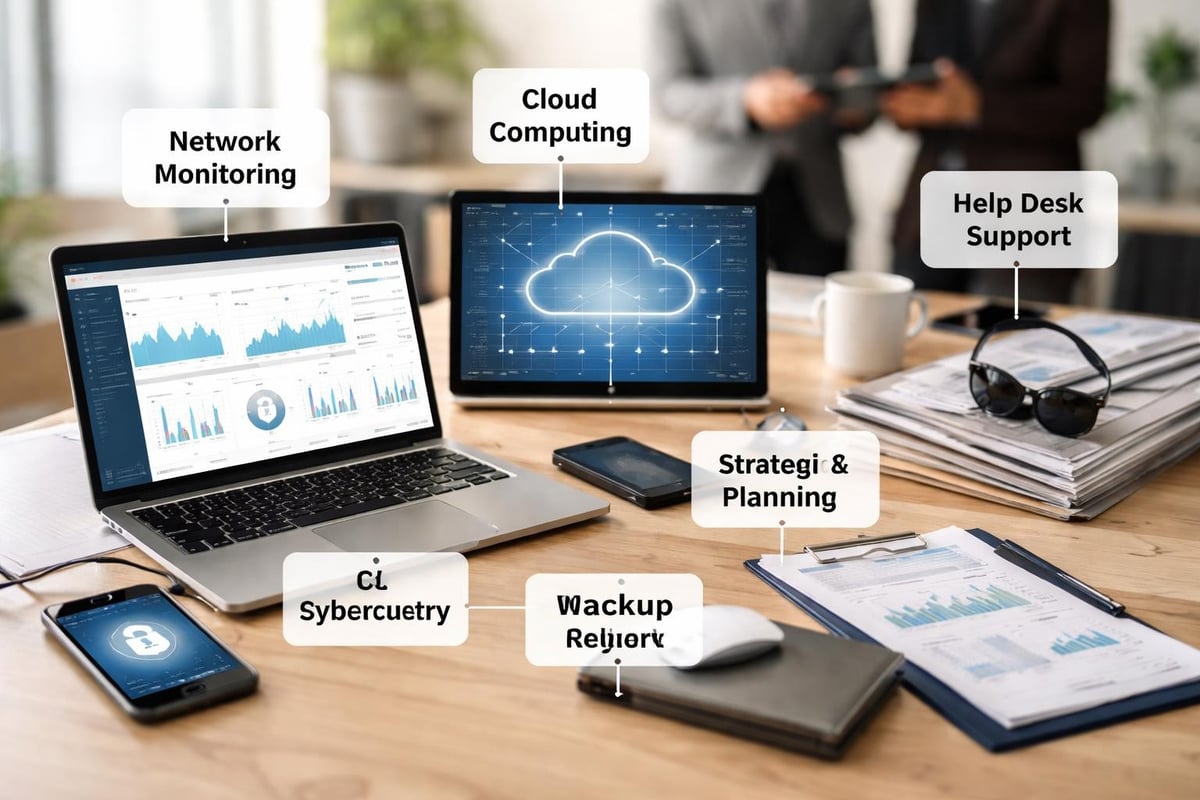
Most comprehensive providers organize their offerings into distinct service categories that address specific business needs:
- Network monitoring and management: Real-time surveillance of all network components, servers, and connected devices
- Cybersecurity protection: Multi-layered defense systems including firewalls, antivirus solutions, and threat detection
- Data backup and disaster recovery: Automated backup systems with tested recovery procedures
- Cloud computing services: Migration, management, and optimization of cloud-based applications and storage
- Help desk support: Responsive technical assistance for end-users experiencing software or hardware issues
- Strategic IT planning: Long-term technology roadmaps aligned with business objectives
Each category addresses critical operational requirements that businesses cannot afford to neglect. The integration of these services creates a comprehensive technology ecosystem that supports growth and productivity.
Benefits of Partnering with an IT Services Provider
The decision to work with an external IT services provider generates measurable advantages across multiple business dimensions. Financial predictability stands among the most significant benefits, as fixed-rate pricing models eliminate surprise expenses associated with emergency repairs or system failures.
Cost efficiency emerges through several mechanisms. Building an in-house IT department requires substantial investment in salaries, benefits, training, and equipment. A single experienced network administrator in Lethbridge might command $70,000 to $90,000 annually, while comprehensive managed services often cost a fraction of that investment.
Enhanced Security and Compliance
Cybersecurity threats have evolved dramatically, with ransomware attacks increasing by 37% year-over-year according to 2026 security reports. An IT services provider maintains current knowledge of threat landscapes and implements layered defense strategies that individual businesses struggle to develop independently.
The Configuration Management Database (CMDB) serves as a critical tool in this security infrastructure, tracking every hardware and software asset while documenting configurations and relationships. This visibility enables faster incident response and more effective security management.
Compliance requirements vary by industry, but most businesses face some level of regulatory obligation regarding data protection. Healthcare organizations must maintain HIPAA compliance, while financial services navigate PCI DSS requirements. Providers understand these frameworks and implement appropriate controls.
| Security Layer | Purpose | Implementation Method |
|---|---|---|
| Perimeter Defense | Block external threats | Next-generation firewalls, intrusion prevention |
| Endpoint Protection | Secure individual devices | Advanced antivirus, application whitelisting |
| Access Control | Manage user permissions | Multi-factor authentication, role-based access |
| Data Encryption | Protect sensitive information | Encryption at rest and in transit |
| Monitoring | Detect anomalies | Security information and event management (SIEM) |
Selecting the Right IT Services Provider
The evaluation process requires systematic assessment of provider capabilities, experience, and cultural fit. Not all IT services providers deliver equivalent value, and choosing poorly can result in frustration and wasted resources.
Start by examining the provider's technical certifications and partnerships. Industry certifications from Microsoft, Cisco, CompTIA, and other vendors demonstrate commitment to professional development and technical competency. These credentials ensure technicians understand current best practices and emerging technologies.
Key Evaluation Criteria
Service level agreements (SLAs) define the relationship between provider and client, establishing clear expectations for response times, resolution periods, and availability guarantees. Review these documents carefully, paying attention to:
- Guaranteed response times for different priority levels
- Specific uptime commitments (typically 99.5% or higher)
- Escalation procedures for unresolved issues
- Performance metrics and reporting frequency
- Penalties or credits for missed SLA targets
Geographic proximity matters for small businesses requiring occasional on-site support. While remote management handles most situations, hardware failures and physical infrastructure issues demand local presence. Providers serving Lethbridge and surrounding areas understand regional business challenges and can respond quickly when physical intervention becomes necessary.
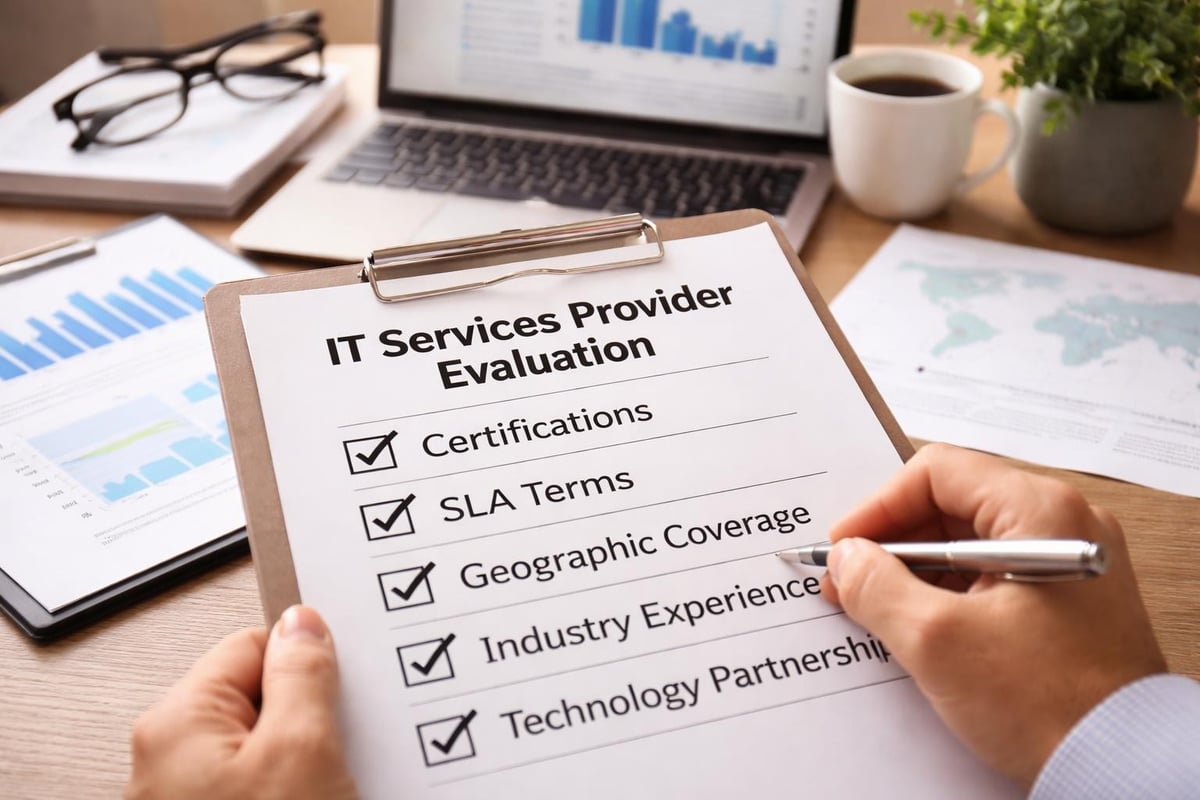
Industry experience provides valuable context. Providers familiar with specific sectors understand common workflows, compliance requirements, and technology preferences. A provider experienced with medical practices knows NPI lookup requirements and HIPAA protocols, while those serving law firms understand legal technology and confidentiality requirements.
Assessing Communication and Support
The quality of communication often predicts relationship success. During the evaluation process, notice how providers explain technical concepts. Effective providers translate complex technology into business language, helping decision-makers understand implications without drowning in jargon.
Support structure deserves close examination. Determine whether you'll work with dedicated account managers or rotate through different technicians. Consistency in support relationships builds knowledge of your specific environment and accelerates problem resolution.
Common Service Models and Pricing Structures
IT services providers typically offer several engagement models designed to match different business needs and budget constraints. Understanding these options helps businesses select the most appropriate arrangement.
Fully managed services represent comprehensive partnerships where the provider assumes responsibility for all IT functions. This model suits businesses lacking internal IT resources or those preferring to outsource technology management entirely. Fixed monthly fees cover unlimited support, monitoring, maintenance, and strategic planning.
Co-managed services combine internal IT staff with external provider expertise. This hybrid approach works well for businesses with one or two IT employees who need specialized support, backup during vacations, or access to advanced skills. The provider supplements rather than replaces internal capabilities.
Pricing Models Comparison
| Model | Structure | Best For | Considerations |
|---|---|---|---|
| Fixed-Rate Monthly | Predictable monthly fee | Businesses wanting budget certainty | Ensure scope is clearly defined |
| Per-Device Pricing | Cost per workstation/server | Growing organizations | Watch for hidden fees on network equipment |
| Tiered Packages | Bronze/Silver/Gold options | Businesses needing flexibility | Compare what's included at each tier |
| Project-Based | One-time fee for specific work | Infrastructure upgrades, migrations | May need ongoing support arrangement |
| Hybrid Models | Fixed base + usage charges | Variable support needs | Understand when overage charges apply |
Fixed-rate fee structures provide the greatest budgetary predictability, essential for small business financial planning. These arrangements transform IT expenses from variable operational costs into fixed overhead, simplifying forecasting and eliminating surprise invoices.
Technology Trends Shaping IT Services
The IT services landscape continues evolving as new technologies emerge and business requirements shift. Providers must adapt their offerings to address these changes while maintaining stability in core infrastructure management.
Cloud computing has transitioned from emerging trend to standard practice. Most businesses now operate hybrid environments combining on-premises infrastructure with cloud-based applications and storage. An effective IT services provider manages this complexity, optimizing workload placement and ensuring seamless integration between environments.
Artificial intelligence and machine learning increasingly influence IT management practices. Automated threat detection systems identify security anomalies faster than human analysts, while predictive analytics forecast hardware failures before they occur. These technologies enhance service quality while reducing costs.
Cybersecurity Evolution
Threat actors continuously develop sophisticated attack methods, forcing defensive strategies to evolve accordingly. Zero-trust security architectures have replaced traditional perimeter-based approaches, assuming no user or device is inherently trustworthy regardless of location.
- Multi-factor authentication becomes standard rather than optional
- Email security addresses phishing through advanced filtering and user training
- Endpoint detection and response provides deeper visibility into device behavior
- Security awareness training transforms employees into defensive assets
- Incident response planning prepares organizations for inevitable breach attempts
The design philosophy behind modern security systems emphasizes comprehensive, authoritative knowledge about network assets and behaviors, enabling faster identification of anomalous activities that might indicate compromise.
Maximizing Value from Your IT Services Partnership
Successful relationships between businesses and their IT services provider require active collaboration rather than passive outsourcing. Business owners who engage strategically with their technology partners achieve superior results.
Establish clear communication channels and regular review meetings. Monthly or quarterly business reviews provide opportunities to assess performance against SLAs, discuss upcoming projects, and align technology investments with business objectives. These sessions ensure the provider understands your evolving needs.
Documentation forms the foundation of effective IT management. Ensure your provider maintains current network diagrams, asset inventories, password vaults, and procedure manuals. This documentation proves invaluable during emergencies and facilitates smooth transitions if circumstances require provider changes.
Strategic Technology Planning
Beyond day-to-day support, leverage your IT services provider's expertise for strategic planning. Technology decisions impact business operations for years, making informed choices critical. Providers familiar with your industry can recommend solutions proven effective in similar environments.
Budget planning benefits from provider input regarding hardware refresh cycles, software licensing requirements, and infrastructure upgrades. Rather than reacting to failures, proactive planning spreads costs across budget cycles and minimizes operational disruptions.
Performance metrics provide objective assessment of service quality. Track key indicators including:
- Average response time for support requests across priority levels
- First-call resolution rate measuring issues solved without escalation
- System uptime percentage compared against SLA guarantees
- Security incident frequency and time-to-resolution
- User satisfaction scores gathered through periodic surveys
These metrics reveal trends and identify areas requiring attention before they escalate into significant problems.

Industry-Specific IT Service Considerations
Different industries face unique technology requirements that general IT services providers may overlook. Healthcare organizations navigate HIPAA compliance while managing electronic health records and medical devices. Legal firms require sophisticated document management and e-discovery capabilities alongside strict confidentiality controls.
Retail businesses need point-of-sale system integration, inventory management, and payment processing security. Manufacturing companies rely on operational technology networks connecting production equipment, requiring specialized knowledge beyond traditional IT infrastructure.
When evaluating providers, assess their experience with businesses similar to yours. Ask for case studies or references demonstrating successful engagements within your industry. This experience accelerates implementation and reduces learning curves.
Regulatory Compliance Support
Compliance represents a growing concern across industries. An IT services provider familiar with relevant regulations helps businesses implement required controls and maintain documentation proving compliance during audits.
Financial services must demonstrate adherence to banking regulations and payment card industry standards. Professional services firms face data protection requirements and professional liability considerations. Your provider should understand these obligations and incorporate compliance into service delivery.
Remote Work and Distributed Team Support
The shift toward remote and hybrid work arrangements has permanently altered IT service requirements. Businesses now support employees working from homes, coffee shops, and client locations rather than centralized offices. This distribution complicates security, support, and infrastructure management.
Modern IT services providers implement technologies enabling secure remote access, including virtual private networks (VPNs), virtual desktop infrastructure (VDI), and cloud-based collaboration platforms. These tools maintain productivity while protecting business data across diverse locations.
Endpoint management becomes critical when devices operate outside traditional network perimeters. Mobile device management (MDM) platforms enforce security policies, encrypt data, and enable remote wipe capabilities if devices are lost or stolen. Your provider should implement comprehensive endpoint protection regardless of device location.
Support accessibility matters for distributed teams. Help desk services must accommodate users across time zones and work schedules, offering multiple contact methods including phone, email, chat, and self-service portals. Response times should remain consistent regardless of user location.
Scaling IT Infrastructure with Business Growth
Business growth creates technology challenges that unprepared organizations struggle to address. An effective IT services provider anticipates scaling requirements and implements infrastructure capable of supporting expansion without costly replacements or major disruptions.
Capacity planning evaluates current resource utilization and projects future needs based on growth trajectories. This analysis identifies when server upgrades, bandwidth increases, or storage expansions become necessary, allowing proactive procurement before performance degrades.
Cloud infrastructure offers particular advantages for growing businesses. Resources scale elastically, matching capacity to demand without large capital investments. Your provider should recommend optimal cloud strategies balancing performance, cost, and control.
| Growth Stage | IT Priorities | Provider Role |
|---|---|---|
| Startup (1-10 employees) | Cost-effective basics, flexibility | Cloud-first strategy, essential security |
| Small Business (11-50) | Reliability, security, productivity tools | Managed services, backup, email systems |
| Growth Phase (51-100) | Scalability, advanced security, compliance | Infrastructure planning, specialized services |
| Established (100+) | Optimization, integration, innovation | Strategic consulting, process automation |
As businesses add locations, IT services providers coordinate network connectivity, ensure consistent security policies, and maintain centralized management visibility. Multi-site support requires sophisticated tools and procedures that inexperienced providers may lack.
Data Backup and Disaster Recovery Planning
Data loss events resulting from hardware failures, cyberattacks, natural disasters, or human error can devastate unprepared businesses. Comprehensive backup and recovery strategies represent non-negotiable components of responsible IT management.
Your IT services provider should implement the 3-2-1 backup rule: three copies of data, on two different media types, with one copy stored off-site. This redundancy protects against various failure scenarios while maintaining recovery options.
Recovery time objectives (RTO) and recovery point objectives (RPO) define acceptable downtime and data loss parameters for different systems. Mission-critical applications require aggressive RTOs measured in minutes or hours, while less critical systems tolerate longer recovery periods. Your provider must understand these requirements and architect solutions accordingly.
Regular testing validates backup integrity and recovery procedures. Many businesses discover backup failures only when attempting restoration during emergencies. Quarterly or semi-annual recovery tests ensure systems function as intended and staff understand procedures.
Business continuity planning extends beyond technical recovery, addressing how operations continue during disruptions. Your IT services provider contributes technology components while business leadership defines operational priorities and acceptable risk levels.
Selecting and partnering with an IT services provider represents a strategic decision that influences every aspect of business operations. The right provider delivers reliable infrastructure, robust security, and strategic guidance that enables growth while controlling costs. For businesses in Lethbridge and surrounding areas seeking comprehensive IT management, Delphi Systems Inc. offers fixed-rate managed services covering network monitoring, cybersecurity, cloud computing, backup solutions, and responsive support that keeps your technology running smoothly while you focus on growing your business.

