
Organizations today face an unprecedented volume of cyber threats, data breaches, and compliance requirements. Implementing a robust information security and management system has become essential for businesses of all sizes, particularly small enterprises that often lack dedicated security teams. This structured approach to managing sensitive company information combines policies, procedures, technology controls, and human resources to protect critical data assets while ensuring business continuity and regulatory compliance.
Understanding the Information Security and Management System Framework
An information security and management system (ISMS) represents a systematic approach to managing sensitive company information so that it remains secure. This framework encompasses people, processes, and IT systems by applying a risk management process. Rather than treating security as a series of isolated technical solutions, an ISMS creates an integrated structure that aligns information security with business objectives.
The foundation of any effective ISMS rests on three core principles known as the CIA Triad:
- Confidentiality ensures that information is accessible only to those authorized to have access
- Integrity maintains the accuracy and completeness of information and processing methods
- Availability ensures that authorized users have access to information and associated assets when required
These principles guide every decision within the information security and management system, from selecting technical controls to developing security policies. Understanding information security management requires recognizing how these elements work together to create a comprehensive protection strategy.

Building Your ISMS: The ISO 27001 Standard
ISO 27001 represents the international standard for implementing an information security and management system. This framework provides a proven methodology that organizations worldwide use to establish, implement, maintain, and continually improve their information security posture. The standard applies to organizations of any size or industry, making it particularly valuable for small businesses seeking a scalable approach to security.
Key Components of ISO 27001
The standard structures the ISMS around several critical components. The context of the organization defines internal and external factors affecting information security objectives. Leadership commitment ensures that management actively supports and resources the security program. Planning activities identify risks and opportunities while establishing measurable security objectives.
| ISMS Component | Primary Function | Business Impact |
|---|---|---|
| Risk Assessment | Identify and evaluate threats | Prioritizes security investments |
| Security Controls | Implement protective measures | Reduces vulnerability exposure |
| Policy Framework | Define security requirements | Guides consistent decision-making |
| Monitoring & Review | Track performance metrics | Enables continuous improvement |
| Internal Audits | Verify compliance | Identifies gaps before certification |
The Statement of Applicability (SOA) serves as a crucial document within your information security and management system. This statement identifies which of the 93 Annex A controls apply to your organization based on your risk assessment results. Not every control will be necessary for every business, and the SOA justifies both inclusions and exclusions.
Implementation Phases
Implementing ISO 27001 follows a structured progression. The initial scoping phase determines which parts of your organization the ISMS will cover. For small businesses in Lethbridge, this might include your entire operation or specific departments handling sensitive customer data.
A comprehensive ISO 27001 implementation guide details how to conduct thorough risk assessments. This process identifies assets, threats, vulnerabilities, and their potential impacts on your business operations. Your risk treatment plan then outlines how you'll address each identified risk through controls, acceptance, transfer, or avoidance.
Practical Steps for ISMS Implementation
Establishing an effective information security and management system requires methodical execution. While the process may seem overwhelming initially, breaking it into manageable phases makes implementation achievable even for organizations with limited resources.
Phase One: Foundation Building
Begin by securing executive commitment and assigning clear responsibilities. Designate an ISMS project manager who will coordinate activities and serve as the primary point of contact. Form a cross-functional team including representatives from IT, operations, human resources, and management.
Define your ISMS scope carefully. Consider:
- Physical locations covered by the system
- Organizational units and departments included
- Technologies and information assets within scope
- Interfaces with external parties and suppliers
- Regulatory and contractual obligations
Document your information security policy at a high level. This policy communicates management's commitment to information security and provides the framework for setting objectives. Keep it concise but comprehensive, addressing your approach to risk management, legal compliance, and continuous improvement.
Phase Two: Risk Assessment and Treatment
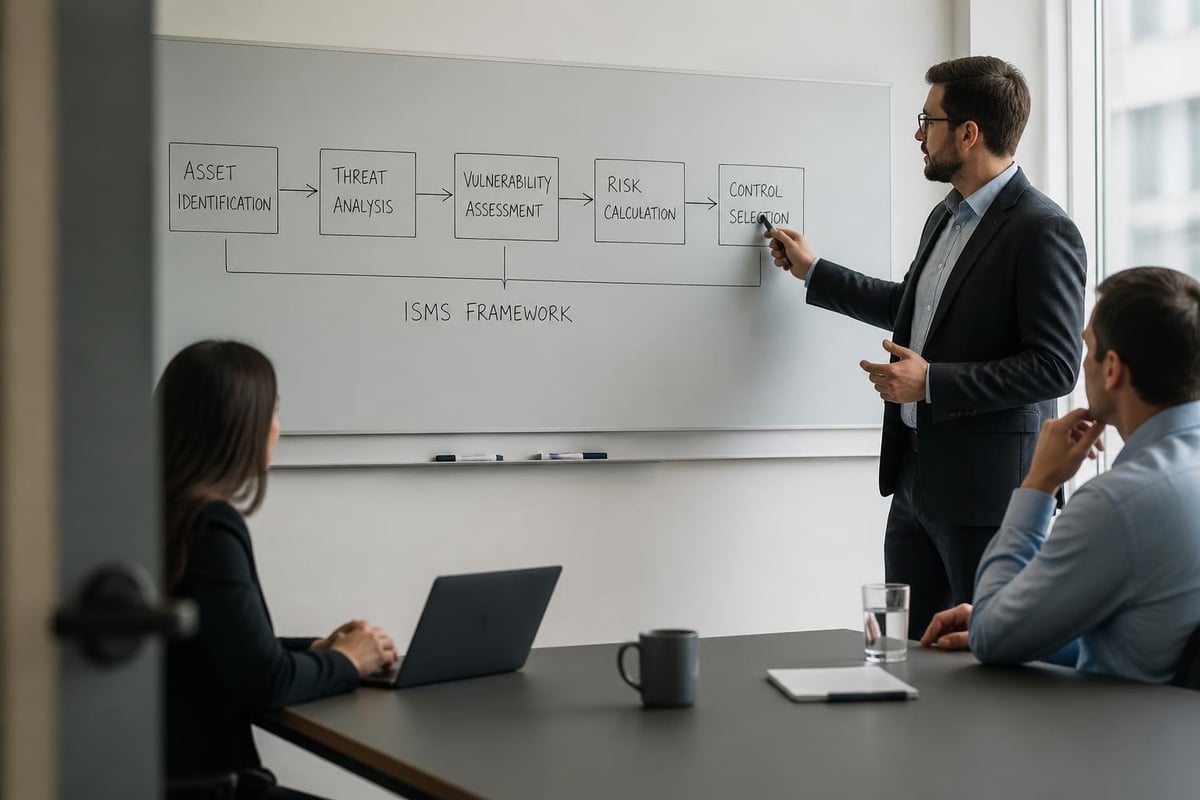
The risk assessment forms the heart of your information security and management system. Start by creating an inventory of information assets including databases, applications, hardware, documents, and intellectual property. For each asset, identify who owns it, where it's stored, and its value to your business operations.
Following the ISO 27001 implementation steps helps structure your risk analysis. Evaluate threats such as cyberattacks, hardware failures, human error, and natural disasters. Assess existing controls and determine residual risk levels.
Your risk treatment plan documents how you'll address unacceptable risks. Common treatment options include:
- Implementing new controls such as encryption, access controls, or monitoring systems
- Accepting low-level risks that fall within your risk appetite
- Transferring risks through cyber insurance or contractual agreements
- Avoiding risks by eliminating certain activities or technologies
Technical and Organizational Controls
An information security and management system balances technical safeguards with organizational measures. Neither approach alone provides adequate protection; both must work in concert to create a defense-in-depth strategy.
Technical Security Controls
Technical controls leverage technology to protect information assets. Access control mechanisms ensure that users can only access data necessary for their job functions. Implementation includes user authentication through strong passwords or multi-factor authentication, authorization based on role-based access control, and audit logging to track access attempts.
Network security controls protect data in transit and prevent unauthorized access to systems. Firewalls filter traffic based on security rules, intrusion detection systems monitor for suspicious activity, and virtual private networks encrypt remote connections. For small businesses in Lethbridge, these controls often integrate with cloud computing platforms to provide enterprise-grade protection.
Encryption transforms readable data into an unreadable format without the proper decryption key. Apply encryption to:
- Data at rest on servers, workstations, and mobile devices
- Data in transit across networks and the internet
- Backup media stored onsite or offsite
- Email communications containing sensitive information
Organizational Security Measures
Policies and procedures provide the human element of your information security and management system. Develop clear, understandable documents covering acceptable use, password management, incident response, business continuity, and vendor management. These policies translate your security objectives into actionable guidance for employees.
Security awareness training ensures that staff understand their role in protecting information. Regular training should cover phishing recognition, social engineering tactics, secure password practices, and incident reporting procedures. Statistics show that human error contributes to the majority of data breaches, making this organizational control critical.
| Control Category | Examples | Implementation Priority |
|---|---|---|
| Access Management | User provisioning, role assignments, access reviews | High |
| Change Management | Software updates, configuration control, testing | High |
| Incident Response | Detection, containment, recovery, lessons learned | High |
| Physical Security | Facility access, equipment protection, disposal | Medium |
| Supplier Management | Vendor assessments, contract reviews, monitoring | Medium |
Monitoring, Measurement, and Continuous Improvement
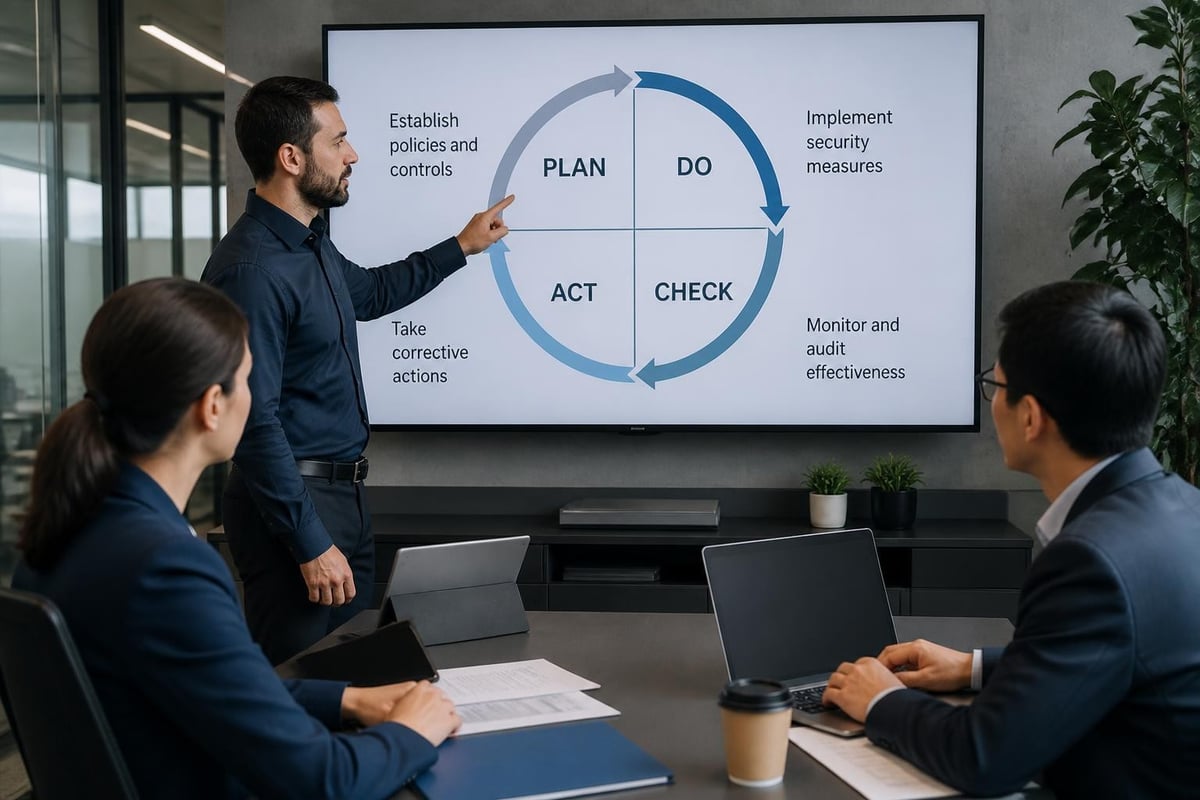
Your information security and management system must evolve as threats change and your business grows. Establishing metrics and monitoring processes enables you to track security performance and identify improvement opportunities.
Performance Metrics
Define key performance indicators (KPIs) that measure ISMS effectiveness. Common metrics include the number of security incidents, time to detect and respond to incidents, percentage of employees completing security training, and results of vulnerability assessments. These measurements provide objective evidence of your security posture.
Leading indicators predict potential security issues before they occur. Track metrics such as patching compliance rates, failed login attempts, and security configuration compliance. Lagging indicators measure events that have already happened, including breach incidents, audit findings, and downtime due to security events.
Internal Audits and Management Reviews
Conduct internal audits at planned intervals to verify that your information security and management system conforms to ISO 27001 requirements. Audits examine whether controls operate effectively, policies reflect current practices, and documentation remains current. The guide to implementing the ISO 27001 standard emphasizes the importance of audit programs in maintaining certification.
Management review meetings provide forums for executives to evaluate ISMS performance. Review audit results, security incidents, performance metrics, and changes in the business or threat landscape. These sessions result in decisions about necessary resources, policy updates, and strategic direction for information security.
Certification Process and Benefits
While certification to ISO 27001 remains optional, achieving this recognition demonstrates your commitment to information security. The certification process validates that your information security and management system meets international standards and operates effectively.
The Certification Journey
External certification involves two audit stages. Stage 1 reviews your ISMS documentation, including policies, procedures, risk assessments, and the Statement of Applicability. Auditors verify that your system design aligns with ISO 27001 requirements and that you're ready for the implementation audit.
Stage 2 examines how your ISMS operates in practice. Auditors interview staff, observe processes, review records, and test controls. They assess whether your organization follows documented procedures and whether controls effectively mitigate identified risks. Following the ISO 27001 implementation checklist helps ensure readiness for this rigorous examination.
Certification Advantages
Achieving ISO 27001 certification delivers tangible business benefits beyond improved security. Many organizations require vendors to demonstrate certified information security practices before sharing sensitive data. Certification can open doors to new business opportunities and strengthen existing client relationships.
Competitive differentiation becomes increasingly important in crowded markets. Small businesses in Lethbridge can leverage certification to stand apart from competitors who lack formal security frameworks. Insurance providers may offer reduced premiums for cyber liability coverage when you demonstrate robust security controls through certification.
Regulatory compliance simplifies when your information security and management system addresses multiple requirements simultaneously. ISO 27001 controls often satisfy obligations under privacy laws, industry regulations, and contractual requirements. This integrated approach reduces compliance complexity and cost.
Common Implementation Challenges
Organizations frequently encounter obstacles when establishing an information security and management system. Recognizing these challenges in advance enables proactive planning and mitigation strategies.
Resource constraints affect small businesses particularly acutely. Limited budgets, small IT teams, and competing priorities can slow ISMS implementation. Address this by:
- Phasing implementation to spread costs over time
- Leveraging cloud-based security services that reduce capital expenses
- Focusing initially on high-risk areas rather than attempting comprehensive coverage
- Partnering with managed IT service providers who offer security expertise
Resistance to change emerges when employees perceive new security controls as obstacles to productivity. Combat this through clear communication about why changes matter, involving staff in developing practical procedures, and demonstrating leadership commitment. Security should enable business operations, not hinder them.
Documentation requirements can overwhelm organizations new to formal management systems. The nine-step guide to implementing ISO 27001 recommends starting with essential documents and expanding over time. Templates and toolkits accelerate development while ensuring you address all necessary elements.
Aligning ISMS With Business Operations
Your information security and management system succeeds when it integrates seamlessly with how your business actually operates. Security controls that conflict with business processes will be circumvented, rendering them ineffective. Design your ISMS to support business objectives while managing risk appropriately.
Risk-Based Decision Making
Not all information requires the same level of protection. Apply stronger controls to high-value or high-sensitivity assets while using lighter-touch measures for lower-risk information. This proportionate approach optimizes your security investment and maintains operational efficiency.
For businesses offering cloud computing services, the ISMS must address specific risks associated with multi-tenant environments, data residency, and service availability. Data backup and recovery procedures receive particular attention, ensuring that both your organization and your clients can recover from incidents.
Integration With Other Management Systems
Many organizations operate multiple management systems covering quality, environmental management, and occupational health and safety. ISO 27001 uses the same high-level structure as other ISO management system standards, facilitating integration. Combined audits, shared documentation, and aligned processes reduce overhead while maintaining effectiveness.
Your information security and management system should reference and complement existing business processes rather than creating parallel structures. Incorporate security considerations into change management, vendor selection, project management, and other established workflows. This integration ensures security becomes part of "how we do things" rather than an additional burden.
Small Business ISMS Considerations
Small businesses face unique challenges and opportunities when implementing an information security and management system. Limited resources must be deployed strategically to achieve meaningful security improvements without overwhelming the organization.
Scale your ISMS appropriately to your business size and complexity. A 10-person company doesn't need the same documentation depth as a multinational corporation. Focus on:
- Clear, concise policies that staff can actually read and understand
- Practical procedures aligned with daily operations
- Controls that address your specific risk profile
- Streamlined documentation that avoids unnecessary complexity
Leverage managed IT services to access expertise and capabilities beyond internal resources. Providers specializing in cybersecurity, network monitoring, and IT support can implement and maintain technical controls more cost-effectively than hiring full-time specialists. This approach allows you to focus on core business activities while ensuring robust information security.
The ISO 27001 implementation roadmap suggests realistic timeframes based on organizational size. Small businesses typically complete implementation in 6-12 months, balancing thoroughness with resource constraints. Rushing the process leads to superficial implementation, while excessive delays allow momentum to dissipate.
Future-Proofing Your ISMS
Technology evolves rapidly, threats constantly emerge, and business requirements shift. Building adaptability into your information security and management system ensures it remains effective over time without requiring complete overhauls.
Stay informed about emerging threats and vulnerabilities affecting your industry and technology stack. Subscribe to security bulletins, participate in information sharing communities, and maintain relationships with security vendors and service providers. This intelligence feeds into your risk assessment updates and control refinements.
Plan for scalability as your business grows. Your ISMS should accommodate new locations, additional employees, expanded services, and increased data volumes without fundamental restructuring. Cloud-based infrastructure and standardized processes facilitate this growth while maintaining security standards.
Review and update your information security and management system regularly. Annual reviews should examine policy relevance, control effectiveness, risk assessment accuracy, and alignment with business strategy. More frequent reviews may be necessary when significant changes occur in technology, regulations, or business operations.
Implementing a comprehensive information security and management system protects your critical business assets while demonstrating your commitment to clients and partners. The structured approach provided by frameworks like ISO 27001 makes enterprise-grade security achievable for organizations of all sizes. Delphi Systems Inc. helps Lethbridge businesses establish and maintain robust information security through managed IT services, cybersecurity solutions, and expert guidance tailored to small business needs. Contact Delphi Systems Inc. today to learn how we can secure your IT infrastructure while you focus on growing your business.

