

Modern small businesses face an uncomfortable reality: cyber threats are no longer a matter of if but when. For businesses in Lethbridge and similar communities, where local enterprises form the economic backbone, a single ransomware attack or data breach can mean the difference between resilience and closure. Business continuity cyber security represents the intersection where operational preparedness meets digital defense, ensuring that when cyber incidents occur, your business doesn't just survive but continues serving customers with minimal disruption. This comprehensive approach goes beyond traditional cybersecurity measures by integrating threat prevention with recovery planning, creating a framework that protects both your data and your business operations.
Understanding Business Continuity Cyber Security
Business continuity cyber security merges two critical disciplines into a unified strategy. Traditional business continuity planning focuses on maintaining operations during any disruption, whether natural disasters, power outages, or equipment failures. Cybersecurity, meanwhile, concentrates on protecting digital assets from unauthorized access, breaches, and attacks.
When combined, these disciplines create a powerful framework that acknowledges modern reality: most business disruptions now have a cyber component.
The Modern Threat Landscape
Small businesses represent prime targets for cybercriminals precisely because they often lack enterprise-level security resources. Attackers know this vulnerability and exploit it systematically. The UK Government’s Cyber Security Breaches Survey 2025/2026 reveals concerning gaps in how organizations integrate continuity planning with cybersecurity measures, particularly among smaller enterprises.
Common cyber threats affecting business continuity include:
- Ransomware attacks that encrypt critical business data
- Distributed Denial of Service (DDoS) attacks that disrupt online operations
- Data breaches compromising customer information and trust
- Phishing campaigns targeting employee credentials
- Supply chain attacks affecting third-party vendors
Recovery times matter significantly. According to the SANS 2025 State of ICS/OT Security Report, many organizations experience substantial recovery lags after cyber incidents, emphasizing the critical need for integrated continuity and recovery planning.

Building a Business Continuity Cyber Security Framework
Creating an effective framework requires systematic planning that addresses both prevention and recovery. This approach ensures your business maintains operations even when facing sophisticated cyber threats.
Risk Assessment and Business Impact Analysis
Start by identifying which systems and data are most critical to your operations. Not all disruptions carry equal weight. A cash register system failure affects operations differently than an email server outage.
The NIST framework for Using Business Impact Analysis provides valuable guidance on extending traditional impact analysis to inform risk prioritization in cybersecurity contexts. This methodology helps small businesses focus limited resources where they matter most.
| Asset Type | Business Impact | Recovery Priority | Protection Level |
|---|---|---|---|
| Customer Database | Critical – Revenue Generation | High (4 hours) | Maximum |
| Email System | High – Communication | Medium (24 hours) | High |
| Website | High – Customer Acquisition | Medium (12 hours) | High |
| Internal Documents | Medium – Productivity | Low (48 hours) | Medium |
| Employee Workstations | Medium – Daily Operations | Medium (24 hours) | Medium |
Developing Response and Recovery Protocols
Once you understand your vulnerabilities, establish clear protocols for responding to incidents. These protocols should specify who does what, when they do it, and how they communicate during a crisis.
Essential protocol components:
- Incident detection and classification procedures
- Communication chains and notification requirements
- Containment strategies to prevent spread
- Recovery steps with specific timelines
- Post-incident review and improvement processes
CISA's Cyber Resilience Review Supplemental Resource Guide outlines foundational activities for managing disruption risk, providing a standard-agnostic framework that small businesses can adapt to their specific needs.
Data Backup and Recovery as Continuity Cornerstones
No business continuity cyber security strategy succeeds without robust backup and recovery capabilities. When ransomware encrypts your files or a breach requires system rebuilding, backups become your lifeline.
The 3-2-1 Backup Rule in Practice
This time-tested approach remains relevant in 2026. Maintain three copies of your data, stored on two different media types, with one copy kept offsite. For small businesses, this typically means:
- Primary data on production servers
- Local backup on network-attached storage or separate servers
- Cloud backup in geographically separate data centers
Modern backup strategies must account for cloud dependencies. The SANS whitepaper on Resiliency and Business Continuity in the Cloud Era examines critical risks when cloud-based services fail, highlighting the importance of maintaining backup independence from primary cloud providers.
Recovery Time and Recovery Point Objectives
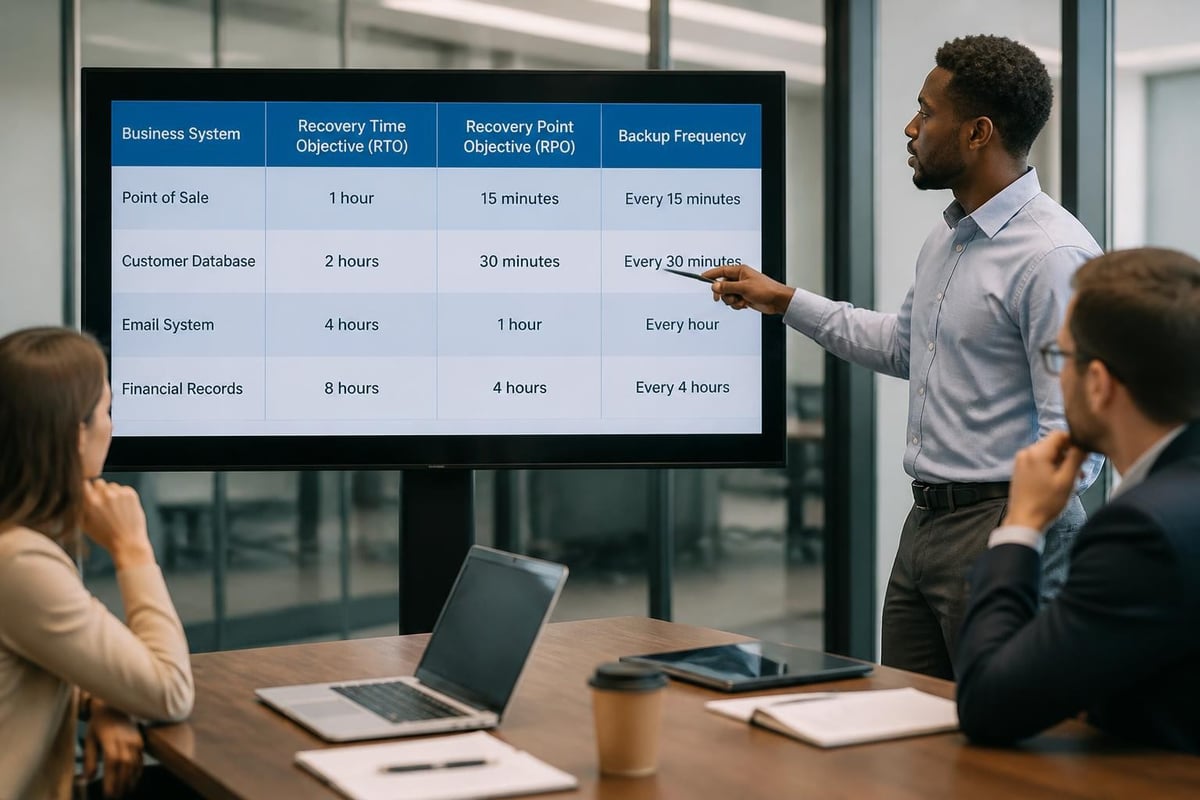
Define acceptable downtime (RTO – Recovery Time Objective) and data loss (RPO – Recovery Point Objective) for each critical system. These metrics drive backup frequency and recovery procedures.
| Business Function | RTO | RPO | Backup Frequency |
|---|---|---|---|
| Point of Sale | 4 hours | 1 hour | Continuous replication |
| Customer Communications | 12 hours | 4 hours | Every 4 hours |
| Financial Records | 24 hours | 24 hours | Daily |
| Marketing Materials | 72 hours | 1 week | Weekly |
Network Monitoring and Threat Detection
Effective business continuity cyber security requires continuous vigilance. You cannot respond to threats you do not detect, and early detection dramatically reduces impact severity.
Real-Time Monitoring Capabilities
Modern managed IT services implement multilayered monitoring that watches for anomalies across your network. This includes tracking unusual login patterns, abnormal data transfers, unexpected system changes, and suspicious network traffic.
Small businesses benefit enormously from managed detection and response services that provide enterprise-grade monitoring without requiring internal security teams. These services monitor your systems around the clock, identifying threats before they escalate into business-disrupting incidents.
Key monitoring components include:
- Network traffic analysis for unusual patterns
- Endpoint detection and response on workstations and servers
- Log aggregation and analysis for security events
- Vulnerability scanning to identify weaknesses
- User behavior analytics to spot compromised accounts
Incident Response Integration
Detection means nothing without appropriate response. Your monitoring systems should trigger predefined response protocols automatically when possible, escalating to human decision-makers for complex situations.
According to the Business Continuity Institute’s Continuity & Resilience Report 2025, organizations are shifting toward effects-based preparedness rather than tick-box compliance, emphasizing practical response capabilities over documentation alone.
Cloud Security and Business Continuity
Cloud computing offers tremendous advantages for small businesses, but it introduces unique business continuity cyber security considerations. Your data resides in third-party infrastructure, creating dependencies that require careful management.
Multi-Cloud and Hybrid Strategies
Avoid single points of failure by distributing critical services across providers when feasible. While complete multi-cloud implementation may exceed small business budgets, strategic redundancy for essential functions provides valuable protection.
Consider these approaches:
- Primary operations in one cloud platform
- Critical backups in a separate cloud provider
- Email and communication tools independent from primary cloud
- Local copies of essential data for offline access
Cloud Provider SLA Understanding
Service Level Agreements define what cloud providers guarantee regarding uptime and recovery. Read these carefully. A 99.9% uptime SLA still allows approximately 8.7 hours of downtime annually, which may exceed your business requirements.
| SLA Percentage | Annual Downtime | Monthly Downtime | Acceptable For |
|---|---|---|---|
| 99% | 3.65 days | 7.2 hours | Non-critical systems |
| 99.9% | 8.7 hours | 43.2 minutes | Most business applications |
| 99.99% | 52.6 minutes | 4.3 minutes | Critical transaction systems |
| 99.999% | 5.3 minutes | 26 seconds | Essential real-time services |
Testing and Validation Procedures
Plans untested are plans that fail. Regular testing validates that your business continuity cyber security measures actually work when needed, revealing gaps before real incidents expose them.
Tabletop Exercises and Simulations
Gather your team quarterly to walk through cyber incident scenarios. These low-cost exercises test decision-making, communication, and protocol understanding without disrupting operations.
Effective scenario examples:
- Ransomware encrypts your file server at peak business hours
- A phishing attack compromises multiple employee email accounts
- Your primary internet connection fails during a critical sales period
- A vendor data breach exposes customer information you stored
- Cloud service provider experiences extended outage
Full Recovery Drills
At least annually, perform actual recovery operations from backup. Restore systems in your test environment, verify data integrity, and measure how long restoration actually takes versus your documented RTOs.

Employee Training and Awareness
Technology alone cannot secure your business. Employees represent both your greatest vulnerability and your strongest defense, depending on their training and awareness.
Security Awareness Programs
Implement regular training that covers current threats and appropriate responses. Monthly short sessions typically prove more effective than annual lengthy presentations. Focus on practical scenarios employees encounter daily.
Training topics should include:
- Recognizing phishing emails and suspicious links
- Proper password creation and management
- Secure handling of customer data
- Reporting procedures for suspected incidents
- Remote work security best practices
Creating a Security-Conscious Culture
Move beyond compliance checkbox training to foster genuine security awareness. When employees understand how cyber incidents affect their jobs, their colleagues, and their customers, they become active participants in your defense strategy rather than reluctant policy followers.
Vendor and Third-Party Risk Management
Your business continuity cyber security extends beyond your direct control to encompass vendors, suppliers, and service providers who access your systems or handle your data.
Assessing Vendor Security Practices
Before engaging third-party services, evaluate their security posture and continuity capabilities. Request evidence of their backup procedures, incident response plans, and security certifications.
| Vendor Risk Factor | Questions to Ask | Minimum Requirement |
|---|---|---|
| Data Access | What company data will they access? | Documented access controls |
| Security Standards | What certifications do they maintain? | Industry-standard compliance |
| Incident Response | How quickly do they detect and respond? | 24/7 monitoring capability |
| Backup Procedures | How often do they backup our data? | Daily minimum |
| Continuity Planning | What is their RTO for service restoration? | Matches your requirements |
Contractual Protections
Ensure contracts specify security requirements, notification obligations for breaches, and liability provisions for security failures. Small businesses often overlook these provisions, accepting standard vendor terms that provide inadequate protection.
Regulatory Compliance and Documentation
Depending on your industry and location, various regulations may mandate specific business continuity cyber security measures. Even absent regulatory requirements, proper documentation proves invaluable during incidents and insurance claims.
Common Compliance Frameworks
Small businesses in Lethbridge and similar markets typically encounter requirements from:
- Payment Card Industry Data Security Standard (PCI DSS) for credit card processing
- Personal Information Protection and Electronic Documents Act (PIPEDA) for customer data
- Industry-specific regulations for healthcare, finance, or legal services
- Cyber insurance policy requirements
Maintaining Effective Documentation
Document your policies, procedures, testing results, and incident responses. This documentation demonstrates due diligence, supports insurance claims, satisfies regulatory audits, and provides institutional knowledge when personnel changes occur.
Keep documentation accessible but secure, with copies stored in multiple locations including offline archives that remain available during cyber incidents.
Continuous Improvement and Adaptation
Business continuity cyber security never reaches completion. Threats evolve, technologies change, and business operations adapt, requiring ongoing refinement of your protective measures.
Learning from Incidents and Near-Misses
Every security event, whether minor or major, provides learning opportunities. Conduct post-incident reviews that identify what worked, what failed, and what requires improvement. Share these lessons across your organization.
Post-incident analysis should examine:
- How the incident was detected and by whom
- Response time from detection to containment
- Effectiveness of communication protocols
- Accuracy of recovery time estimates
- Gaps in procedures or training
- Changes needed to prevent recurrence
Staying Current with Emerging Threats
Cyber threats evolve constantly. Ransomware variants emerge regularly, attackers develop new social engineering tactics, and vulnerabilities appear in widely used software. Managed IT service providers monitor these developments, updating protective measures proactively rather than reactively.
Subscribe to threat intelligence feeds relevant to small businesses, participate in local business security groups, and maintain relationships with cybersecurity professionals who understand your specific operational context.
Fixed-Rate Managed IT Services Benefits
For small businesses, building comprehensive business continuity cyber security capabilities internally often proves economically impractical. Fixed-rate managed IT services provide predictable costs while delivering enterprise-grade protection tailored to small business needs.
Comprehensive Coverage Without Capital Investment
Managed services eliminate the need for significant upfront infrastructure investments, specialized staff hiring, and constant technology refresh cycles. Instead, businesses pay predictable monthly fees covering monitoring, maintenance, updates, and support.
This model transforms cybersecurity from a capital expenditure with uncertain ROI into an operational expense with measurable business continuity benefits. Small businesses gain access to sophisticated tools, experienced professionals, and proven procedures without building these capabilities from scratch.
Proactive Rather Than Reactive Protection
Traditional IT support models respond after problems occur. Managed services with business continuity cyber security focus prevent problems before they disrupt operations through continuous monitoring, regular maintenance, automatic updates, and proactive threat hunting.
This shift from reactive to proactive dramatically reduces downtime, minimizes disruption severity, and allows business owners to focus on growth rather than technology troubleshooting.
Business continuity cyber security represents essential protection for modern small businesses, integrating threat prevention with operational resilience to ensure your enterprise survives and thrives despite inevitable cyber challenges. By implementing comprehensive frameworks that address detection, response, recovery, and continuous improvement, businesses create sustainable competitive advantages in increasingly digital markets. Delphi Systems Inc. specializes in delivering these integrated business continuity cyber security capabilities to Lethbridge area businesses through fixed-rate managed IT services, combining cloud computing, advanced cybersecurity, robust data backup and recovery, continuous network monitoring, and responsive IT support to keep your operations secure and running smoothly.

