


Understanding security in information security requires a comprehensive approach that goes beyond installing antivirus software or setting up firewalls. For small businesses in Lethbridge and across North America, implementing effective security measures means protecting valuable data assets, ensuring business continuity, and maintaining customer trust. The layered approach to security in information security encompasses risk management, policy development, technical controls, and continuous monitoring to create a resilient defense against evolving threats.
The Foundation of Security in Information Security
Security in information security builds upon three fundamental principles known as the CIA triad: confidentiality, integrity, and availability. These pillars form the basis of every security decision organizations make when protecting their digital assets.
Confidentiality ensures that sensitive information remains accessible only to authorized individuals. This includes customer data, financial records, proprietary business information, and employee personal details. Small businesses must implement access controls, encryption, and authentication mechanisms to maintain confidentiality.
Integrity guarantees that data remains accurate, complete, and unaltered except through authorized changes. This principle protects against unauthorized modifications, whether accidental or malicious, ensuring businesses can trust their information systems.
Availability ensures that authorized users can access information and systems when needed. Downtime costs small businesses an average of $427 per minute, making availability a critical component of security in information security strategies.
Building a Security Framework
Organizations need structured approaches to manage security effectively. The NIST Risk Management Framework provides a comprehensive methodology that integrates security, privacy, and cyber supply chain risk management into system development lifecycles.
| Framework Component | Purpose | Key Activities |
|---|---|---|
| Prepare | Establish context | Define risk tolerance, assign roles |
| Categorize | Classify systems | Determine impact levels |
| Select | Choose controls | Implement security measures |
| Implement | Deploy controls | Configure and document |
| Assess | Test effectiveness | Verify control operation |
| Authorize | Accept risk | Management approval |
| Monitor | Continuous oversight | Track changes, update controls |
Risk Management as a Security Strategy
Risk management forms the cornerstone of effective security in information security programs. Understanding information security risk management components helps organizations identify vulnerabilities before they become critical incidents.
The risk management process begins with asset identification. Small businesses must catalog their data, systems, applications, and network infrastructure to understand what needs protection. This inventory should include physical assets like servers and workstations, as well as intangible assets such as intellectual property and customer relationships.
Conducting Effective Risk Assessments
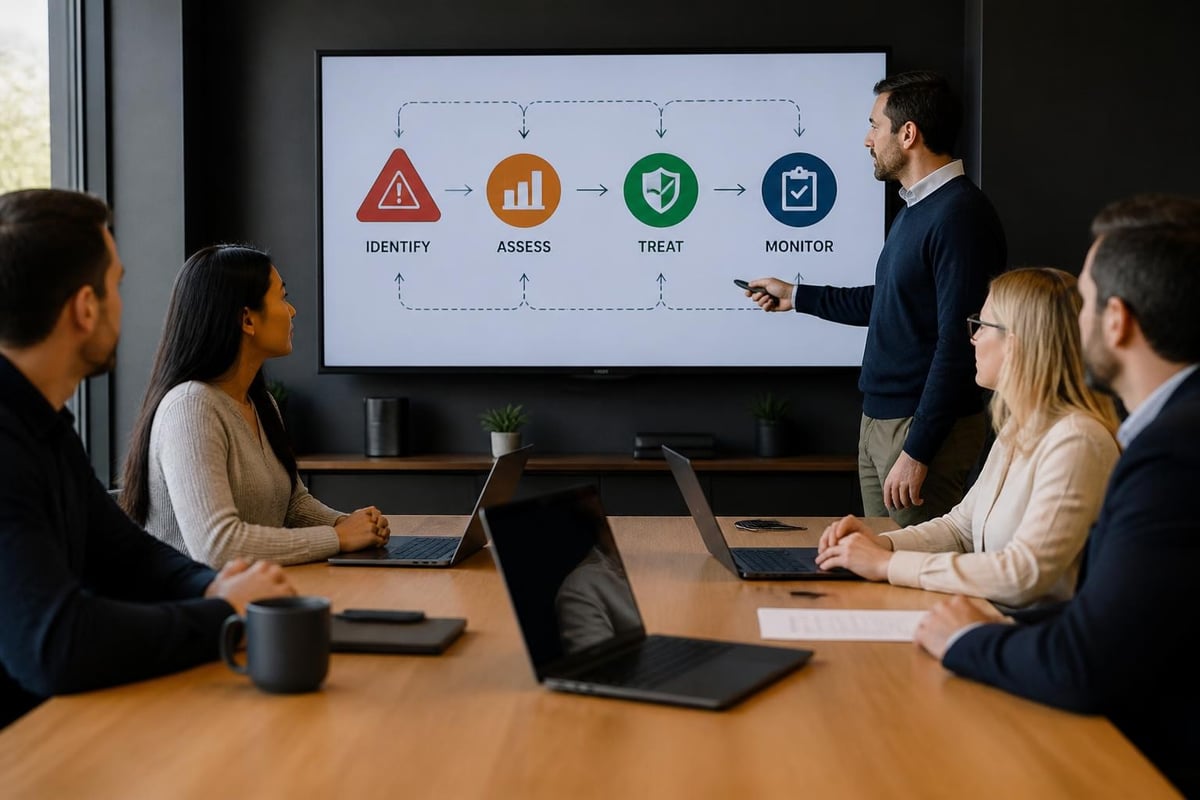
Risk assessments evaluate the likelihood and impact of potential security incidents. This systematic approach helps prioritize security investments and allocate resources effectively.
Risk Identification involves recognizing threats that could exploit vulnerabilities in your systems:
- External threats: cybercriminals, nation-state actors, hacktivists
- Internal threats: disgruntled employees, accidental data exposure
- Environmental threats: natural disasters, power failures, hardware malfunctions
- Third-party threats: vendor security breaches, supply chain compromises
Risk Analysis quantifies the potential impact of identified threats. Organizations calculate risk levels by multiplying the likelihood of occurrence by the potential impact on business operations. This calculation helps determine which risks require immediate attention versus those that can be monitored over time.
Risk Treatment involves selecting appropriate responses to identified risks. Organizations can accept, avoid, transfer, or mitigate risks based on their risk tolerance and available resources. Understanding risk management importance enables businesses to make informed decisions about security investments.
Technical Controls for Information Security
Implementing technical controls strengthens security in information security by creating multiple defensive layers. This defense-in-depth approach ensures that if one control fails, others remain in place to protect critical assets.
Network Security Measures
Network segmentation divides infrastructure into isolated zones, limiting lateral movement for attackers who breach perimeter defenses. Small businesses should separate guest networks from operational networks and create dedicated segments for sensitive data storage.
Firewalls serve as the first line of defense, filtering traffic based on predetermined security rules. Next-generation firewalls add advanced features like intrusion prevention, application awareness, and deep packet inspection to identify sophisticated threats.
Virtual Private Networks (VPNs) encrypt data transmissions between remote users and corporate networks. With remote work becoming standard practice, VPNs provide essential protection for data traveling across public internet connections.
Access Control Implementation
Strong authentication mechanisms verify user identities before granting system access. Multi-factor authentication (MFA) requires users to provide multiple verification forms, significantly reducing unauthorized access risks even when passwords are compromised.
| Authentication Factor | Examples | Security Level |
|---|---|---|
| Knowledge | Passwords, PINs | Low |
| Possession | Security tokens, smartphones | Medium |
| Inherence | Fingerprints, facial recognition | High |
| Location | GPS coordinates, IP addresses | Medium |
| Behavior | Typing patterns, gait analysis | High |
Role-based access control (RBAC) assigns permissions based on job functions rather than individual users. This approach simplifies administration and ensures employees access only the information necessary for their responsibilities.
Data Protection Strategies
Protecting data requires comprehensive strategies addressing information throughout its lifecycle. Security in information security extends from data creation through storage, transmission, and eventual destruction.
Encryption transforms readable data into unintelligible ciphertext, protecting information even if unauthorized parties gain access to storage media or intercept network transmissions. Modern encryption standards like AES-256 provide robust protection for sensitive business information.
Backup and Recovery Planning
Data backup strategies ensure business continuity following security incidents, hardware failures, or natural disasters. The 3-2-1 backup rule recommends maintaining three copies of data on two different media types, with one copy stored offsite.
Backup frequency depends on data criticality and change rates:
- Critical financial systems: hourly or continuous backups
- Customer databases: daily backups
- Static reference data: weekly or monthly backups
Recovery testing validates that backups function correctly and meet recovery time objectives. Organizations should conduct quarterly tests to ensure backup integrity and staff familiarity with restoration procedures.

Security Policies and Procedures
Written policies establish organizational expectations for security in information security practices. These documents provide guidance for employees, contractors, and third parties accessing company systems and data.
An acceptable use policy defines appropriate technology usage, including internet browsing, email communication, and personal device usage. Clear policies help prevent security incidents caused by employee misunderstanding or negligence.
Incident response procedures outline steps for detecting, containing, and recovering from security breaches. Well-documented procedures reduce response times and minimize damage during actual incidents.
Employee Training Programs
Human error causes approximately 88% of data breaches, making security awareness training essential for protecting organizational assets. Regular training sessions should cover:
- Phishing recognition and reporting
- Password security best practices
- Physical security awareness
- Mobile device security
- Social engineering tactics
- Data handling requirements
Training effectiveness improves through simulated phishing campaigns that test employee vigilance while providing immediate feedback on suspicious email characteristics.
Monitoring and Incident Response
Continuous monitoring detects security incidents quickly, reducing the window between breach occurrence and discovery. The average time to identify a breach exceeds 200 days, giving attackers extensive opportunity to steal data or cause damage.
Security Information and Event Management (SIEM) systems aggregate logs from multiple sources, correlating events to identify suspicious patterns. These platforms provide real-time alerts when anomalous activities occur, enabling rapid response.
Building an Incident Response Plan
Effective incident response requires preparation before breaches occur. Response plans should define team roles, communication protocols, and escalation procedures to coordinate activities during high-pressure situations.
Preparation phase activities include:
- Establishing an incident response team with defined responsibilities
- Developing communication templates for stakeholders and customers
- Creating forensic analysis capabilities or vendor relationships
- Documenting system baselines for comparison during investigations
- Establishing relationships with law enforcement and legal counsel
Detection and analysis involves identifying security events and determining their scope and severity. Security teams must distinguish between false positives and genuine threats requiring immediate action.
Containment strategies limit incident spread while preserving evidence for forensic analysis. Short-term containment might involve disconnecting affected systems, while long-term measures address root causes.
Compliance and Regulatory Requirements
Security in information security often intersects with legal and regulatory obligations. Small businesses handling customer data must comply with various privacy laws and industry standards.
The General Data Protection Regulation (GDPR) affects organizations processing European Union resident data, requiring specific security controls and breach notification procedures. Canadian businesses must also consider PIPEDA requirements for personal information protection.
Industry-specific regulations impose additional requirements:
- Healthcare: HIPAA mandates for protecting patient health information
- Financial services: PCI DSS standards for payment card data security
- Government contractors: FedRAMP or state-level security requirements
Following information security best practices helps organizations meet compliance obligations while strengthening overall security posture.

Vendor and Third-Party Risk Management
Third-party relationships introduce additional security considerations. Vendors accessing your network or handling customer data extend your attack surface, requiring careful evaluation and ongoing monitoring.
Vendor security assessments evaluate third-party security practices before establishing business relationships. These assessments should review:
- Security certifications and compliance status
- Incident response capabilities
- Data handling and protection measures
- Subcontractor relationships and oversight
- Business continuity planning
- Insurance coverage for security incidents
Contractual protections establish security expectations through service level agreements, security addendums, and right-to-audit clauses. Clear contracts define responsibilities and liability in case of security incidents affecting your organization.
Supply Chain Security
Supply chain attacks compromise trusted vendors to gain access to target organizations. These sophisticated attacks require vigilant monitoring of vendor security posture throughout relationships.
Organizations should implement vendor risk scoring systems that continuously assess third-party security based on publicly available information, security questionnaire responses, and periodic audits.
Cloud Security Considerations
Cloud computing offers numerous benefits for small businesses, including scalability, cost efficiency, and geographic redundancy. However, cloud adoption introduces unique security considerations requiring specialized approaches to security in information security.
The shared responsibility model defines security obligations between cloud providers and customers. Providers secure underlying infrastructure, while customers protect their data, applications, and access controls.
| Responsibility Area | Provider | Customer |
|---|---|---|
| Physical security | ✓ | |
| Network infrastructure | ✓ | |
| Virtualization layer | ✓ | |
| Operating systems | Partial | ✓ |
| Applications | ✓ | |
| Data | ✓ | |
| Identity management | ✓ |
Cloud security tools include Cloud Access Security Brokers (CASBs) that provide visibility into cloud application usage, data loss prevention, and threat protection across multiple cloud services.
Emerging Security Challenges
The threat landscape continuously evolves, introducing new challenges for organizations maintaining security in information security programs. Staying informed about emerging threats helps businesses adapt defensive strategies proactively.
Ransomware remains one of the most significant threats facing small businesses. These attacks encrypt business data, demanding payment for decryption keys. Prevention requires robust backup strategies, employee training, and network segmentation to limit attack spread.
Internet of Things (IoT) devices introduce vulnerabilities through inadequate built-in security. Businesses should segment IoT devices on separate networks and change default credentials immediately upon deployment.
Artificial intelligence enables both defensive innovations and new attack methods. While AI improves threat detection and response automation, attackers use it to create more convincing phishing campaigns and identify system vulnerabilities.
Security Metrics and Measurement
Measuring security program effectiveness enables continuous improvement and demonstrates value to business leadership. Key performance indicators should align with business objectives while providing actionable insights.
Leading indicators predict future security posture:
- Percentage of systems with current patches
- Time to patch critical vulnerabilities
- Employee security training completion rates
- Multi-factor authentication adoption
- Security configuration compliance scores
Lagging indicators measure past performance:
- Number of security incidents detected
- Mean time to detect incidents
- Mean time to respond and recover
- Cost per security incident
- Percentage of incidents caused by human error
Regular reporting communicates security program status to stakeholders, justifying investments and highlighting areas requiring additional resources or attention.
Building a Security Culture
Technology alone cannot protect organizations from security threats. Building a security-conscious culture where employees understand their role in protecting company assets significantly strengthens overall security posture.
Leadership commitment demonstrates organizational security priorities. When executives prioritize security in decision-making and resource allocation, employees recognize its importance and take their responsibilities seriously.
Recognition programs reward employees who identify and report security concerns, encouraging vigilance across the organization. Positive reinforcement proves more effective than punitive approaches for building lasting security awareness.
Simplified reporting mechanisms make it easy for employees to report suspicious activities without fear of repercussions. Organizations should establish clear channels for security concerns and respond promptly to reports.
Integration with Business Operations
Effective security in information security integrates seamlessly with business processes rather than creating obstacles. Security teams should partner with operational departments to develop controls that protect assets while enabling productivity.
Change management processes ensure security considerations inform system modifications, new deployments, and business process changes. Security reviews during planning phases prevent vulnerabilities from reaching production environments.
Business impact analysis identifies critical systems and data, informing security investment priorities and recovery time objectives. Understanding operational dependencies helps security teams focus resources on protecting elements most essential for business continuity.
Regular security reviews assess whether existing controls remain adequate as business operations evolve. Quarterly assessments identify gaps created by new technologies, changed business processes, or emerging threats.
Implementing comprehensive security in information security requires ongoing commitment, specialized expertise, and continuous adaptation to emerging threats. Small businesses benefit from partnering with experienced managed IT service providers who understand the unique challenges facing organizations in competitive markets. Delphi Systems Inc. delivers tailored cybersecurity solutions, network monitoring, and IT support that help Lethbridge businesses maintain secure, efficient operations while focusing on growth and customer service.

