

Cloud computing has revolutionized how businesses operate, offering scalability, flexibility, and cost savings that traditional IT infrastructure simply cannot match. However, as organizations increasingly migrate their critical operations and sensitive data to the cloud, they face a growing array of security challenges. Understanding and addressing cloud computing security issues has become essential for small businesses that want to leverage cloud benefits without exposing themselves to devastating breaches, compliance violations, or data loss. For companies in Lethbridge and beyond, developing a comprehensive approach to cloud security is not just an IT concern-it's a business imperative that directly impacts reputation, regulatory standing, and bottom-line results.
The Rising Complexity of Cloud Security Threats
The threat landscape surrounding cloud environments has evolved dramatically over the past few years. Modern attackers no longer rely solely on brute-force methods or simple phishing campaigns. Instead, they exploit sophisticated vulnerabilities across multiple attack vectors, making cloud computing security issues increasingly difficult to detect and prevent.
Recent research reveals a troubling trend: 80% of cloud breaches are caused by basic security mistakes such as misconfigurations and exposed credentials. This statistic underscores a critical reality-many organizations struggle with foundational security practices before even addressing advanced threats.
Common Attack Vectors Targeting Cloud Infrastructure
Cybercriminals have adapted their tactics to specifically target cloud environments. Understanding these attack methods is the first step toward building effective defenses:
- Third-party software exploitation: Attackers increasingly compromise cloud systems by exploiting vulnerabilities in third-party applications and tools integrated into cloud platforms
- API vulnerabilities: Insecure application programming interfaces provide direct pathways for unauthorized access to cloud resources
- Credential theft: Stolen or weak passwords remain one of the most common entry points for cloud breaches
- Insider threats: Current or former employees with legitimate access can intentionally or accidentally compromise cloud security
- Account hijacking: Attackers use stolen credentials or session tokens to gain control of legitimate user accounts
The shift toward targeting third-party components represents a particularly concerning development. Cloud environments typically integrate numerous external services, each representing a potential vulnerability that could compromise the entire infrastructure.

Critical Configuration Challenges and Mismanagement
Configuration errors represent the single largest category of cloud computing security issues that businesses face today. The complexity of modern cloud platforms, combined with limited security expertise, creates an environment where misconfigurations can easily occur and persist undetected.
The Misconfiguration Epidemic
Cloud platforms offer tremendous flexibility through extensive configuration options, but this same flexibility creates opportunities for critical errors. When organizations fail to properly configure security settings, they inadvertently expose sensitive data and systems to unauthorized access.
Common misconfiguration mistakes include:
- Leaving storage buckets publicly accessible without authentication requirements
- Failing to encrypt data both in transit and at rest
- Implementing overly permissive access controls that grant excessive privileges
- Neglecting to enable logging and monitoring features
- Using default security settings without customization for specific business needs
The growing disconnect between cloud complexity and security team capabilities exacerbates these challenges. As cloud environments become more sophisticated, many organizations struggle to maintain adequate oversight and control.
Identity and Access Management Failures
Proper identity and access management (IAM) forms the cornerstone of cloud security. However, implementing effective IAM policies requires careful planning and ongoing maintenance that many small businesses find challenging.
| IAM Challenge | Impact | Solution Approach |
|---|---|---|
| Excessive permissions | Users gain access to resources beyond their job requirements | Implement least-privilege principles and regular access reviews |
| Lack of multi-factor authentication | Single compromised password grants full account access | Require MFA for all user accounts, especially administrative roles |
| Abandoned accounts | Former employee credentials remain active indefinitely | Establish automated deprovisioning processes |
| Shared credentials | Multiple users share the same login, eliminating accountability | Create individual accounts with role-based access control |
Addressing these IAM challenges requires both technical solutions and organizational discipline. Regular audits of user permissions and access patterns help identify and remediate potential security gaps before they lead to breaches.
Data Protection and Privacy Concerns
Data represents the most valuable asset in cloud environments, making its protection a paramount concern. Cloud computing security issues related to data protection span multiple dimensions, from encryption and backup strategies to compliance with privacy regulations.
Encryption Gaps and Vulnerabilities
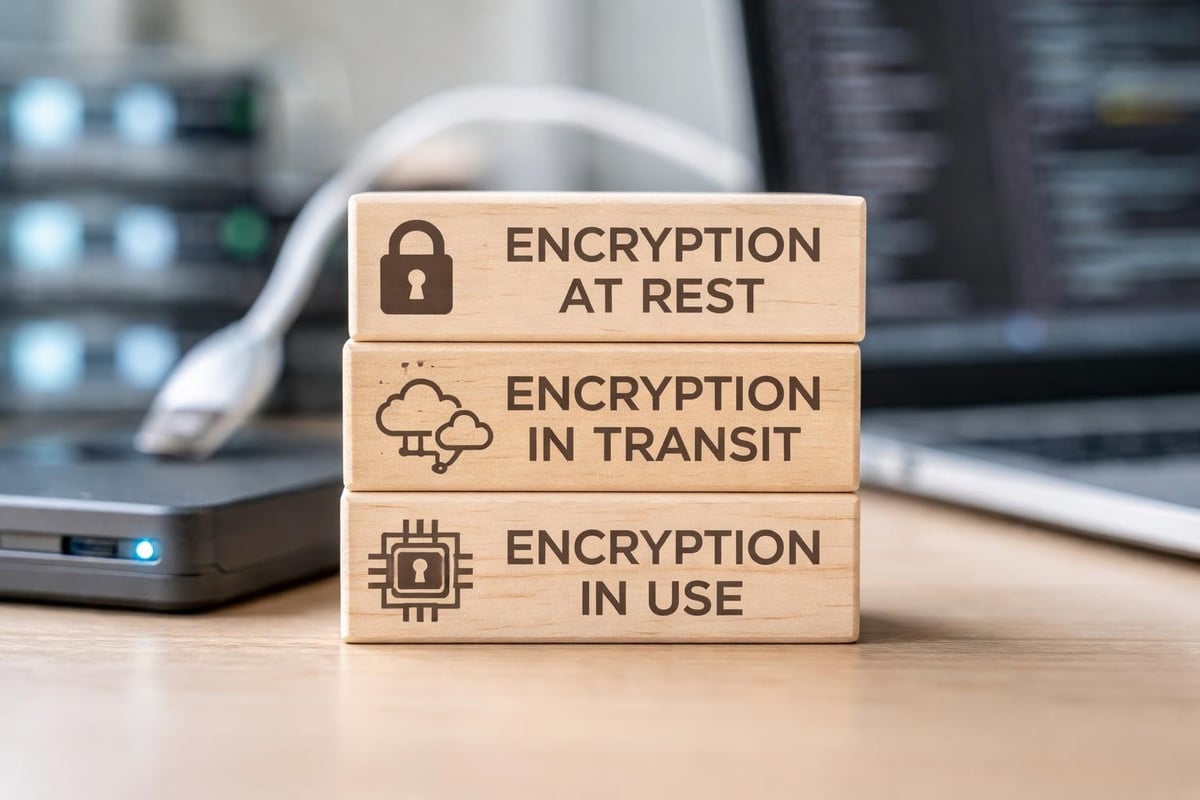
Encryption serves as a fundamental control for protecting data confidentiality, yet many organizations fail to implement comprehensive encryption strategies. Data requires protection in three distinct states:
- At rest: Data stored in databases, file systems, and archives must be encrypted to prevent unauthorized access if physical media is compromised
- In transit: Data moving between locations, whether between cloud regions or from users to cloud services, needs encryption to prevent interception
- In use: Sensitive data being processed in memory requires protection through advanced techniques like confidential computing
Without encryption across all three states, organizations leave critical vulnerabilities that attackers can exploit. The challenge intensifies when businesses use multiple cloud providers or hybrid environments, requiring consistent encryption policies across diverse platforms.
Backup and Recovery Vulnerabilities
Cloud providers offer robust infrastructure, but they operate under a shared responsibility model. Many businesses mistakenly assume that cloud providers automatically protect their data against all loss scenarios, creating dangerous gaps in backup coverage.
Critical backup considerations include:
- Understanding the shared responsibility model and your obligations for data protection
- Implementing regular automated backups with appropriate retention periods
- Testing recovery procedures to ensure backups function correctly when needed
- Protecting backup data with the same security rigor as production systems
- Maintaining off-site backups to guard against regional outages or disasters
Organizations that neglect these backup fundamentals expose themselves to catastrophic data loss from ransomware attacks, accidental deletions, or system failures.
Compliance and Regulatory Challenges
Regulatory compliance represents a significant dimension of cloud computing security issues, particularly as governments worldwide implement stricter data protection laws. Small businesses must navigate complex regulatory landscapes while maintaining operational efficiency.
Key Regulatory Frameworks Affecting Cloud Security
Different industries face varying compliance requirements, but several frameworks apply broadly to businesses using cloud services:
| Regulation | Scope | Key Cloud Security Requirements |
|---|---|---|
| GDPR | EU data protection | Data residency controls, breach notification, data subject rights |
| PIPEDA | Canadian privacy law | Consent management, safeguard requirements, accountability |
| HIPAA | Healthcare data (US) | Access controls, encryption, audit logging, business associate agreements |
| PCI DSS | Payment card data | Network segmentation, encryption, access restriction, monitoring |
Meeting these requirements in cloud environments demands careful attention to data location, access controls, and audit capabilities. The top cloud security challenges often revolve around maintaining compliance across multiple jurisdictions and regulatory frameworks simultaneously.
Documentation and Audit Trail Requirements
Compliance frameworks universally require comprehensive documentation of security controls and detailed audit trails of system access and data modifications. Cloud environments must provide:
- Centralized logging of all administrative actions and data access events
- Immutable audit records that cannot be altered or deleted
- Regular security assessments and vulnerability scans
- Documented incident response procedures and breach notification processes
- Evidence of employee security training and awareness programs
Many small businesses struggle with these documentation requirements, lacking the dedicated compliance personnel that larger enterprises employ. However, failure to maintain adequate documentation can result in severe penalties during regulatory audits.
Visibility and Monitoring Limitations
Effective security requires comprehensive visibility into cloud environments, yet achieving this visibility presents significant challenges. The distributed nature of cloud infrastructure, combined with the dynamic scaling of resources, makes continuous monitoring essential but complex.
The Shadow IT Problem
Shadow IT-the use of cloud services without IT department approval or knowledge-represents a growing cloud computing security issue. Employees frequently adopt cloud applications to improve productivity without considering security implications.
This unauthorized cloud usage creates multiple risks:
- Security policies cannot be applied to unknown services
- Sensitive data may be stored in unsecured locations
- Access controls and authentication requirements may be inadequate
- Compliance violations may occur without organizational awareness
- Data loss prevention measures cannot protect data in unauthorized systems
Addressing shadow IT requires both technical controls and cultural changes that encourage employees to work with IT departments rather than circumventing established processes.
Insufficient Security Monitoring
Many organizations lack the tools and expertise needed for effective cloud security monitoring. Without proper monitoring, detecting and responding to cloud security breaches becomes extremely difficult, allowing attackers to maintain persistent access for extended periods.
Essential monitoring capabilities include:
- Real-time alerting for suspicious activities and security events
- Automated threat detection using behavioral analysis and machine learning
- Correlation of events across multiple cloud services and regions
- Integration with security information and event management (SIEM) systems
- Regular vulnerability scanning and penetration testing
Implementing comprehensive monitoring requires significant investment in both technology and skilled personnel, creating challenges for resource-constrained small businesses.
Third-Party Risk and Supply Chain Security
Modern cloud environments rarely exist in isolation. They integrate with numerous third-party services, vendors, and partners, each representing a potential security vulnerability. Managing these third-party risks has become one of the most challenging aspects of cloud security.
Vendor Security Assessment Challenges
Organizations must evaluate the security posture of every third-party service they integrate into their cloud environment. This assessment process should examine:
- The vendor's security certifications and compliance attestations
- Data handling and privacy practices
- Incident response capabilities and breach notification procedures
- Backup and disaster recovery arrangements
- Subprocessor relationships and fourth-party risk exposure
Unfortunately, many businesses lack the expertise to conduct thorough vendor assessments, accepting vendor security claims at face value without independent verification. Recent critical vulnerabilities in widely-used cloud infrastructure tools demonstrate how third-party software flaws can compromise entire cloud ecosystems.
Software Supply Chain Vulnerabilities
The software supply chain extends beyond direct vendors to include open-source components, libraries, and frameworks embedded in cloud applications. Attackers increasingly target these supply chain elements because compromising a single widely-used component can affect thousands of organizations simultaneously.
Organizations need strategies to address supply chain security:
- Maintain complete inventories of all software components and dependencies
- Monitor for newly disclosed vulnerabilities in used components
- Implement automated patch management for timely security updates
- Verify the integrity of downloaded software and updates
- Establish contingency plans for compromised or discontinued components
The shifting cloud threat landscape emphasizes that third-party exploitation has become a primary attack method, requiring businesses to extend security controls beyond their direct cloud infrastructure.
Network Security and Perimeter Defense
Traditional network security models relied on strong perimeter defenses-firewalls and intrusion detection systems protecting a well-defined network boundary. Cloud computing fundamentally disrupts this model, as cloud resources may be distributed across multiple regions, providers, and networks without a clear perimeter.
The Zero Trust Security Model
Zero trust security has emerged as the preferred approach for addressing cloud computing security issues in distributed environments. Rather than trusting any user or device by default, zero trust continuously verifies every access request based on multiple factors.
Core zero trust principles include:
- Verify explicitly using all available data points for authentication decisions
- Use least-privilege access to limit user permissions to the minimum necessary
- Assume breach by designing systems that limit damage from compromised accounts
- Segment networks to prevent lateral movement by attackers
- Continuously monitor and validate security posture across all assets
Implementing zero trust requires significant architectural changes and may initially impact user convenience, but it provides substantially stronger security for cloud environments.
Securing Cloud Network Connections
Businesses must secure multiple types of network connections in cloud environments:
| Connection Type | Security Measures | Common Vulnerabilities |
|---|---|---|
| User-to-cloud | VPN, TLS encryption, MFA | Man-in-the-middle attacks, credential theft |
| Cloud-to-cloud | Private networking, encryption | Data interception, unauthorized access |
| On-premise-to-cloud | Dedicated connections, encryption | Configuration errors, insufficient access control |
| API connections | API gateways, authentication tokens | Insecure APIs, token theft |
Each connection type requires specific security controls tailored to its unique characteristics and risk profile. The common security challenges of cloud computing often stem from inadequate protection of these network connections.
Application Security in Cloud Environments
Applications running in cloud environments face unique security challenges that differ from traditional on-premise deployments. The shared responsibility model means that while cloud providers secure the underlying infrastructure, businesses remain responsible for securing their applications and data.
API Security Vulnerabilities
APIs serve as the primary interface for cloud services, making API security essential for overall cloud security. However, APIs frequently contain vulnerabilities that attackers can exploit:
- Insufficient authentication and authorization checks
- Lack of rate limiting enabling denial-of-service attacks
- Excessive data exposure revealing sensitive information
- Inadequate input validation allowing injection attacks
- Missing encryption for sensitive data transmission
Organizations need comprehensive API security programs that include design reviews, security testing, and runtime protection measures. Many cloud computing security issues trace back to inadequate API security practices.
Container and Serverless Security
Modern cloud applications increasingly use containers and serverless architectures, introducing new security considerations:
Container security challenges:
- Vulnerable base images containing known security flaws
- Excessive container privileges enabling privilege escalation
- Inadequate network segmentation between containers
- Lack of runtime monitoring for container behavior
- Insecure container registries exposing images to tampering
Serverless security considerations:
- Function-level access control and permission management
- Dependency vulnerabilities in function code and libraries
- Inadequate logging and monitoring of function execution
- Secrets management for API keys and credentials
- Event injection attacks targeting function triggers
Both approaches require security measures specifically designed for their architectural characteristics, as traditional security tools may not provide adequate protection.
Resource Management and Cost Security
While not traditionally considered a security concern, resource management directly impacts cloud security. Attackers can exploit poorly managed cloud resources to run cryptomining operations, launch attacks against other targets, or simply generate massive bills that drain business resources.
Preventing Resource Abuse
Unauthorized resource consumption represents a significant cloud computing security issue that can result in unexpected costs and service degradation:
- Implement resource quotas and limits to prevent runaway consumption
- Configure billing alerts for unusual spending patterns
- Regularly audit active resources to identify unauthorized deployments
- Require approval workflows for provisioning high-cost resources
- Monitor for cryptomining and other resource-intensive malicious activities
Resource abuse often indicates broader security compromises, as attackers who gain access to cloud accounts frequently use those resources for cryptocurrency mining or distributed denial-of-service attacks.
Security Cost Optimization
Many businesses struggle to balance security investments with budget constraints. However, cost-effective security approaches can provide strong protection without breaking the bank:
| Security Measure | Cost Level | Effectiveness |
|---|---|---|
| Multi-factor authentication | Low | High |
| Security awareness training | Low | High |
| Automated backup solutions | Medium | High |
| Cloud access security broker (CASB) | Medium | Medium-High |
| Advanced threat detection | High | High |
| 24/7 security operations center | High | Very High |
Prioritizing high-impact, lower-cost measures allows small businesses to build strong security foundations before investing in more expensive advanced capabilities.
Building a Comprehensive Cloud Security Strategy
Addressing cloud computing security issues requires a holistic strategy that encompasses people, processes, and technology. No single security tool or practice can adequately protect cloud environments-instead, organizations need layered defenses that address risks from multiple angles.
Essential Security Framework Components
A comprehensive cloud security framework should include these key elements:
Governance and policy:
- Clearly defined security policies covering all cloud services
- Regular policy reviews and updates reflecting evolving threats
- Executive sponsorship and accountability for security outcomes
- Security metrics and KPIs to measure program effectiveness
Technical controls:
- Identity and access management with least-privilege principles
- Encryption for data at rest, in transit, and in use
- Network segmentation and zero trust architecture
- Automated security monitoring and incident detection
- Regular vulnerability scanning and patch management
Operational processes:
- Incident response plans tested through tabletop exercises
- Change management procedures requiring security reviews
- Regular security awareness training for all employees
- Third-party risk assessment and vendor management
- Compliance audit preparation and documentation
Implementing these framework components requires sustained effort and ongoing refinement as threats evolve and business needs change.
The Role of Managed IT Services
Many small businesses lack the internal resources to implement and maintain comprehensive cloud security programs. Managed IT service providers offer expertise and capabilities that would be prohibitively expensive to develop in-house.
Benefits of managed security services include:
- Access to specialized security expertise and certifications
- 24/7 monitoring and incident response capabilities
- Proactive threat hunting and vulnerability management
- Regular security assessments and compliance audits
- Fixed-rate pricing that makes budgeting predictable
For businesses in Lethbridge and surrounding areas, partnering with experienced managed service providers enables them to leverage enterprise-grade security capabilities while focusing their internal resources on core business activities.
Security Awareness and Human Factors
Technology controls form only part of an effective cloud security program. The human element-employees, contractors, and partners who access cloud systems-represents both a critical vulnerability and an essential line of defense.
Developing Security-Conscious Culture
Organizations must cultivate a culture where security becomes everyone's responsibility, not just the IT department's concern. This cultural transformation requires:
- Regular training that educates employees about current threats and proper security practices
- Simulated phishing exercises to test and improve threat recognition
- Clear reporting procedures for suspected security incidents
- Recognition programs that reward security-conscious behavior
- Leadership modeling of security best practices
The unseen risks of cloud storage for businesses often stem from employees who lack awareness of proper data handling practices, inadvertently exposing sensitive information through careless sharing or storage decisions.
Common Human Security Errors
Understanding typical security mistakes helps organizations develop targeted training and technical controls:
- Reusing passwords across multiple accounts and services
- Clicking on suspicious links or downloading unverified attachments
- Sharing credentials with colleagues or storing them insecurely
- Misconfiguring security settings due to lack of understanding
- Bypassing security controls perceived as inconvenient
Addressing these human factors requires both education and technical safeguards that make secure choices the easy and default option.

Protecting cloud environments from the diverse array of security threats requires comprehensive strategies that address technical, organizational, and human dimensions of risk. Small businesses cannot afford to treat cloud security as an afterthought or rely solely on cloud providers to protect their critical assets.
For organizations seeking to strengthen their cloud security posture without the overhead of building in-house expertise, professional guidance makes all the difference. Delphi Systems Inc. helps Lethbridge businesses navigate cloud computing security issues through comprehensive managed IT services that include proactive monitoring, expert cybersecurity implementation, and strategic guidance tailored to each organization's unique needs. Let our team handle your cloud security challenges so you can focus on growing your business with confidence.

