


Small businesses face unprecedented cybersecurity challenges in 2026, with data breaches and ransomware attacks becoming increasingly sophisticated. Information security services have evolved from optional add-ons to essential components of business continuity planning. Organizations that implement comprehensive security frameworks protect not only their data but also their reputation, customer trust, and bottom line. Understanding the scope and value of these services helps business leaders make informed decisions about protecting their digital assets and maintaining operational resilience.
Understanding Modern Information Security Services
Information security services encompass a comprehensive range of solutions designed to protect business data, systems, and networks from unauthorized access, disclosure, disruption, or destruction. These services extend far beyond traditional antivirus software, addressing the complex threat landscape that businesses navigate today.
The foundation of effective information security rests on three core principles: confidentiality, integrity, and availability. Confidentiality ensures that sensitive information remains accessible only to authorized individuals. Integrity guarantees that data remains accurate and unaltered except through approved processes. Availability ensures that authorized users can access information and systems when needed.
Key Components of Security Service Offerings
Professional information security services typically include several critical elements that work together to create a robust defense posture:
- Threat monitoring and detection to identify suspicious activities before they escalate
- Vulnerability assessments that reveal weaknesses in current infrastructure
- Incident response planning to minimize damage when security events occur
- Access control management ensuring proper authentication and authorization
- Security awareness training to transform employees into security assets
- Compliance management to meet industry regulations and standards
Organizations that partner with experienced providers gain access to specialized expertise without the overhead of building internal security teams. This approach proves particularly valuable for small businesses operating in competitive markets where every dollar must contribute to growth.
Risk Assessment and Vulnerability Management
Effective information security services begin with comprehensive risk assessment. This process identifies potential threats, evaluates existing vulnerabilities, and determines the likelihood and impact of various security incidents. Small businesses often underestimate their risk exposure, assuming cybercriminals target only large enterprises.
The reality paints a different picture. According to authoritative sources in cybersecurity research, small businesses represent attractive targets because they typically maintain fewer security controls while holding valuable customer data, financial information, and intellectual property.
The Vulnerability Assessment Process
Professional security providers conduct systematic evaluations that examine every aspect of your IT environment:
- Network infrastructure scanning to identify outdated systems and misconfigurations
- Application security testing to uncover software vulnerabilities
- Social engineering assessments to evaluate human factors in security
- Physical security reviews to address on-premises access controls
- Cloud security audits to verify proper configuration of cloud resources
- Wireless network analysis to detect unauthorized access points
Organizations receive detailed reports ranking vulnerabilities by severity and business impact. This prioritization enables strategic allocation of resources toward the most critical security gaps.
| Vulnerability Type | Common Examples | Business Impact |
|---|---|---|
| Unpatched Systems | Outdated operating systems, legacy applications | High – Creates entry points for known exploits |
| Weak Authentication | Simple passwords, no multi-factor authentication | Critical – Enables unauthorized access |
| Misconfigured Cloud | Public storage buckets, overprivileged accounts | High – Exposes sensitive data |
| Insider Threats | Excessive permissions, poor access controls | Medium – Potential data exfiltration |
| Unsecured Endpoints | Personal devices, remote connections | Medium – Expands attack surface |
Proactive Threat Detection and Response
Information security services have shifted from reactive to proactive approaches. Rather than waiting for security incidents to occur, modern services employ continuous monitoring and threat intelligence to identify and neutralize risks before they impact operations.
Security Operations Centers (SOCs) provide around-the-clock surveillance of network traffic, system logs, and user activities. Advanced analytics and machine learning algorithms detect anomalies that might indicate emerging threats. When suspicious activity appears, security teams investigate immediately, determining whether events represent genuine threats or false positives.
Building an Incident Response Framework
Every organization needs a structured approach to security incidents. Information security services include developing, testing, and maintaining incident response plans that minimize downtime and data loss.
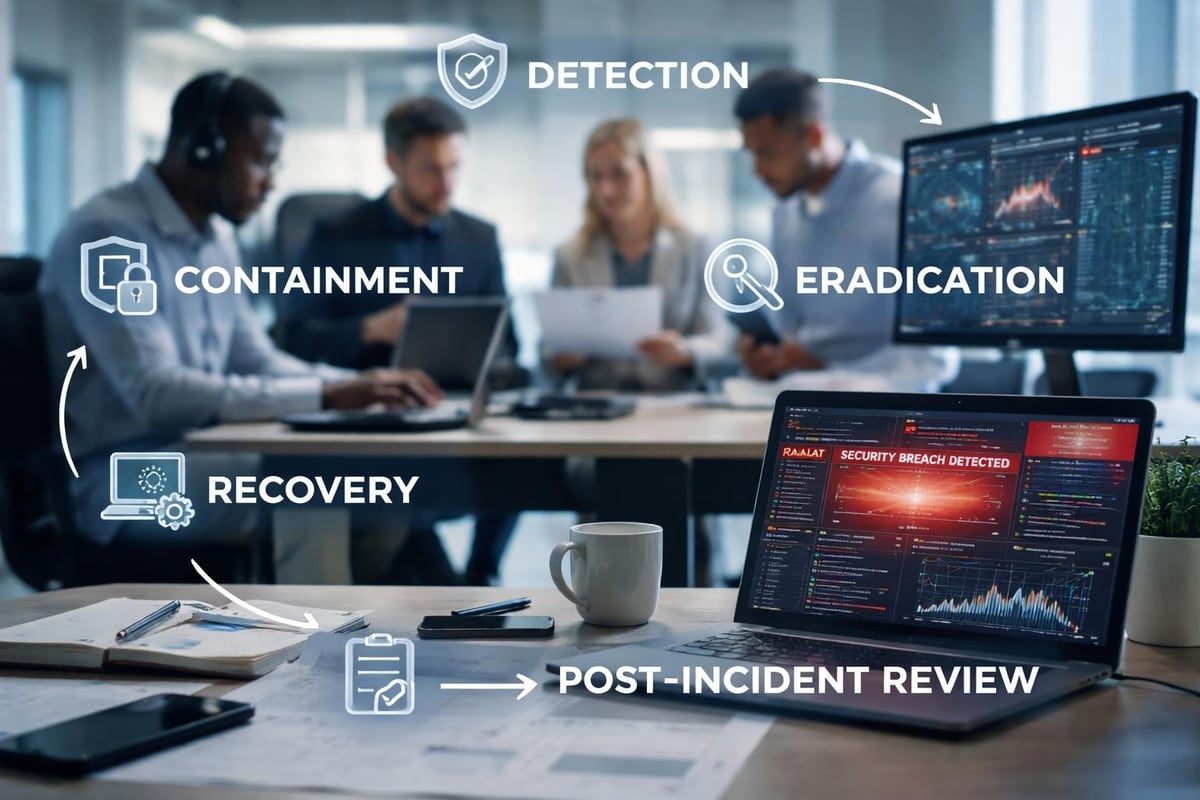
The framework typically encompasses six distinct phases:
- Preparation – Establishing response teams, tools, and communication protocols
- Detection – Identifying potential security incidents through monitoring
- Analysis – Determining the scope, severity, and nature of the incident
- Containment – Isolating affected systems to prevent spread
- Eradication – Removing threats and closing vulnerabilities
- Recovery – Restoring normal operations and validating system integrity
Small businesses benefit significantly from documented procedures that guide decision-making during high-pressure situations. Clear responsibilities and escalation paths ensure rapid, coordinated responses that protect business continuity.
Data Protection and Encryption Strategies
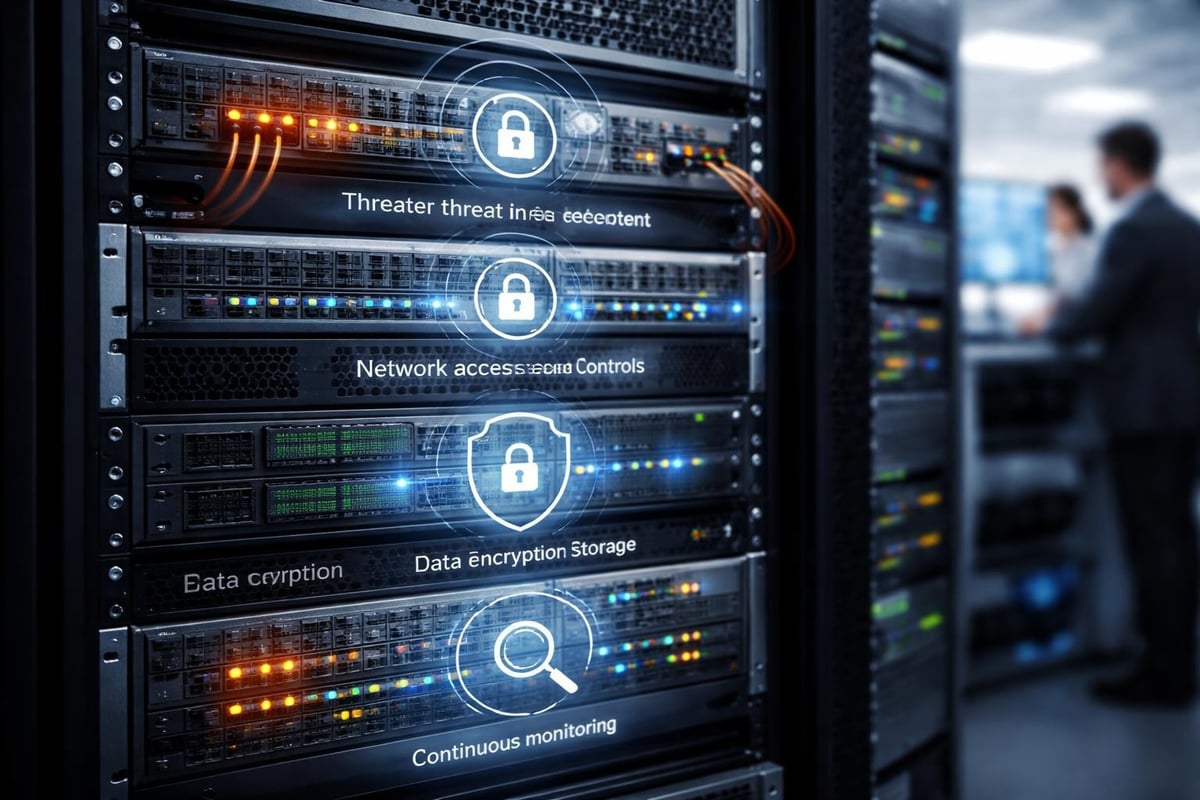
Protecting sensitive information requires multiple layers of security controls. Information security services implement encryption, access controls, and data loss prevention measures that safeguard information throughout its lifecycle.
Encryption transforms readable data into coded formats that unauthorized parties cannot decipher. Modern security services apply encryption at rest (stored data) and in transit (data moving across networks). This dual approach ensures protection whether information resides on servers, travels between locations, or sits on employee devices.
Classification and Access Control
Not all business data requires identical protection levels. Information security services help organizations classify data based on sensitivity and business value:
- Public information – Marketing materials, published content
- Internal use – Employee communications, general business documents
- Confidential – Financial records, strategic plans, employee data
- Restricted – Customer payment information, trade secrets, regulated data
Each classification level receives appropriate security controls. Restricted data might require multi-factor authentication, encryption, and detailed access logging, while public information needs minimal protection. This tiered approach optimizes security investments while maintaining usability.
Access control systems enforce the principle of least privilege, granting users only the permissions necessary for their roles. Regular access reviews ensure that permissions remain appropriate as employees change positions or leave the organization.
Compliance and Regulatory Requirements
Businesses operating in 2026 navigate complex regulatory landscapes that mandate specific information security practices. Information security services ensure compliance with relevant standards while avoiding costly penalties and reputational damage.
Different industries face varying requirements. Healthcare organizations must comply with HIPAA regulations protecting patient information. Financial institutions follow standards set by banking regulators and payment card industry requirements. Even businesses without sector-specific mandates must address general privacy laws protecting customer data.
Common Compliance Frameworks
| Framework | Applicability | Key Requirements |
|---|---|---|
| PCI DSS | Organizations processing credit cards | Network segmentation, encryption, access controls |
| HIPAA | Healthcare providers and associates | Patient data protection, breach notification |
| SOC 2 | Service providers handling customer data | Security, availability, confidentiality controls |
| GDPR | Businesses serving EU residents | Data protection, privacy rights, breach reporting |
| PIPEDA | Canadian organizations | Personal information protection, consent management |
Professional information security services maintain current knowledge of regulatory changes and implementation requirements. They conduct gap analyses comparing current practices against compliance standards, then develop remediation plans addressing identified deficiencies.
Documentation represents a critical compliance component. Authoritative sources confirm that regulators expect organizations to demonstrate security controls through policies, procedures, audit logs, and risk assessments. Security service providers help businesses create and maintain this documentation, streamlining audit processes and demonstrating due diligence.
Network Security and Monitoring
Network security forms the foundation of comprehensive information security services. Protected networks prevent unauthorized access while enabling legitimate business activities. Modern approaches combine perimeter defenses with internal segmentation and continuous monitoring.
Firewalls serve as the first line of defense, filtering traffic based on predetermined security rules. Next-generation firewalls inspect packet contents, identifying threats hidden within seemingly legitimate communications. Intrusion detection and prevention systems add another layer, recognizing attack patterns and blocking malicious activities automatically.
Advanced Monitoring Capabilities
Information security services deploy sophisticated monitoring tools that provide visibility across the entire IT environment:
- Network traffic analysis revealing unusual data flows or communication patterns
- Endpoint detection and response monitoring individual devices for suspicious activities
- Security information and event management correlating data from multiple sources
- User behavior analytics identifying anomalous actions that might indicate compromised accounts
- Threat intelligence integration comparing observed activities against known attack indicators
Small businesses gain enterprise-grade security capabilities through managed services that would prove prohibitively expensive to build internally. Providers leverage economies of scale, distributing advanced tool costs across multiple clients while maintaining specialized expertise.

Cloud Security Management
Cloud adoption accelerated dramatically in recent years, with businesses migrating applications, data, and infrastructure to cloud platforms. Information security services have evolved to address unique cloud security challenges while enabling organizations to leverage cloud benefits safely.
Cloud security differs from traditional on-premises approaches. Responsibility shifts between cloud providers and customers based on service models. Infrastructure-as-a-Service platforms require customers to secure operating systems, applications, and data. Platform-as-a-Service solutions shift more responsibility to providers. Software-as-a-Service applications handle most infrastructure security, leaving customers responsible for access controls and data protection.
Key Cloud Security Considerations
Effective cloud security requires attention to configuration, access management, and data protection:
- Identity and access management controlling who can access cloud resources
- Encryption key management protecting data while maintaining operational access
- Cloud security posture management identifying misconfigurations automatically
- Cloud workload protection securing applications running in cloud environments
- Data loss prevention preventing unauthorized data exfiltration
- Compliance monitoring ensuring cloud deployments meet regulatory requirements
Information security services help businesses navigate shared responsibility models, implementing appropriate controls for their specific cloud deployments. Regular security assessments verify configurations remain secure as cloud environments evolve.
Security Awareness and Training Programs
Technology controls provide essential protection, but human factors remain critical to information security success. Employees represent both the greatest vulnerability and the most valuable security asset. Information security services include comprehensive training programs that transform workforce behavior.
Effective security awareness training addresses real-world scenarios employees encounter daily. Rather than generic presentations, modern programs use interactive simulations, phishing tests, and role-specific modules that engage participants and demonstrate practical application.
Building a Security-Conscious Culture
Organizations with strong security cultures experience fewer incidents and faster threat detection. Information security services help develop this culture through:
- Regular training sessions covering evolving threats and best practices
- Simulated phishing campaigns teaching employees to recognize social engineering
- Clear reporting procedures encouraging incident reporting without fear of punishment
- Executive sponsorship demonstrating organizational commitment to security
- Recognition programs rewarding security-conscious behaviors
Businesses that invest in security awareness see measurable improvements in threat prevention. Employees become active participants in organizational defense rather than passive security risks.
Backup and Disaster Recovery Integration
Information security services extend beyond preventing incidents to ensuring business continuity when security events occur. Comprehensive backup and disaster recovery planning protects organizations from data loss whether caused by cyberattacks, hardware failures, or natural disasters.
Modern backup strategies follow the 3-2-1 rule: three copies of data, stored on two different media types, with one copy maintained off-site. This approach protects against various failure scenarios while enabling rapid recovery. Cloud-based backup solutions provide geographic redundancy and scalable storage capacity suited to small business needs.
Recovery Time and Point Objectives
Professional information security services help organizations define appropriate recovery targets:
| Business Function | Recovery Time Objective | Recovery Point Objective | Priority Level |
|---|---|---|---|
| Email and communication | 4 hours | 1 hour | Critical |
| Customer database | 8 hours | 4 hours | High |
| Financial systems | 12 hours | 24 hours | High |
| Internal documentation | 24 hours | 24 hours | Medium |
| Marketing materials | 48 hours | 48 hours | Low |
These objectives guide backup frequency, storage requirements, and recovery procedures. Regular testing validates that recovery processes work as designed, revealing gaps before actual disasters occur.
The Information Security Forum emphasizes that backup integrity represents a critical security consideration. Information security services include backup verification, ensuring that recovered data remains free from malware and corruption.
Vendor and Third-Party Risk Management
Small businesses increasingly rely on external vendors, partners, and service providers. Each relationship introduces potential security risks. Information security services include vendor risk management programs that evaluate and monitor third-party security practices.
Supply chain attacks have grown more sophisticated, with cybercriminals targeting smaller vendors as pathways to larger organizations. Comprehensive vendor management protects against these indirect threats while ensuring partners maintain adequate security standards.
Vendor Assessment Process
Information security services conduct thorough evaluations of vendor security postures:
- Initial security questionnaires gathering baseline security information
- Security certification verification confirming compliance with relevant standards
- Contract security requirements establishing minimum security expectations
- Ongoing monitoring tracking vendor security performance over time
- Incident notification procedures ensuring rapid communication about security events
- Regular reassessments adapting to changing risk profiles
Organizations maintain vendor risk registers documenting security assessments, identified risks, and mitigation strategies. This systematic approach enables informed decisions about vendor relationships and appropriate risk acceptance.
Emerging Threats and Future Considerations
The threat landscape continues evolving as cybercriminals develop new attack methods and exploit emerging technologies. Information security services adapt to address artificial intelligence-powered attacks, Internet of Things vulnerabilities, and sophisticated social engineering campaigns.
Ransomware remains a primary threat to small businesses, with attackers demanding payment to restore encrypted data or threatening to publish stolen information. Modern ransomware gangs operate sophisticated business models, targeting victims strategically and negotiating payments through established protocols.
Preparing for Tomorrow's Challenges
Forward-looking information security services incorporate emerging threat intelligence and defensive technologies:
- AI-powered threat detection identifying novel attack patterns
- Zero-trust architecture eliminating implicit trust within networks
- Extended detection and response correlating threats across endpoints, networks, and cloud
- Automated response capabilities containing threats faster than manual processes
- Quantum-resistant cryptography preparing for post-quantum computing threats
Small businesses benefit from managed service providers who invest continuously in new technologies and threat intelligence. This partnership model delivers cutting-edge protection without requiring individual organizations to become security experts.
Understanding how to identify authoritative sources for security information helps businesses distinguish credible threat intelligence from noise. Information security services filter vast quantities of security information, delivering actionable insights relevant to specific business contexts.
Comprehensive information security services protect small businesses from evolving cyber threats while enabling growth and innovation. Professional security partnerships deliver expertise, tools, and processes that safeguard operations without diverting focus from core business activities. Delphi Systems Inc. provides tailored information security services designed specifically for small businesses in Lethbridge and surrounding areas, combining proactive threat monitoring, compliance management, and disaster recovery planning with transparent fixed-rate pricing that makes enterprise-grade security accessible and affordable.

