
Business cyber security has evolved from a technical afterthought into a fundamental pillar of organizational success. Small and medium-sized businesses face the same sophisticated threats as large enterprises, yet often operate with fewer resources and expertise to defend against them. The stakes have never been higher, with cyberattacks affecting 43 percent of UK businesses in the last year alone, demonstrating the widespread nature of digital threats. Understanding and implementing robust security measures is no longer optional; it's essential for survival in today's interconnected business environment.
Understanding the Modern Threat Landscape
The business cyber security challenges of 2026 differ significantly from even two years ago. Cybercriminals have refined their techniques, targeting vulnerabilities in remote work environments, cloud infrastructure, and supply chain relationships. Ransomware attacks continue to dominate headlines, with cyber insurance payouts skyrocketing as organizations grapple with the financial impact of successful breaches.
Small businesses in regions like Lethbridge and surrounding areas face unique challenges. Many operate under the mistaken belief that their size makes them less attractive targets. The reality is that cybercriminals specifically seek out smaller organizations, knowing they typically have weaker defenses than larger corporations while still possessing valuable data and financial resources.
Common Threat Vectors Targeting Businesses
Phishing and social engineering remain the most effective methods for gaining initial access to business networks. Attackers craft increasingly sophisticated emails that appear to come from trusted sources, tricking employees into revealing credentials or downloading malicious software.
Ransomware attacks have evolved into a devastating threat category. These attacks encrypt business-critical data and demand payment for restoration. Ransomware mechanisms have become more sophisticated, often including double extortion tactics where attackers threaten to publish stolen data if ransom demands aren't met.
Additional threat vectors include:
- Unpatched software vulnerabilities that attackers exploit
- Weak or reused passwords across business systems
- Unsecured remote access points and VPN connections
- Insider threats from disgruntled or careless employees
- Supply chain compromises through third-party vendors

Building a Strong Defense Foundation
Effective business cyber security starts with foundational practices that create multiple layers of protection. This defense-in-depth approach ensures that if one security measure fails, others remain in place to prevent or minimize damage.
Employee Training and Security Awareness
Human error remains the weakest link in most security infrastructures. Small businesses remain cautious about AI adoption despite persistent human error threats, highlighting the ongoing challenge of balancing technology with human judgment.
Regular security awareness training should cover:
- Recognizing phishing attempts through email, phone, and text message
- Safe browsing practices and avoiding suspicious websites
- Proper password management and credential protection
- Incident reporting procedures for suspected security events
- Physical security measures for devices and sensitive documents
Training sessions should occur quarterly at minimum, with simulated phishing campaigns to test and reinforce learning. Make security awareness part of your business culture rather than a compliance checkbox.
Access Control and Authentication
Implementing proper access controls ensures that employees can only access systems and data necessary for their specific roles. This principle of least privilege minimizes potential damage from compromised accounts or insider threats.
| Access Control Method | Security Level | Implementation Complexity | Best Used For |
|---|---|---|---|
| Role-Based Access Control (RBAC) | High | Medium | Structured organizations with defined roles |
| Multi-Factor Authentication (MFA) | Very High | Low | All systems, especially remote access |
| Single Sign-On (SSO) | Medium | Medium | Simplifying access across multiple applications |
| Privileged Access Management (PAM) | Very High | High | Administrative and sensitive system access |
Multi-factor authentication represents one of the most effective security improvements organizations can implement. By requiring a second form of verification beyond passwords, MFA blocks the majority of unauthorized access attempts even when credentials are compromised.
Technical Controls and Network Security
Beyond foundational practices, business cyber security requires robust technical controls that actively protect, detect, and respond to threats. These measures form the technical backbone of your security infrastructure.
Network Monitoring and Intrusion Detection
Continuous network monitoring provides visibility into what's happening across your IT infrastructure. Modern monitoring solutions detect anomalous behavior patterns that may indicate compromise, such as unusual data transfers, unauthorized access attempts, or malware communication with command-and-control servers.
Key monitoring capabilities include:
- Real-time traffic analysis across network segments
- Log aggregation and correlation from multiple sources
- Automated alerting for suspicious activities
- Behavioral analytics to identify deviations from normal patterns
Small businesses benefit significantly from managed security services that provide 24/7 monitoring without requiring in-house security operations center staff. This approach delivers enterprise-grade protection at a fraction of the cost of building internal capabilities.
Firewall and Endpoint Protection
Modern firewalls operate far beyond simple packet filtering. Next-generation firewalls combine traditional firewall functionality with intrusion prevention, application awareness, and threat intelligence integration.
Endpoint protection has evolved similarly, moving beyond signature-based antivirus to comprehensive endpoint detection and response (EDR) solutions. These tools monitor endpoint behavior, detect suspicious activities, and can automatically isolate compromised devices to prevent lateral movement across your network.

Data Protection and Business Continuity
Protecting data and ensuring business continuity represent critical aspects of comprehensive business cyber security. No security system is perfect, so organizations must prepare for the possibility of successful attacks.
Backup and Recovery Strategies
Regular backups serve as your last line of defense against ransomware and other destructive attacks. Effective backup strategies follow the 3-2-1 rule: maintain three copies of data, on two different media types, with one copy stored offsite.
Modern backup approaches include:
- Automated daily backups of critical business systems
- Immutable backup copies that cannot be encrypted or deleted by attackers
- Regular recovery testing to verify backup integrity and recovery procedures
- Cloud-based backup solutions for geographic redundancy
- Version retention allowing recovery from multiple points in time
Testing your recovery procedures is as important as creating backups. Many organizations discover backup failures only when attempting restoration during actual incidents. Quarterly recovery tests ensure your backup strategy works when needed most.
Data Encryption and Privacy
Encryption protects data both at rest and in transit, ensuring that intercepted or stolen information remains unreadable without proper decryption keys. Modern encryption standards provide strong protection without significant performance impacts.
Implement encryption for:
- Laptop and mobile device storage to protect against physical theft
- Email communications containing sensitive business information
- Cloud storage for documents and files
- Database systems storing customer or financial data
- Network traffic through VPN connections for remote workers
Compliance and Best Practices Framework
Adhering to established cybersecurity frameworks provides structured guidance for building and maintaining effective security programs. These frameworks distill decades of security expertise into actionable recommendations.
Industry Standards and Guidelines
The CISA cybersecurity best practices offer accessible guidance specifically designed for businesses. Their recommendations emphasize practical, high-impact measures that organizations of any size can implement.
Core CISA recommendations include:
- Implementing comprehensive logging across systems
- Maintaining tested backup and recovery capabilities
- Using encryption for sensitive data protection
- Establishing incident reporting and response procedures
Organizations seeking more comprehensive frameworks might consider additional cybersecurity best practices that address continuous vulnerability scanning, supply chain security, and security metrics development.
Vulnerability Management Programs
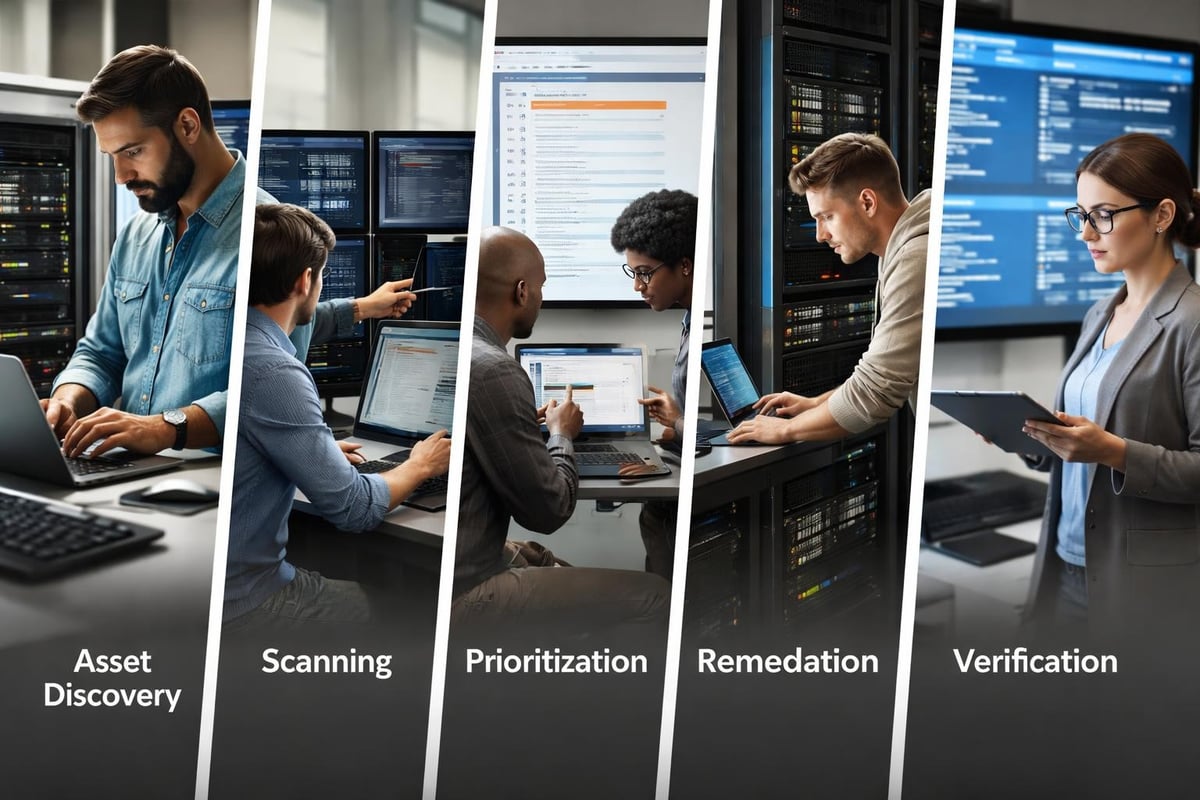
Proactive vulnerability management identifies and addresses security weaknesses before attackers can exploit them. This ongoing process includes regular scanning, prioritized remediation, and continuous improvement.
| Vulnerability Management Phase | Frequency | Key Activities | Expected Outcomes |
|---|---|---|---|
| Asset Discovery | Weekly | Identify all devices and applications | Complete inventory |
| Vulnerability Scanning | Weekly | Automated scanning of known vulnerabilities | Risk assessment |
| Prioritization | As needed | Rank vulnerabilities by severity and exploitability | Remediation roadmap |
| Patching and Remediation | Monthly (critical: immediately) | Apply security updates and configuration changes | Reduced attack surface |
| Verification | After remediation | Confirm successful vulnerability resolution | Documented closure |
Software updates and patch management deserve special attention. Unpatched systems represent low-hanging fruit for attackers who actively scan the internet for vulnerable systems. Establishing a systematic patch management process ensures critical updates are deployed promptly while testing prevents updates from disrupting business operations.
Securing Remote Work and Cloud Services
The shift toward remote work and cloud computing has fundamentally changed business cyber security requirements. Organizations must protect data and systems that no longer reside within traditional network perimeters.
Remote Access Security
Virtual Private Networks (VPNs) create encrypted tunnels for remote workers accessing business systems. However, VPNs alone are insufficient for comprehensive remote access security. Zero-trust architecture principles assume that threats exist both inside and outside the network, requiring verification for every access request regardless of origin.
Secure remote access requires:
- Multi-factor authentication for all remote connections
- Endpoint security validation before granting access
- Network segmentation limiting access to necessary resources only
- Session monitoring and logging for security visibility
- Regular security assessments of remote work configurations
Cloud Security Considerations
Cloud computing offers tremendous benefits for small businesses, but introduces new security responsibilities. The shared responsibility model means cloud providers secure the infrastructure while customers must secure their data, applications, and access controls.
Critical cloud security measures:
- Strong identity and access management controlling who can access cloud resources
- Data classification and encryption protecting sensitive information
- Configuration management ensuring secure cloud service settings
- API security protecting application programming interfaces
- Cloud security posture management monitoring for misconfigurations and vulnerabilities
Businesses migrating to cloud platforms should understand their specific security responsibilities and implement appropriate controls. Many security incidents in cloud environments result from misconfiguration rather than sophisticated attacks.
Incident Response and Recovery Planning
Despite best efforts, security incidents will occur. Effective business cyber security includes preparing for incidents through documented response procedures and recovery capabilities.
Developing an Incident Response Plan
An incident response plan documents the specific steps your organization will take when detecting a security incident. This plan reduces confusion during stressful situations and ensures consistent, effective responses.
Essential incident response plan components:
- Identification procedures for detecting and classifying incidents
- Containment strategies to limit incident scope and damage
- Investigation processes for understanding attack methods and impact
- Recovery steps for restoring normal business operations
- Communication protocols for internal stakeholders and external parties
Assign specific roles and responsibilities within your incident response team. Small businesses may not have dedicated security staff, but should identify who will lead response efforts, communicate with stakeholders, coordinate technical remediation, and document incident details.
Post-Incident Analysis and Improvement
Learning from security incidents strengthens future defenses. After containing and recovering from incidents, conduct thorough post-incident reviews to identify improvement opportunities.
The post-incident analysis should examine:
- How attackers gained initial access to systems
- What security controls failed or were bypassed
- How quickly the incident was detected and contained
- What worked well during the response process
- What changes could prevent similar incidents
Document findings and implement recommended improvements systematically. This continuous improvement cycle transforms incidents from costly failures into valuable learning experiences that strengthen overall security posture.
Vendor and Third-Party Risk Management
Modern businesses rely on numerous vendors and service providers, each representing a potential security risk. Business cyber security programs must extend beyond organizational boundaries to address supply chain and vendor risks.
Evaluating Vendor Security Practices
Before engaging new vendors or service providers, evaluate their security practices to ensure they meet your standards. This assessment becomes particularly important for vendors accessing your systems or handling sensitive data.
Key vendor security evaluation areas:
- Security certifications and compliance attestations
- Data handling and privacy practices
- Incident response capabilities and history
- Business continuity and disaster recovery plans
- Security training for vendor personnel
Incorporate security requirements into vendor contracts, specifying expected security controls, incident notification timelines, and audit rights. Regular vendor security reviews ensure ongoing compliance with contractual requirements.
Managing Third-Party Access
Vendors requiring access to your systems represent elevated security risks. Implement strict controls around third-party access to minimize potential exposure.
| Third-Party Access Control | Purpose | Implementation |
|---|---|---|
| Dedicated Vendor Accounts | Accountability and auditing | Unique credentials for each vendor, not shared with employees |
| Time-Limited Access | Minimize exposure window | Automatic access expiration requiring renewal |
| Access Monitoring | Detect unauthorized activities | Logging and reviewing vendor session activities |
| Privileged Access Management | Control administrative access | Separate approval workflow for elevated permissions |
Review third-party access regularly and promptly revoke access when vendor relationships end or access is no longer required. Orphaned vendor accounts represent significant security vulnerabilities that attackers actively seek.
Security Technology Investment Priorities
Small businesses face budget constraints that require careful prioritization of security technology investments. Focus on solutions providing maximum security value relative to cost.
High-Impact Security Investments
Managed detection and response services deliver professional security monitoring and incident response capabilities without requiring internal security expertise. These services provide 24/7 coverage at a fraction of the cost of hiring security analysts.
Email security solutions block phishing attempts, malware attachments, and business email compromise attacks. Given that email represents the primary attack vector for most threats, email security investments generate substantial returns.
Endpoint protection platforms combining antivirus, firewall, and behavioral detection secure the devices employees use daily. Modern endpoint solutions provide centralized management, allowing consistent security policies across all devices.
Additional high-value investments include:
- Password management tools reducing credential-related risks
- Network segmentation separating critical systems from general use networks
- Security awareness training platforms automating and tracking employee education
- Backup and disaster recovery solutions ensuring business continuity
Avoiding Common Investment Mistakes
Organizations sometimes invest in sophisticated security tools they lack expertise to operate effectively. A complex solution providing limited actual protection wastes resources better spent on simpler, well-implemented controls.
Consider total cost of ownership including licensing, implementation, training, and ongoing management when evaluating security solutions. The cheapest option often proves more expensive over time due to hidden costs or insufficient capabilities requiring replacement.
Partner with experienced security professionals who can help identify appropriate solutions for your specific risk profile and operational environment. For businesses in Lethbridge and surrounding areas, working with local experts ensures solutions account for regional considerations and provide readily accessible support.
Protecting your business from cyber threats requires a comprehensive approach combining technology, processes, and people. The strategies outlined here provide a roadmap for building effective defenses appropriate for organizations of any size. As a business providing managed IT services focused on security and network management, Delphi Systems Inc. helps small businesses in Lethbridge implement these critical protections through our fixed-rate managed services. We handle the complexity of business cyber security so you can focus on growing your business with confidence that your IT infrastructure is secure and efficiently managed.

