

Small businesses increasingly rely on cloud infrastructure to streamline operations, reduce costs, and enhance flexibility. As organizations migrate critical systems and data to cloud environments, the importance of robust network security in cloud computing cannot be overstated. For businesses in Lethbridge and beyond, understanding how to protect cloud-based assets while maintaining operational efficiency has become a fundamental component of their IT strategy. The shared responsibility model between cloud providers and users creates unique security challenges that require careful attention and proactive management.
Understanding the Cloud Security Landscape in 2026
The cloud computing environment presents distinct security considerations compared to traditional on-premises infrastructure. Network security in cloud computing encompasses multiple layers of protection designed to safeguard data, applications, and services hosted across distributed systems. Unlike conventional networks where businesses maintain direct control over physical infrastructure, cloud environments require organizations to navigate shared responsibility frameworks with their service providers.
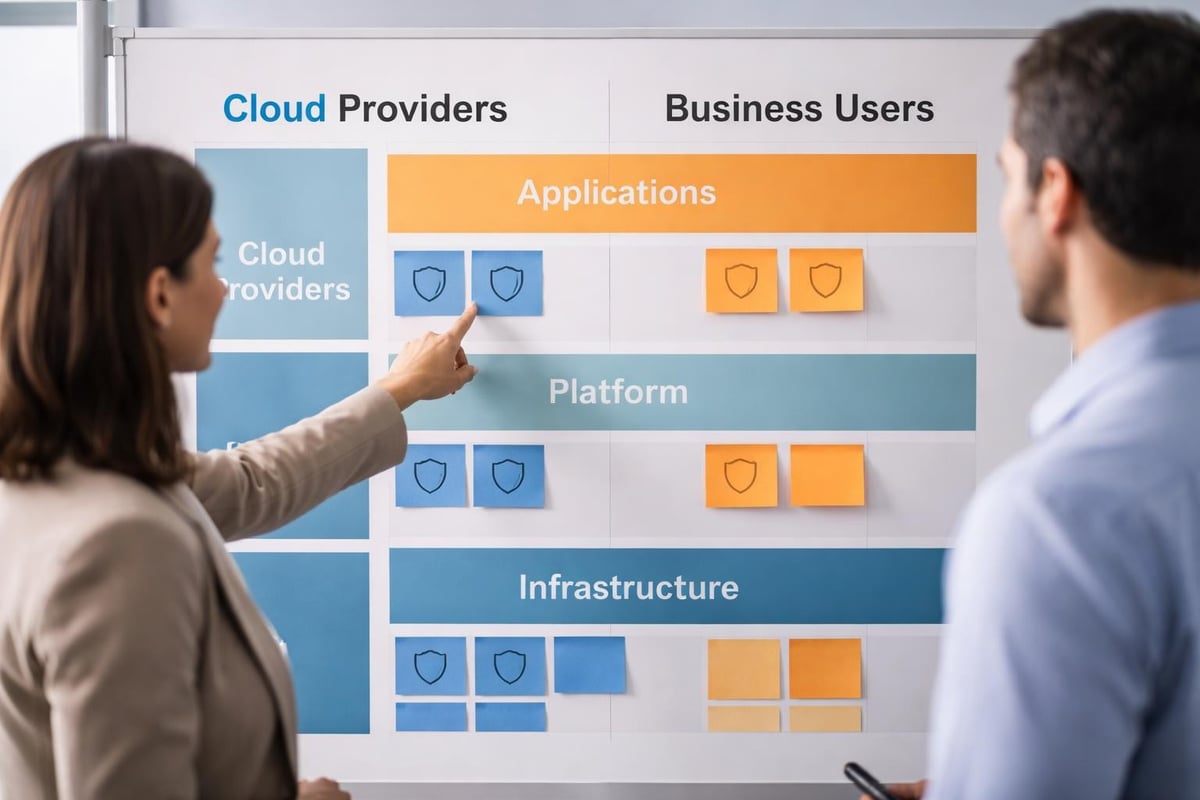
The Shared Responsibility Model
Cloud service providers manage the security of the underlying infrastructure, including physical servers, storage systems, and network hardware. Meanwhile, businesses retain responsibility for securing their data, managing user access, configuring applications properly, and implementing appropriate network controls.
This division creates specific obligations:
- Provider responsibilities: Physical security, infrastructure maintenance, hypervisor protection, and network foundation
- Customer responsibilities: Data encryption, access management, application security, and network configuration
- Shared elements: Patch management, network traffic protection, and monitoring systems
Understanding these boundaries prevents security gaps that attackers frequently exploit. According to research on security challenges in cloud computing, misconfigurations represent one of the most common vulnerabilities in cloud deployments.
Critical Components of Cloud Network Security
Implementing comprehensive network security in cloud computing requires multiple interconnected components working in concert. Each element addresses specific vulnerabilities while contributing to overall system resilience.
Access Control and Identity Management
Zero-trust architecture has become the gold standard for cloud security in 2026. This approach assumes no user or device should be automatically trusted, regardless of network location.
Key access control measures include:
- Multi-factor authentication (MFA) for all user accounts
- Role-based access control (RBAC) limiting permissions to necessary functions
- Privileged access management monitoring administrative activities
- Single sign-on (SSO) streamlining authentication while maintaining security
| Access Control Type | Primary Function | Implementation Complexity |
|---|---|---|
| Multi-Factor Authentication | Verify user identity | Low |
| Role-Based Access Control | Limit permissions | Medium |
| Privileged Access Management | Monitor admin activity | High |
| Single Sign-On | Centralize authentication | Medium |
Small businesses should prioritize MFA implementation as the most effective security measure relative to its deployment simplicity. Every user account accessing cloud resources should require at least two verification factors.
Network Segmentation and Isolation
Proper network segmentation prevents lateral movement if attackers breach perimeter defenses. Virtual private clouds (VPCs) enable businesses to create isolated network environments within public cloud infrastructure.
Segmentation strategies include:
- Separate environments for development, testing, and production
- Isolated subnets for different application tiers
- Dedicated networks for sensitive data processing
- Microsegmentation within workloads for granular control
This approach limits the blast radius of potential security incidents. If one segment becomes compromised, attackers cannot easily pivot to other network areas containing critical resources.
Encryption Protocols
Encryption serves as the foundational layer protecting data both in transit and at rest. Network security in cloud computing demands encryption at multiple points throughout the data lifecycle.
Modern cloud security implementations require:
- TLS 1.3 or higher for all data transmission
- AES-256 encryption for stored data
- End-to-end encryption for sensitive communications
- Key management systems with proper rotation policies
Many small businesses overlook encryption key management, creating vulnerabilities even when encryption is enabled. Proper key rotation schedules and secure storage prevent unauthorized decryption of protected information.
Common Threats Facing Cloud Networks
Understanding the threat landscape helps organizations prioritize security investments and implement appropriate countermeasures. The challenges in network security for cloud computing continue evolving as attackers develop more sophisticated techniques.
Data Breaches and Unauthorized Access
Data breaches remain the most financially damaging security incidents for businesses. Attackers target cloud environments through stolen credentials, exploited vulnerabilities, or social engineering tactics.
Prevention requires:
- Regular security audits identifying configuration weaknesses
- Automated scanning for exposed resources
- Continuous monitoring of access logs
- Incident response plans tested quarterly
API Vulnerabilities
Application programming interfaces (APIs) enable cloud services to communicate but also create potential entry points for attackers. Insecure APIs can expose sensitive data or allow unauthorized operations.

Insider Threats
Current or former employees with legitimate access credentials pose unique challenges. Network security in cloud computing must account for both malicious insiders and accidental data exposure by well-intentioned staff.
Mitigation strategies include:
- User behavior analytics detecting anomalous activities
- Automated alerts for unusual data access patterns
- Regular access reviews removing unnecessary permissions
- Data loss prevention tools blocking unauthorized transfers
| Threat Type | Primary Risk | Detection Difficulty | Business Impact |
|---|---|---|---|
| Data Breaches | Financial loss, reputation damage | Medium | High |
| API Vulnerabilities | Unauthorized access, data exposure | High | High |
| Insider Threats | Data theft, sabotage | Very High | Medium to High |
| DDoS Attacks | Service disruption | Low | Medium |
Implementation Best Practices
Deploying effective network security in cloud computing requires systematic planning and ongoing management. Small businesses should follow cloud network security best practices tailored to their specific risk profile and resource constraints.
Security Configuration Management
Proper configuration prevents the majority of cloud security incidents. Automated tools scan cloud environments for deviations from security baselines and compliance standards.
Essential configuration practices:
- Enable logging across all cloud services
- Disable default credentials immediately
- Restrict public access unless explicitly required
- Apply security groups with least-privilege principles
- Document all configuration changes with approval workflows
Continuous Monitoring and Threat Detection
Real-time visibility into network activity enables rapid threat detection and response. Modern security information and event management (SIEM) systems aggregate logs from multiple sources, applying machine learning to identify suspicious patterns.
Monitoring should cover:
- Network traffic flows between cloud resources
- Authentication attempts and access patterns
- Configuration changes to critical systems
- Resource utilization anomalies indicating compromised instances
Small businesses benefit from managed security services that provide expert analysis without requiring dedicated in-house security teams. For organizations in Lethbridge seeking comprehensive protection, partnering with experienced providers ensures continuous monitoring without overwhelming internal IT staff.
Regular Security Assessments
Quarterly vulnerability assessments identify weaknesses before attackers exploit them. Penetration testing simulates real-world attack scenarios, validating the effectiveness of security controls.
Assessment components include:
- Vulnerability scanning for known software flaws
- Configuration reviews against industry benchmarks
- Access audits verifying appropriate permissions
- Compliance checks ensuring regulatory adherence
The Delphi Systems Inc. blog provides additional insights into maintaining secure cloud environments throughout the year.
Compliance and Regulatory Considerations
Many industries face strict data protection requirements affecting how businesses implement network security in cloud computing. Understanding applicable regulations helps organizations avoid costly penalties while protecting customer information.
Common Compliance Frameworks
Different frameworks apply based on industry, data types, and geographic location:
- PCI DSS for businesses processing credit card transactions
- HIPAA for healthcare organizations handling patient records
- SOC 2 demonstrating security controls to customers and partners
- PIPEDA governing personal information in Canada
Cloud providers typically offer compliance certifications, but businesses remain responsible for configuring services appropriately. Audit trails, encryption requirements, and access controls must align with specific regulatory standards.
Data Residency and Sovereignty
Canadian businesses must consider where cloud providers store data physically. Some regulations mandate keeping certain information within national borders.
Key considerations:
- Select cloud regions matching data residency requirements
- Understand provider policies for data replication
- Verify backup locations comply with regulations
- Review contracts for data handling procedures

Building a Cloud Security Strategy
Effective network security in cloud computing requires comprehensive planning aligned with business objectives. Small businesses should develop strategies balancing security requirements with operational efficiency and budget constraints.
Risk Assessment and Prioritization
Begin by identifying critical assets and evaluating potential threats. Not all data requires identical protection levels, allowing businesses to allocate resources efficiently.
Risk assessment steps:
- Inventory all cloud resources and data classifications
- Identify potential threats specific to your industry
- Evaluate likelihood and impact of each threat
- Prioritize controls addressing highest risks
- Document risk acceptance for lower-priority items
Security Tool Integration
Modern cloud environments benefit from integrated security platforms rather than disparate point solutions. Consolidation improves visibility while reducing management complexity.
Consider platforms offering:
- Centralized security policy management
- Automated compliance reporting
- Unified threat intelligence
- Integration with existing IT management tools
| Security Tool Category | Primary Purpose | Small Business Priority |
|---|---|---|
| Firewall Management | Traffic filtering | High |
| Intrusion Detection | Threat identification | High |
| SIEM Platform | Log analysis | Medium |
| Vulnerability Scanner | Weakness identification | High |
| Data Loss Prevention | Information protection | Medium |
Staff Training and Awareness
Human error causes significant security incidents in cloud environments. Regular training ensures employees understand security policies and recognize common attack techniques.
Training should cover:
- Phishing identification and reporting procedures
- Password hygiene and MFA importance
- Proper handling of sensitive information
- Cloud service usage guidelines
- Incident reporting protocols
Quarterly security awareness sessions keep threats top-of-mind while reinforcing proper practices. Interactive training modules prove more effective than passive documentation review.
Emerging Trends Shaping Cloud Security
The landscape of network security in cloud computing continues evolving with technological advancement and changing threat patterns. Businesses should monitor these trends to maintain effective protection strategies.
Artificial Intelligence and Machine Learning
AI-powered security tools detect sophisticated threats faster than traditional signature-based approaches. Machine learning models identify anomalous behavior patterns indicating potential compromises.
Applications include:
- Automated threat hunting across vast log datasets
- Predictive analytics forecasting likely attack vectors
- Behavioral analysis detecting insider threats
- Adaptive access controls adjusting to risk levels
Zero Trust Network Access
The traditional network perimeter has dissolved in cloud computing environments. Zero trust architectures verify every access request regardless of origin, assuming breach has already occurred.
Implementation involves:
- Continuous authentication and authorization
- Microsegmentation limiting lateral movement
- Least-privilege access enforcement
- Real-time risk assessment for each transaction
Research on expanding attack surfaces in cloud environments demonstrates why traditional perimeter security no longer suffices.
Container and Serverless Security
Modern application architectures using containers and serverless functions introduce unique security considerations. Network security in cloud computing must adapt to these ephemeral, dynamic workloads.
Challenges include:
- Securing rapidly changing container instances
- Monitoring serverless function execution
- Managing secrets in automated deployments
- Implementing network policies for microservices
Organizations adopting these technologies should implement container-specific security platforms providing visibility into application behavior and runtime protection.
Integration with Existing IT Infrastructure
Small businesses typically maintain hybrid environments combining cloud services with on-premises systems. Seamless security integration across these platforms prevents gaps attackers might exploit.
Hybrid Cloud Connectivity
Secure connections between cloud and on-premises networks require:
- VPN tunnels encrypting traffic between environments
- Direct connect services providing dedicated bandwidth
- Software-defined WAN optimizing traffic routing
- Unified security policies consistent across locations
Legacy System Protection
Older applications migrated to cloud infrastructure may lack modern security features. Additional controls compensate for these limitations:
- Network isolation separating legacy systems from other workloads
- Web application firewalls protecting outdated software
- Virtual patching mitigating vulnerabilities without code changes
- Enhanced monitoring detecting exploitation attempts
The complexities of cloud network security require careful planning when integrating diverse systems and platforms.
Cost Optimization Without Compromising Security
Budget-conscious small businesses must balance comprehensive protection with financial constraints. Strategic approaches maximize security value while controlling expenses.
Prioritized Security Investments
Focus initial investments on controls providing maximum risk reduction:
- Multi-factor authentication implementation
- Automated backup and recovery systems
- Network traffic monitoring and logging
- Regular security training for staff
Additional controls can be phased in as budgets allow or risks increase.
Managed Security Services
Outsourcing security management to specialized providers offers several advantages:
- Access to expert knowledge without hiring costs
- 24/7 monitoring and response capabilities
- Predictable monthly expenses
- Scalable services matching business growth
Fixed-rate fee structures help small businesses plan security budgets accurately while ensuring comprehensive protection. Organizations can focus on core business activities while experienced professionals maintain network security in cloud computing environments.
Security Automation
Automating routine security tasks reduces labor costs while improving consistency:
- Automated patch management keeping systems current
- Policy enforcement without manual intervention
- Threat detection through algorithmic analysis
- Compliance reporting generated automatically
Initial automation setup requires investment, but ongoing operational savings quickly justify the expense.
Implementing robust network security in cloud computing protects small businesses from increasingly sophisticated threats while enabling the operational benefits cloud platforms provide. The strategies outlined above help organizations build comprehensive security programs tailored to their specific needs and risk profiles. Delphi Systems Inc. helps Lethbridge businesses navigate these complex requirements with managed IT services combining cloud expertise, cybersecurity protection, and continuous network monitoring. Our fixed-rate approach provides predictable costs while ensuring your cloud infrastructure remains secure and efficiently managed, allowing you to focus on growing your business with confidence.

