

In 2026, the landscape of IT infrastructure is evolving faster than ever, making managed it hosting an essential strategy for businesses seeking security, scalability, and peace of mind. This guide demystifies the current state of managed IT hosting, highlighting the latest benefits, emerging trends, and how to select the right provider. Our aim is to empower business owners and IT leaders with the knowledge needed to make informed decisions. Explore what managed IT hosting is, discover its advantages, see how AI and automation are transforming services, and learn how to confidently choose and implement the best solution for your organization.
Understanding Managed IT Hosting in 2026
Managed IT hosting in 2026 represents a fundamental shift in how organizations approach their digital infrastructure. This model delivers comprehensive management of IT systems by external experts, offering businesses a streamlined, secure, and scalable foundation for growth.

Definition and Core Concepts
Managed IT hosting is the end-to-end administration of servers, networks, and applications by a specialized third party. Unlike traditional hosting, which often leaves maintenance and support to the customer, managed IT hosting includes proactive monitoring, automated updates, and robust security controls.
Service models now include cloud, hybrid, dedicated, and application-specific hosting. By 2026, these offerings integrate AI and automation for faster response and optimization. For example, managed WordPress hosting with AI-powered tools from GoDaddy demonstrates how providers now enable smarter performance.
Industry trends show that 70% of SMBs utilize some form of managed IT hosting. According to the Managed Hosting Market Growth Forecast, this sector is expected to see significant expansion, reinforcing its role as a business enabler.
The Business Case for Managed IT Hosting
Choosing managed IT hosting brings cost advantages, with predictable pricing and lower IT labor expenses. Enhanced security and compliance are built in, offering features like firewalls, DDoS protection, and automated patching to meet regulatory needs.
Providers such as GoDaddy offer 99.9% uptime guarantees, ensuring optimal performance. Businesses can scale resources as needed, supporting rapid growth without the headache of infrastructure management.
A small business expanding its e-commerce operations can rely on managed IT hosting to handle increased demand seamlessly. Ultimately, managed IT hosting serves as a strategic investment, freeing leaders to focus on core objectives instead of day-to-day IT issues.
Key Components of a Modern Managed IT Hosting Solution
A robust managed IT hosting solution covers critical areas:
- Infrastructure management: servers, storage, and networks.
- Application management: updates, patching, and performance optimization.
- Security services: malware scanning, firewalls, and endpoint protection.
- Backup and disaster recovery: daily backups, rapid restores.
- Monitoring and support: 24/7 helpdesk, proactive resolution.
- Vendor management and integration services.
For instance, Navisite delivers multi-layered managed IT hosting, bundling infrastructure, security, and expert support into a unified package. This holistic approach is essential for businesses aiming to minimize risk and maximize uptime.
Who Needs Managed IT Hosting?
Managed IT hosting is ideal for small and medium businesses lacking dedicated IT teams. Enterprises seeking cost control and agility also benefit, as do regulated sectors like healthcare and finance that must comply with strict standards.
Organizations with remote or distributed workforces require the flexibility and security that managed IT hosting provides. Startups experiencing rapid growth can scale effortlessly with these solutions.
A healthcare clinic, for example, may leverage managed IT hosting to maintain compliance and ensure uninterrupted access to patient records. In fact, 60% of businesses cite security as their primary reason for choosing managed IT hosting.
Managed IT Hosting vs. Other IT Solutions
Compared to unmanaged hosting, managed IT hosting offers a full-service model, eliminating the do-it-yourself burden. Unlike cloud-only services, it layers on expert management and support. On-premises infrastructure, while customizable, brings higher costs and complexity.
Hybrid managed IT hosting models are bridging these gaps in 2026, combining cloud flexibility with dedicated resources for mission-critical workloads.
A typical use case is hybrid managed IT hosting for essential business applications, where uptime and security are paramount. For most modern organizations, managed IT hosting delivers the best blend of value, performance, and peace of mind.
The Benefits of Managed IT Hosting in 2026
Businesses in 2026 are turning to managed it hosting for far more than just convenience. The advantages now extend deep into security, performance, cost control, productivity, and technology access. Let us explore how managed it hosting empowers organizations to thrive in the constantly evolving digital landscape.

Enhanced Security and Compliance
Security threats are evolving rapidly, and managed it hosting offers advanced, layered protection. Providers deliver AI-driven threat detection, automated malware scanning, and robust firewalls.
Compliance is simplified with built-in tools supporting GDPR, HIPAA, and PCI DSS. Automated patch management keeps systems current, minimizing vulnerabilities. For example, GoDaddy’s managed it hosting includes DDoS protection and rapid malware removal.
A recent industry report notes that 85% of providers now include compliance features by default. Security is no longer a checklist, but an ongoing managed service that adapts to new risks.
Superior Performance and Reliability
Managed it hosting guarantees high performance and reliability. Providers deliver 99.9% uptime SLAs, automated scaling for traffic spikes, and seamless integration of CDN and caching technology.
Daily backups and one-click restores protect business continuity. GoDaddy’s managed WordPress hosting, for instance, leverages CDN to offer sites up to 2x faster.
Industry data shows 90% of managed it hosting users report better website speed and reliability. These features keep businesses online and responsive, regardless of demand.
Cost Optimization and Predictable Pricing
Predictable, flat-rate pricing models make budgeting easier with managed it hosting. Businesses avoid surprise expenses and reduce the need for a large internal IT staff.
The total cost of ownership is lower compared to on-premises or DIY solutions. Delphi Systems, for example, offers a fixed-fee managed it hosting model tailored for small businesses.
Industry averages reveal savings of 25-40% on IT costs. Managed it hosting transforms IT from a fluctuating expense to a strategic, cost-contained investment.
Focus on Core Business and Productivity
By offloading daily IT management to experts, managed it hosting lets your team focus on what matters most. Faster deployment, automated updates, and proactive troubleshooting reduce downtime.
A small business, for example, can grow its online presence while leaving technical challenges to the provider. Managed it hosting enables organizations to treat IT as an enabler rather than a distraction.
Surveys report that 75% of SMBs using managed it hosting see measurable productivity gains among their staff.
Access to Cutting-Edge Technology and Expertise
Managed it hosting gives every business access to enterprise-grade tools and expertise. Providers offer AI-powered insights, automation, and integration with platforms like AWS, Azure, or VMware.
With 24/7 expert support and advanced onboarding tools, organizations can leverage innovations previously reserved for large enterprises. According to AI and Automation in IT Management, AI-driven management is now standard, delivering proactive monitoring and optimization.
Managed it hosting democratizes next-generation IT, leveling the playing field for businesses of all sizes.
How AI, Automation, and Cloud Are Transforming Managed IT Hosting
The evolution of managed it hosting in 2026 is defined by rapid advances in artificial intelligence, automation, and cloud innovation. These technologies are not only reshaping operational efficiency but also raising the bar for security, performance, and sustainability. Let’s explore how each area is transforming the managed it hosting landscape.

The Rise of AI-Driven Managed Hosting
AI is now central to managed it hosting, powering everything from automated monitoring to intelligent threat detection. Providers use AI to identify anomalies, predict issues, and optimize workloads in real time. For example, GoDaddy’s Airo Site Designer leverages AI to streamline site creation and performance tuning.
Predictive analytics help prevent downtime by forecasting capacity needs and automating responses. According to industry trends, 80% of providers now use AI for at least one core function. To understand the broader impact of AI on IT management, see AI-Driven IT Management in 2026, which details how proactive alerts and optimization are becoming standard. This AI integration reduces human error and accelerates support, making managed it hosting more reliable than ever.
Automation in Managed IT Hosting Operations
Automation is revolutionizing managed it hosting operations by handling routine tasks like software updates, security patching, and daily backups. Providers now offer self-healing infrastructure, where systems automatically detect and resolve issues without manual intervention.
This automation minimizes downtime and ensures updates are applied quickly, enhancing reliability. Navisite’s automated maintenance is a prime example, letting businesses focus on growth rather than troubleshooting. With managed it hosting, automation also brings cost savings and higher service levels, as teams spend less time on repetitive tasks and more on strategic initiatives.
Cloud-Native and Multi-Cloud Managed Hosting
The shift to cloud-native architectures is a defining trend in managed it hosting for 2026. Businesses are embracing microservices, containers, and serverless designs to improve flexibility and scalability. Managed hosting providers support seamless migration to and between leading clouds like AWS, Azure, and Google Cloud.
Multi-cloud strategies are increasingly common, with 65% of customers leveraging multiple platforms for resilience and performance. Solutions like Navisite’s managed cloud services for SAP, Oracle, and Microsoft make it easier to integrate legacy and modern workloads. Managed it hosting now means unified management across diverse cloud environments, reducing complexity for IT teams.
The Role of Cybersecurity in 2026 Managed Hosting
Cybersecurity is at the heart of managed it hosting, with providers delivering multi-layered protection using AI and automation. Advanced features include AI-driven threat intelligence, automated incident response, and continuous vulnerability assessments.
Providers offer built-in security operations centers (SOCs), web application firewalls, and DDoS mitigation. GoDaddy’s 24/7 malware scanning and removal is a practical example. In 2026, 92% of managed it hosting providers offer advanced security features, ensuring businesses stay protected against evolving threats and compliance requirements.
Integrations, APIs, and Customization
Modern managed it hosting is defined by its flexibility and interoperability. Providers offer API-driven management tools that allow businesses to automate workflows and tailor services to unique needs. Integration with SaaS, ERP, CRM, and custom applications is seamless.
Customizable service stacks enable organizations to choose the exact mix of platforms and tools required. For example, managed hosting solutions for Salesforce or ServiceNow allow for deep business process integration. This level of customization ensures managed it hosting can adapt to any industry or operational challenge.
Sustainability and Green IT in Managed Hosting
Sustainability is becoming a core consideration in managed it hosting. Providers are investing in energy-efficient data centers, carbon-neutral operations, and green certifications. Many now publicize their renewable energy usage and environmental commitments.
Cloud providers lead the way with green initiatives, reducing the carbon footprint of IT operations. Choosing a managed it hosting provider with strong sustainability credentials is increasingly important for businesses aiming to meet environmental goals. In 2026, green IT is not just a trend, it is a key differentiator in the managed hosting market.
Choosing the Right Managed IT Hosting Provider
Selecting the best managed it hosting provider is a critical step for business success in 2026. With rapidly evolving technology and increasing security challenges, your decision impacts everything from daily operations to long-term growth. Establish clear evaluation criteria to ensure your provider aligns with your needs, budget, and compliance requirements.
Key Criteria for Evaluating Providers
When evaluating managed it hosting providers, prioritize security credentials and compliance certifications. Uptime guarantees and performance service level agreements should be clearly defined, ensuring your business stays online. Assess the range of platforms and technologies supported, from cloud and hybrid to application-specific hosting.
Consider the provider’s ability to customize and scale services as your needs evolve. Quality of support is essential, so check for 24/7 availability and strong client satisfaction ratings. For example, GoDaddy offers a 99.9% uptime guarantee and award-winning support, making it a reliable choice for many businesses.
Questions to Ask Potential Providers
Before finalizing your managed it hosting partner, ask detailed questions about their service scope. What exactly is included in the standard package? How do they approach security, both proactively and reactively, and do they offer compliance support for regulations like GDPR or HIPAA?
Clarify the onboarding and migration process, including potential downtime and data protection measures. Understand their pricing model, whether it is flat-rate or usage-based, and ask about any extra costs. Finally, review their support channels, ensuring you have access to help whenever you need it.
Comparing Top Managed IT Hosting Solutions
Comparing managed it hosting solutions requires a clear understanding of your priorities. Leading providers like GoDaddy, Navisite, AWS, Azure, and regional MSPs offer distinct features, automation levels, and security options. The table below summarizes key differentiators:
| Provider | Security | Automation | Support | Platforms | Pricing |
|---|---|---|---|---|---|
| GoDaddy | Strong | High | 24/7 Awarded | WordPress, Web | Flat-rate |
| Navisite | Advanced | High | 24/7 Expert | Enterprise | Custom |
| AWS/Azure | Robust | Variable | Enterprise | Multi-cloud | Usage |
Customer satisfaction scores, contract terms, and the ability to customize services should all influence your final decision.
Delphi Systems Inc.: Local Expertise in Managed IT Hosting
For businesses in Lethbridge and Southern Alberta, Delphi Systems Inc. provides managed it hosting with a strong local touch. Their focus on small business needs includes proactive security, cloud solutions, reliable backup, and responsive support.
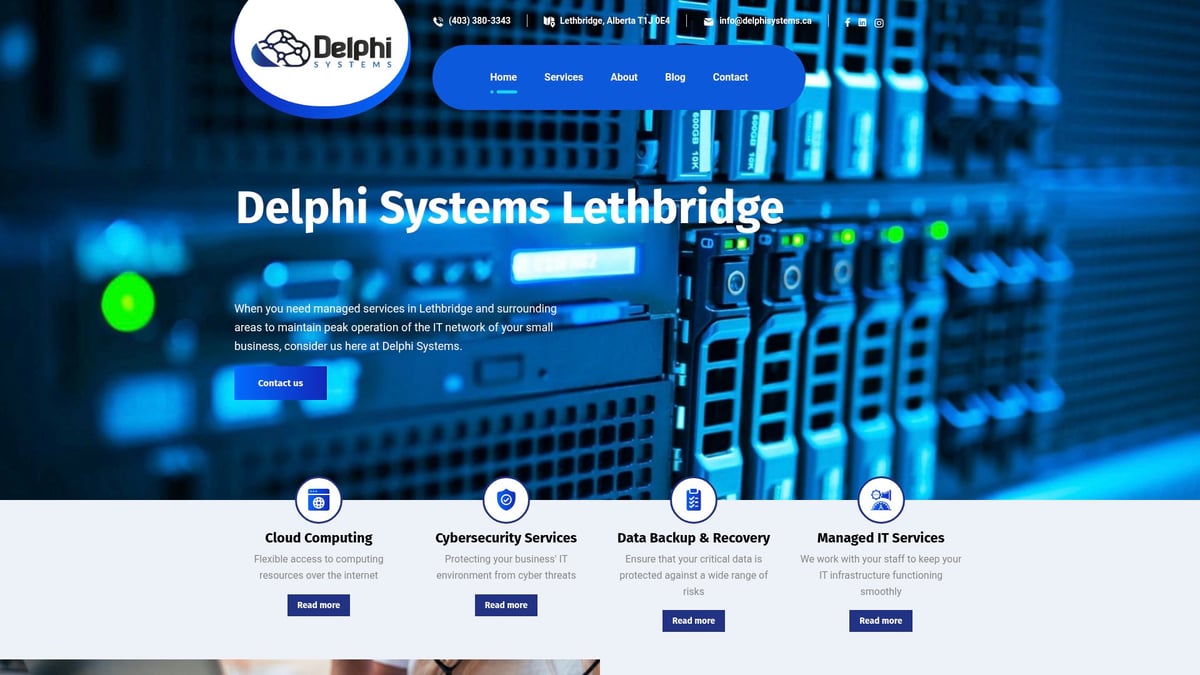
Delphi’s predictable, flat-rate pricing helps organizations budget confidently. They maintain strong partnerships with vendors like Dell, Microsoft, Bitdefender, and Meraki. Client testimonials consistently highlight Delphi’s reliability, peace of mind, and expert guidance. Local businesses benefit from the team’s deep knowledge of regional requirements and challenges.
Steps to a Successful Migration to Managed IT Hosting
Migrating to managed it hosting requires strategic planning. Begin by assessing your current infrastructure and identifying business objectives. Shortlist providers who meet your technical, security, and compliance needs.
Develop a detailed migration plan, including data backups and downtime mitigation. Execute the migration with your provider’s support and monitor progress closely. For a deeper look at authentication and security during transitions, review the Managed TLS Under Migration Study. Post-migration, optimize and monitor your environment for ongoing performance and safety.
Common Pitfalls to Avoid
Avoid common mistakes when choosing managed it hosting by paying close attention to service level agreements and support quality. Ignoring compliance and security requirements can lead to costly breaches or fines. Overlooking scalability may hinder future growth.
Do not base your decision solely on price, as cheaper providers may lack critical features. Failing to plan for disaster recovery and business continuity can cause major disruptions. Carefully evaluate contracts to ensure your provider truly meets your business needs.
Future Trends and Predictions for Managed IT Hosting
The future of managed it hosting is being shaped by rapid advancements in technology, evolving business needs, and growing demands for security and compliance. As we look ahead to 2026, several key trends are set to redefine how organizations leverage managed it hosting for agility, resilience, and strategic growth.
The Expansion of AI and Autonomous IT Operations
AI is transforming managed it hosting by enabling self-managing infrastructure and automated remediation. Providers now deploy AI-driven capacity planning to anticipate resource needs and perform predictive maintenance, minimizing downtime. For example, AI bots handle routine support requests and optimization tasks, freeing IT teams for higher-value activities.
A recent industry survey found that 90% of managed it hosting providers are investing in AI research and development. This commitment ensures that businesses can expect faster response times, fewer disruptions, and smarter resource allocation as AI continues to evolve.
Edge Computing and Decentralized Hosting
Edge computing is emerging as a game changer for managed it hosting, especially for applications requiring low latency and real-time analytics. The proliferation of edge data centers allows providers to deliver managed it hosting closer to end users, supporting IoT deployments and mission-critical workloads in sectors like healthcare and manufacturing.
By leveraging managed it hosting at the network edge, organizations gain a competitive advantage through faster data processing and improved user experiences. Edge strategies will become increasingly important as digital transformation accelerates.
Industry-Specific Managed Hosting Solutions
Industry-specific managed it hosting solutions are gaining traction as businesses seek tailored support for compliance and operational demands. Providers are developing vertical offerings for industries such as healthcare, finance, retail, and manufacturing, integrating compliance frameworks like HIPAA, PCI, and GDPR.
For example, Navisite offers managed it hosting services optimized for SAP and Oracle environments in regulated industries. This focus on industry expertise positions managed it hosting as a differentiator for businesses that require specialized solutions and robust compliance.
The Role of Managed Hosting in Digital Transformation
Managed it hosting is becoming the backbone of digital transformation initiatives across industries. It enables seamless cloud migration, automation, and innovation by providing scalable, secure, and flexible infrastructure. Organizations can support remote and hybrid workforces, ensuring operational continuity and agility.
A notable case study involves a business scaling operations globally using managed it hosting to streamline IT management and accelerate growth. This approach allows leaders to focus on strategic initiatives, knowing their infrastructure is optimized and future-ready.
Security Innovations and Zero Trust Architectures
Security is at the forefront of managed it hosting evolution, with providers adopting zero trust architectures to safeguard data and applications. Managed it hosting now features continuous authentication, micro-segmentation, and least-privilege access, reducing risks and enhancing compliance.
Providers are integrating zero trust models into their platforms, responding to research that shows 75% of enterprises plan to adopt zero trust via managed it hosting by 2027. These innovations help organizations proactively address emerging threats and regulatory requirements.
Evolving Service Models: From MSPs to Strategic Partners
The role of managed it hosting providers is shifting from traditional service delivery to strategic partnership. Providers now offer consulting, IT strategy, and technology roadmaps alongside core hosting services, helping organizations align IT investments with business goals.
MSPs are evolving to become trusted advisors, guiding clients through digital transformation and ongoing innovation. The future of managed it hosting is value-driven, with providers acting as integral partners in clients' long-term success.
Step-by-Step Guide: Implementing Managed IT Hosting in Your Organization
Adopting managed it hosting can transform your organization’s IT strategy, but the path to success requires careful planning and execution. Follow this step-by-step guide to ensure a smooth, efficient transition that aligns with your business goals and maximizes the benefits of managed it hosting.
Step 1: Assess Your IT Needs and Goals
Begin by conducting a thorough inventory of your current infrastructure, including hardware, software, and network resources. Identify pain points such as security gaps, scalability limitations, or compliance concerns.
Gather input from leaders and end-users to understand business objectives and future requirements. For example, a retailer planning to expand e-commerce operations may prioritize uptime and secure payment processing. This foundational assessment ensures your managed it hosting solution will address actual needs and support strategic growth.
Step 2: Shortlist and Evaluate Managed Hosting Providers
Research potential managed it hosting providers based on their expertise, security credentials, and client feedback. Request detailed proposals and schedule interviews to clarify offerings.
Compare key criteria:
- Supported platforms and technologies
- Security and compliance certifications
- Customization options
- Pricing models and contract terms
A side-by-side comparison of providers like GoDaddy, Navisite, and local MSPs can help you make an informed decision. Choose a managed it hosting partner who aligns with your operational goals and industry requirements.
Step 3: Plan and Prepare for Migration
Develop a clear migration roadmap outlining timelines, responsibilities, and risk mitigation strategies. Back up all data and applications before starting the transition process.
Communicate the migration plan to all stakeholders to set expectations and minimize disruptions. For example, a healthcare provider may schedule migration during off-peak hours to reduce impact. Meticulous planning at this stage is essential for a seamless move to managed it hosting.
Step 4: Execute the Migration
Coordinate closely with your chosen provider to ensure a smooth transfer of data and applications. Monitor migration progress in real time and address any issues promptly.
After migration, thoroughly test systems and applications to confirm functionality. Many providers offer migration wizards or support teams to streamline the process, especially for popular platforms like WordPress. Successful execution is a vital milestone in your managed it hosting journey.
Step 5: Optimize and Monitor Your Managed Hosting Environment
Leverage your provider’s management tools for ongoing performance monitoring and optimization. Set up automated backups, regular security scans, and real-time alerts to maintain system integrity.
Schedule periodic reviews with your provider to align IT performance with evolving business goals. For instance, an SMB might use AI-driven insights to fine-tune resource allocation and improve application speed. Continuous optimization is key to realizing the full value of managed it hosting.
Step 6: Foster a Partnership with Your Provider
Establish clear communication channels and escalation paths with your managed it hosting provider. Take advantage of consulting and advisory services for long-term IT planning.
Collaborate on growth initiatives, technology upgrades, and new projects to ensure your IT environment evolves alongside your business. Building a strong partnership transforms your provider into a strategic ally, supporting innovation and resilience with managed it hosting expertise.
As we’ve explored, managed IT hosting in 2026 is all about giving you the freedom to focus on your business while trusted experts keep your technology secure, efficient, and ready for tomorrow. If you want to spend less time worrying about IT headaches and more time on what you do best, partnering with a local team who truly understands the needs of small businesses can make all the difference. Ready to discuss how managed hosting can help you reach your goals? Let’s talk about your specific needs—Call us now.
