

Understanding the landscape of threats in computer security has become essential for small businesses operating in 2026. Cyber criminals continuously refine their tactics, targeting organizations that may lack the resources of larger enterprises. For businesses in Lethbridge and surrounding areas, recognizing these threats represents the first step toward building a resilient IT infrastructure that protects sensitive data, maintains operational continuity, and preserves customer trust.
The Evolution of Modern Security Threats
Threats in computer security have transformed dramatically over the past decade. What once consisted primarily of simple viruses and email scams has evolved into sophisticated, multi-layered attacks that exploit both technological vulnerabilities and human psychology.
Today's threat landscape encompasses everything from automated bot networks to state-sponsored cyber espionage. Small businesses face particular challenges because they often possess valuable data while lacking dedicated security teams. According to recent research on AI-powered cyber threats, many organizations acknowledge their current defenses cannot adequately address modern attack vectors.
The Financial Impact on Small Businesses
The consequences of security breaches extend far beyond immediate data loss. Small businesses face:
- Direct financial losses from theft, ransom payments, and fraud
- Operational downtime that disrupts productivity and revenue generation
- Legal liabilities related to data protection regulations
- Reputation damage that erodes customer confidence
- Recovery costs for system restoration and security improvements
Industry studies indicate that more than 60% of small businesses that experience significant cyber attacks cease operations within six months. This stark reality underscores why understanding threats in computer security cannot remain an IT department concern alone.

Malware and Ransomware Attacks
Malware represents malicious software designed to infiltrate, damage, or disable computer systems. This category encompasses viruses, worms, trojans, and spyware. Each variant operates differently but shares the common goal of compromising system integrity.
Ransomware has emerged as one of the most damaging threats in computer security for small businesses. These attacks encrypt organizational data and demand payment for restoration. Attackers increasingly target backup systems to eliminate recovery options, forcing businesses into impossible decisions.
Common Malware Distribution Methods
| Method | Description | Risk Level |
|---|---|---|
| Email Attachments | Malicious files disguised as legitimate documents | High |
| Drive-by Downloads | Automatic downloads from compromised websites | Medium-High |
| USB Devices | Infected external drives and hardware | Medium |
| Software Vulnerabilities | Exploitation of unpatched systems | High |
| Supply Chain Attacks | Compromised third-party software updates | Very High |
Modern malware often includes polymorphic capabilities, allowing it to change its code signature to evade detection. Traditional antivirus solutions struggle against these adaptive threats, making layered security approaches essential.
Phishing and Social Engineering
While technical safeguards protect against automated attacks, human vulnerability remains the weakest link in most security strategies. Phishing attacks manipulate employees into revealing credentials, downloading malware, or transferring funds to fraudulent accounts.
These threats in computer security exploit psychological triggers rather than technical weaknesses. Attackers create urgency, impersonate authority figures, and craft convincing scenarios that bypass logical skepticism.
Evolving Phishing Techniques
Contemporary phishing campaigns demonstrate increasing sophistication:
- Spear phishing targets specific individuals using personalized information gathered from social media and public records
- Business email compromise impersonates executives to authorize fraudulent transactions
- Voice phishing (vishing) uses phone calls to extract sensitive information
- SMS phishing (smishing) leverages text messages with malicious links
- AI-generated deepfakes create convincing audio or video impersonations
According to IBM's research on comprehensive cybersecurity threats, phishing accounts for approximately 90% of successful data breaches. Small businesses face particular risk because employees may wear multiple hats, making verification procedures less consistent.
Employee training represents the most effective defense against social engineering. Regular simulations help staff recognize manipulation tactics, while clear verification protocols for financial transactions create procedural barriers against fraud.
Network-Based Security Threats
Network infrastructure presents multiple attack surfaces that threats in computer security actively exploit. Understanding these vulnerabilities helps organizations implement appropriate protective measures.
Distributed Denial of Service (DDoS) attacks overwhelm systems with traffic from multiple sources, rendering services unavailable to legitimate users. While often associated with large enterprises, small businesses increasingly face DDoS attacks as extortion tactics or competitive sabotage.
Man-in-the-Middle Attacks
These sophisticated threats intercept communications between two parties without their knowledge. Attackers position themselves between users and services to:
- Capture authentication credentials
- Steal sensitive business data
- Modify transaction details
- Inject malicious content into legitimate communications
Public Wi-Fi networks present particular vulnerability to man-in-the-middle attacks. Employees accessing business systems from coffee shops or airports may inadvertently expose credentials to monitoring attackers.
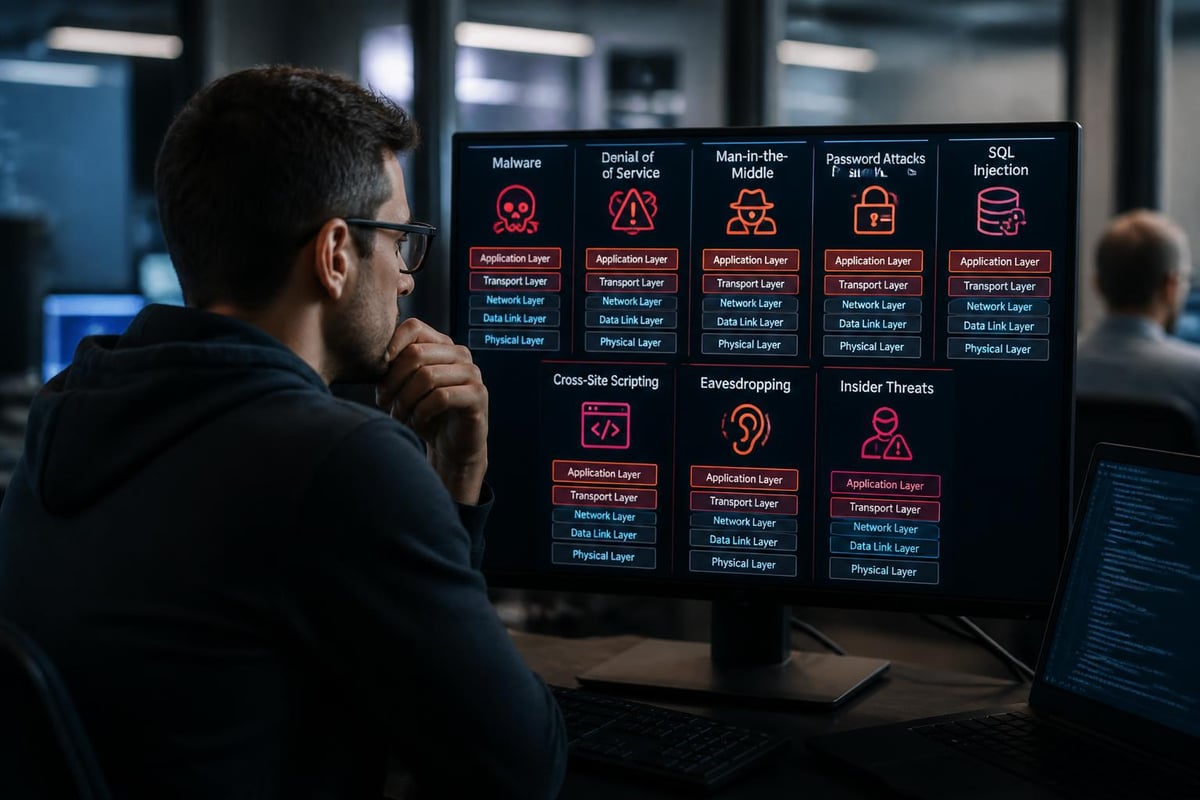
The nine main categories of network security threats identified by security experts demonstrate the complexity of modern network defense. Each category requires specific countermeasures, from encryption protocols to intrusion detection systems.
Insider Threats and Access Control
Not all threats in computer security originate from external actors. Insider threats pose unique challenges because perpetrators possess legitimate access credentials and understand organizational vulnerabilities.
Insider threats manifest in several forms:
- Malicious insiders intentionally steal data or sabotage systems
- Negligent employees inadvertently expose systems through poor security practices
- Compromised accounts where external attackers leverage stolen credentials
- Departing employees who retain access beyond their employment period
Research indicates insider threats cause approximately 34% of security incidents. The challenge lies in balancing security controls against operational efficiency and employee trust.
Identity and Access Management
According to analysis of identity security risks facing organizations, companies struggle to manage the explosion of machine and AI identities alongside human users. The average organization now manages thousands of distinct identities across cloud services, applications, and network resources.
Effective access control requires:
- Principle of least privilege – granting minimum necessary permissions
- Multi-factor authentication – requiring multiple verification methods
- Regular access reviews – auditing who can access what resources
- Automated deprovisioning – removing access when roles change
- Activity monitoring – tracking unusual behavior patterns
Emerging Threats in the AI Era
The integration of artificial intelligence into both attack and defense strategies represents a fundamental shift in threats in computer security. Attackers leverage AI to automate reconnaissance, craft convincing phishing messages, and identify system vulnerabilities at unprecedented scale.
Emerging cybersecurity risks for 2026 include AI-powered cyberattacks that adapt in real-time to defensive measures. These systems analyze defender responses and modify attack strategies faster than human security teams can respond.
Quantum Computing Threats
Looking beyond immediate concerns, quantum computing capabilities threaten to render current encryption standards obsolete. Security experts predict nation-states may possess weaponized quantum computers within five years, capable of breaking encryption that currently protects sensitive communications and stored data.
Small businesses should begin planning for this transition by:
- Understanding which data requires long-term confidentiality
- Monitoring quantum-resistant encryption standards development
- Building relationships with managed service providers who track emerging technologies
- Budgeting for eventual cryptographic infrastructure updates
Cloud Security Challenges
As businesses migrate to cloud platforms, threats in computer security adapt to target these environments. Cloud services introduce unique vulnerabilities related to shared responsibility models, API security, and multi-tenant architecture.
Misconfigured cloud storage represents one of the most common security failures. Default settings that prioritize accessibility over security have exposed millions of records across various industries. A single configuration error can expose entire databases to public internet access.
| Cloud Security Challenge | Business Impact | Mitigation Strategy |
|---|---|---|
| Data Breach | Customer data exposure, regulatory fines | Encryption, access controls, monitoring |
| Account Hijacking | Unauthorized access to systems and data | Multi-factor authentication, session management |
| Insecure APIs | Application vulnerabilities | API security testing, authentication |
| Insufficient Visibility | Inability to detect threats | Cloud security monitoring, logging |
| Compliance Violations | Legal penalties, certification loss | Regular audits, automated compliance checks |
Third-party cloud providers maintain physical security and infrastructure protection, but customers bear responsibility for data security, access management, and application configuration. Understanding this division of responsibility prevents dangerous security gaps.
Supply Chain Security Risks
Modern businesses rely on interconnected networks of vendors, service providers, and software suppliers. This creates exposure to supply chain attacks where threats in computer security compromise trusted partners to gain access to target organizations.
Notable supply chain compromises in recent years have affected thousands of organizations simultaneously through compromised software updates. Small businesses face particular risk because vendor security assessments may seem burdensome or expensive to implement consistently.
Vendor Risk Management
Effective supply chain security requires systematic approaches:
- Cataloging all third-party services and software dependencies
- Assessing vendor security practices through questionnaires and certifications
- Establishing contractual security requirements and incident notification clauses
- Monitoring vendor security incidents and breach notifications
- Maintaining contingency plans for vendor service disruption
The interconnected nature of modern business means a security failure at any point in the supply chain can cascade throughout the network. Comprehensive approaches to computer security risks must account for these extended attack surfaces.
Mobile Device Security
The proliferation of smartphones and tablets in business environments expands the attack surface for threats in computer security. Employees access corporate email, cloud applications, and sensitive data from personal devices that may lack adequate security controls.
Bring Your Own Device (BYOD) policies create convenience and cost savings but introduce significant security challenges. Mobile devices face unique threats including:
- Malicious applications that request excessive permissions
- Operating system vulnerabilities in older devices
- Lost or stolen devices containing unencrypted data
- Insecure Wi-Fi connections exposing credentials
- SMS-based attacks targeting two-factor authentication
Mobile device management (MDM) solutions help organizations enforce security policies across diverse device ecosystems. These platforms enable remote data wiping, application whitelisting, and encryption enforcement without requiring complete control over personal devices.
Zero-Day Vulnerabilities
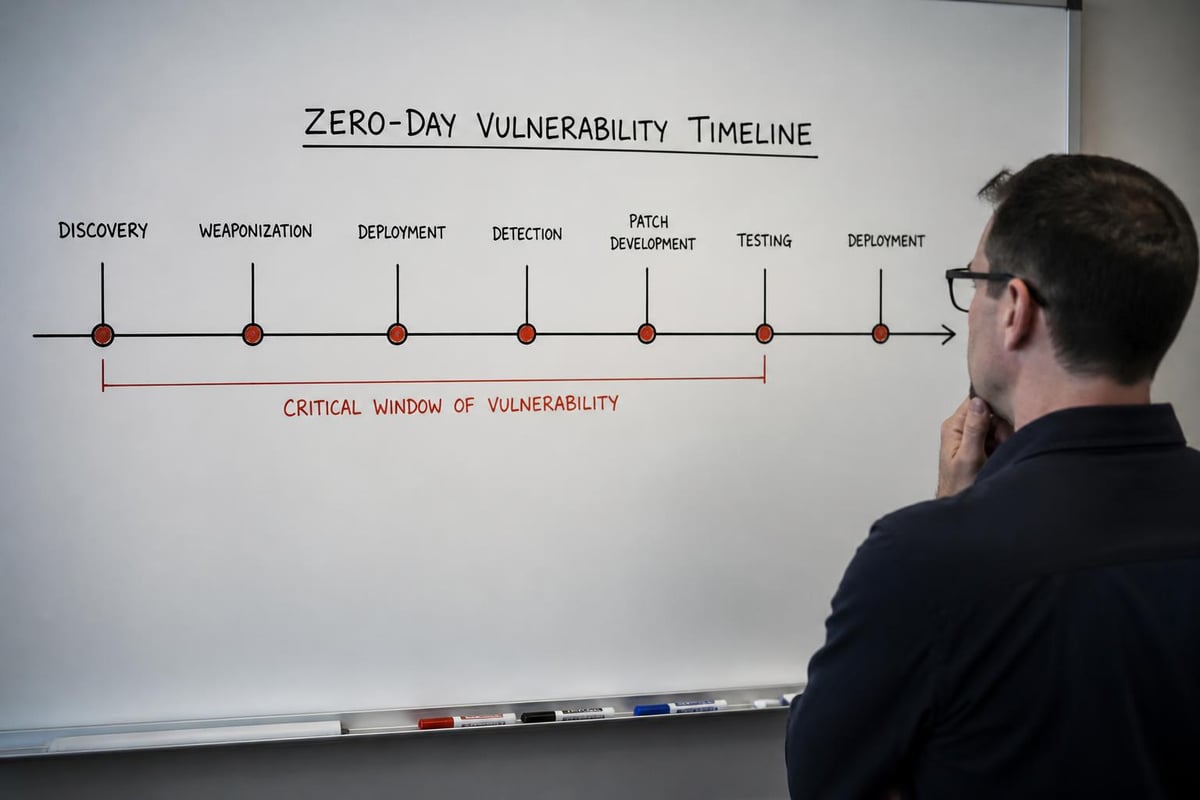
Zero-day exploits target previously unknown software vulnerabilities before developers can create patches. These threats in computer security present particular danger because no existing defense mechanisms address them directly.
The window between vulnerability discovery and patch deployment creates opportunity for attackers. Small businesses face challenges maintaining current patch levels across all systems while balancing operational requirements and testing procedures.
Vulnerability Management Best Practices
Organizations can reduce zero-day risk through:
- Maintaining comprehensive asset inventories of all software and hardware
- Implementing automated patch management systems
- Segmenting networks to contain potential breaches
- Deploying intrusion detection systems to identify unusual activity
- Establishing emergency patch procedures for critical vulnerabilities
Even with diligent patch management, some systems may require special handling due to compatibility requirements or operational constraints. These exceptions demand compensating controls like network isolation or enhanced monitoring.
Password and Authentication Attacks
Despite decades of security awareness, weak passwords remain among the most exploited threats in computer security. Attackers use various techniques to compromise credentials:
- Brute force attacks systematically try password combinations
- Dictionary attacks use common words and phrases
- Credential stuffing exploits passwords leaked from other breaches
- Password spraying tries common passwords against many accounts
- Keylogging captures keystrokes to steal credentials
The average person manages dozens of online accounts, leading to password reuse across multiple services. When attackers breach one service, they test stolen credentials against banking, email, and business systems.
Moving Beyond Passwords
Modern authentication strategies reduce reliance on passwords alone:
| Authentication Method | Security Level | User Convenience | Implementation Cost |
|---|---|---|---|
| Passwords Only | Low | High | Low |
| Multi-Factor Authentication | High | Medium | Medium |
| Biometric Authentication | Very High | High | High |
| Hardware Security Keys | Very High | Medium | Medium-High |
| Passwordless Systems | High | Very High | High |
Multi-factor authentication (MFA) requires users to provide multiple forms of verification, typically combining something they know (password), something they have (phone or token), and something they are (biometric). This layered approach prevents attackers from gaining access even with stolen passwords.
Data Backup and Recovery
While preventing threats in computer security remains the primary focus, organizations must also prepare for successful attacks. Data backup and recovery capabilities determine whether a security incident becomes a minor disruption or catastrophic failure.
Effective backup strategies follow the 3-2-1 rule:
- Maintain three copies of important data
- Store copies on two different media types
- Keep one copy offsite or in cloud storage
Ransomware attackers increasingly target backup systems specifically to eliminate recovery options. Organizations must protect backup infrastructure with the same diligence applied to production systems, including network isolation and access controls.
Regular testing of backup restoration procedures verifies that data recovery actually works when needed. Many organizations discover backup failures only during crisis situations when time pressures maximize stress and minimize recovery options.
Regulatory Compliance and Security
Legal and regulatory requirements increasingly mandate specific security controls for businesses handling certain types of data. Understanding applicable regulations helps organizations avoid penalties while implementing security measures that protect against threats in computer security.
Common regulatory frameworks affecting small businesses include:
- PIPEDA (Personal Information Protection and Electronic Documents Act) for Canadian businesses
- PCI DSS (Payment Card Industry Data Security Standard) for businesses processing credit cards
- HIPAA (Health Insurance Portability and Accountability Act) for healthcare-related data
- SOX (Sarbanes-Oxley Act) for publicly traded companies
- GDPR (General Data Protection Regulation) for businesses serving EU customers
Compliance requirements often mandate specific technical controls, employee training programs, incident response procedures, and regular security assessments. While compliance does not guarantee security, it establishes baseline practices that address common vulnerabilities.
Building a Security-Conscious Culture
Technology alone cannot defend against threats in computer security. Organizational culture determines whether security policies succeed or fail in practice. Employees who understand risks and their role in prevention become active defenders rather than passive vulnerabilities.
Effective security culture includes:
- Regular training on current threats and recognition techniques
- Clear policies for reporting suspicious activity without fear of blame
- Leadership demonstrating commitment through resource allocation and participation
- Recognition programs rewarding security-conscious behavior
- Transparent communication about security incidents and lessons learned
Security should integrate naturally into daily workflows rather than creating burdensome procedures that employees circumvent. When security measures conflict with productivity, organizations must either redesign processes or accept that staff will find workarounds.
Understanding the diverse threats in computer security empowers small businesses to make informed decisions about protection strategies and resource allocation. The rapidly evolving threat landscape requires ongoing vigilance, regular security assessments, and adaptive defenses that match attacker sophistication. For businesses in Lethbridge seeking comprehensive protection against these threats, Delphi Systems Inc. provides managed IT services that include advanced cybersecurity, network monitoring, and data backup solutions tailored to small business needs. Our fixed-rate fee structure and proactive approach ensure your IT infrastructure remains secure and operational, allowing you to focus on growing your business with confidence.

