

Small businesses across Lethbridge and surrounding areas face an unprecedented landscape of digital dangers that can compromise sensitive data, disrupt operations, and damage customer trust. Understanding security threats in information security is no longer optional for organizations that depend on technology to serve their clients and manage operations. As cybercriminals develop more sophisticated attack methods and leverage artificial intelligence to scale their efforts, business owners must recognize the specific vulnerabilities that put their networks at risk. The managed IT services sector has observed a dramatic increase in attack frequency and complexity throughout 2026, making proactive security measures essential for survival in today's digital economy.
Understanding the Current Threat Landscape
The environment of security threats in information security has evolved significantly over the past few years, with attackers targeting small and medium-sized businesses with increasing frequency. Many business owners mistakenly believe their organizations are too small to attract attention from cybercriminals, but this assumption creates dangerous vulnerabilities.
Why Small Businesses Are Prime Targets
Small businesses represent attractive targets for several strategic reasons:
- Limited cybersecurity budgets compared to enterprise organizations
- Fewer dedicated IT security professionals monitoring networks
- Outdated software and hardware that contains known vulnerabilities
- Employees who may lack comprehensive security awareness training
- Valuable data connections to larger partner organizations and supply chains
Cybercriminals recognize these weaknesses and deliberately focus their efforts on businesses that lack robust defenses. According to research on information security threats, employee errors and inadequate security protocols contribute significantly to successful breaches.

The Financial Impact of Security Breaches
When security threats in information security materialize into actual breaches, the financial consequences extend far beyond immediate remediation costs. Businesses face potential expenses including forensic investigations, legal fees, regulatory fines, notification requirements, credit monitoring services for affected customers, and lost revenue during downtime.
The total cost breakdown typically includes:
| Cost Category | Typical Impact |
|---|---|
| Immediate Response | $15,000-$50,000 |
| Legal and Compliance | $25,000-$100,000 |
| Lost Business Revenue | $50,000-$500,000 |
| Reputation Recovery | $30,000-$200,000 |
| Infrastructure Upgrades | $20,000-$75,000 |
These figures represent conservative estimates for small businesses, with actual costs varying based on breach severity, industry sector, and regulatory requirements. The average total cost of a data breach for small businesses in 2026 exceeds $200,000, an amount that forces many organizations to close permanently.
Common Security Threats Facing Business Networks
Recognizing specific security threats in information security helps organizations prioritize their defensive investments and training initiatives. The threat landscape includes both technical vulnerabilities and human factors that attackers exploit with remarkable success.
Malware and Ransomware Attacks
Malicious software continues to represent one of the most prevalent security threats in information security, with ransomware attacks specifically designed to encrypt critical business data and demand payment for restoration. These attacks often enter networks through email attachments, compromised websites, or software vulnerabilities.
Modern ransomware operations have evolved into sophisticated business models, with attackers offering "customer service" to victims and threatening to publish stolen data if payments are not received. The various types of information security threats include trojans, worms, and spyware that can remain undetected for extended periods.
Phishing and Social Engineering
Email-based attacks remain extraordinarily effective because they exploit human psychology rather than technical vulnerabilities:
- Attackers craft convincing messages that appear to come from trusted sources
- Recipients are prompted to click malicious links or provide sensitive credentials
- Compromised accounts provide attackers with legitimate access to internal systems
- Lateral movement allows attackers to access additional resources and data
- Exfiltration occurs before detection in many cases
Social engineering extends beyond email to phone calls, text messages, and even physical impersonation. Employees working remotely face particular challenges in verifying the authenticity of requests from colleagues or supervisors.
Insider Threats and Employee Negligence
Not all security threats in information security originate from external attackers. Insider threats include both malicious employees who deliberately compromise security and well-intentioned staff members who make dangerous mistakes. Insider breaches have become increasingly severe, representing a significant challenge for organizations of all sizes.
Common insider threat scenarios include employees using unauthorized cloud storage services, sharing passwords with colleagues, accessing systems beyond their authorized scope, or removing data when departing the organization. These actions may occur without malicious intent but create substantial vulnerabilities.

Technical Vulnerabilities and Attack Vectors
Beyond human-centered threats, technical weaknesses in infrastructure create opportunities for security threats in information security to compromise business operations.
Unpatched Software and Legacy Systems
Organizations running outdated operating systems, applications, or network equipment operate with known security flaws that attackers can exploit using readily available tools. Software vendors regularly release patches to address discovered vulnerabilities, but many businesses delay or ignore these critical updates.
The patching challenge includes several dimensions:
- Critical business systems that cannot be taken offline for maintenance
- Compatibility concerns between updated software and existing applications
- Limited IT staff time to test and deploy patches across all devices
- Shadow IT systems that business units install without IT department knowledge
- End-of-life software that no longer receives security updates from vendors
Legacy systems pose particular challenges because they were designed before modern security threats existed and cannot be easily upgraded or replaced due to cost constraints or integration requirements.
Weak Access Controls and Authentication
Inadequate access management represents one of the most common security threats in information security that organizations face. Many businesses grant employees broader system access than their roles require, creating unnecessary risk if those accounts become compromised.
| Authentication Method | Security Level | Implementation Complexity |
|---|---|---|
| Simple Passwords | Low | Easy |
| Complex Password Requirements | Medium | Easy |
| Multi-Factor Authentication | High | Moderate |
| Single Sign-On with MFA | Very High | Complex |
| Passwordless Authentication | Very High | Complex |
Multi-factor authentication significantly reduces the risk of account compromise by requiring additional verification beyond passwords. However, adoption remains inconsistent across small business environments where convenience often takes precedence over security.
Network Security Gaps
Perimeter security focuses on protecting the boundary between internal networks and the external internet, but many organizations maintain insufficient monitoring and control at this critical junction. Firewalls require regular updates and proper configuration to block malicious traffic while allowing legitimate business communications.
Wireless networks create additional attack surfaces, particularly when businesses fail to implement strong encryption or segment guest access from internal resources. Attackers can sometimes compromise wireless networks from parking lots or adjacent buildings, gaining initial access without any interaction with employees.
Emerging Threats and Future Concerns
The landscape of security threats in information security continues to evolve as technology advances and attackers develop new exploitation techniques.
Cloud Security Challenges
As businesses migrate operations to cloud platforms, they encounter new security considerations that differ from traditional on-premises infrastructure. Shared responsibility models require organizations to understand which security controls they must implement versus those managed by cloud providers.
Cloud-specific security concerns include:
- Misconfigured storage buckets that expose sensitive data publicly
- Inadequate identity and access management across multiple platforms
- Lack of visibility into cloud service usage across the organization
- Data residency and compliance requirements in different jurisdictions
- Integration security between cloud services and on-premises systems
Understanding information security threats in cloud environments requires specialized expertise that many small businesses lack internally.
Supply Chain Attacks
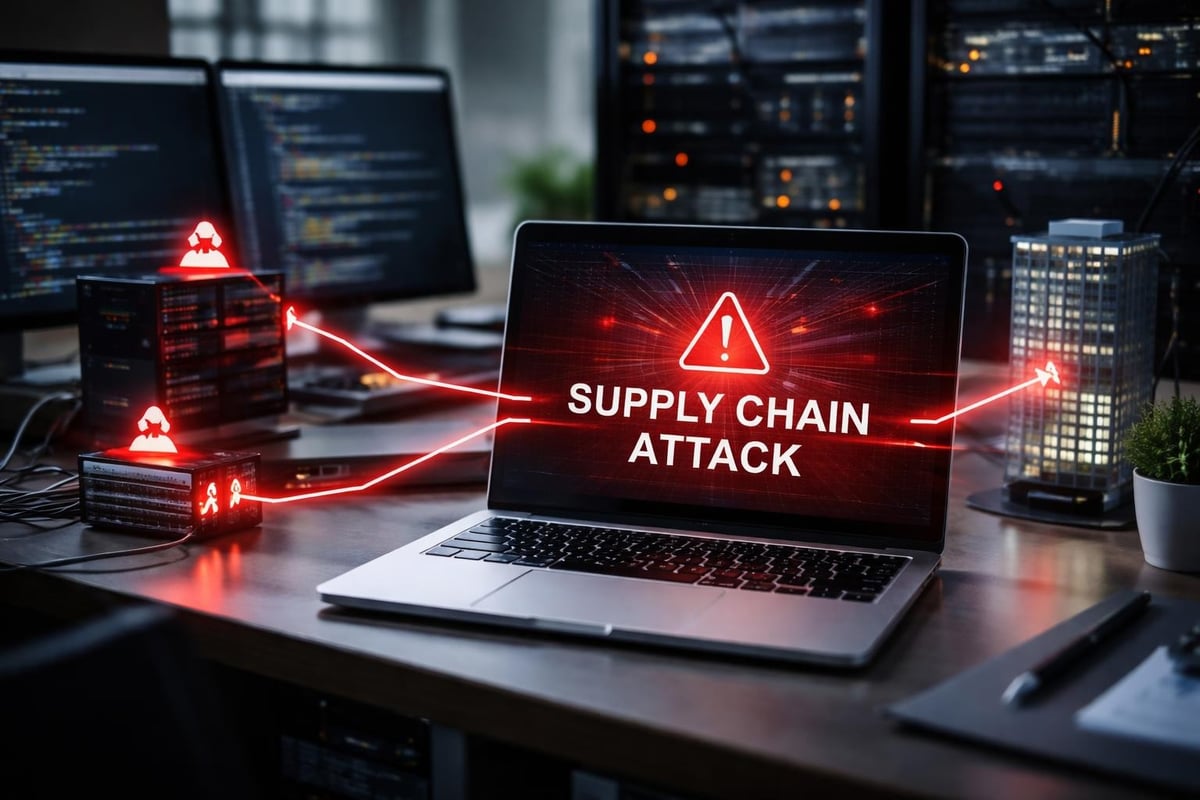
Attackers increasingly target vendors and service providers as pathways to compromise their ultimate victims. By compromising a software vendor or managed service provider, criminals can potentially access hundreds or thousands of client organizations simultaneously.
These sophisticated attacks require organizations to evaluate the security practices of every vendor with access to their networks or data. Supply chain security threats in information security represent one of the most challenging aspects of modern cybersecurity because businesses must trust partners while verifying their security posture.
AI-Powered Attacks
Artificial intelligence enables attackers to automate reconnaissance, craft more convincing phishing messages, and adapt their tactics based on defender responses. Machine learning algorithms can analyze vast amounts of data to identify vulnerabilities or predict when security teams are less vigilant.
Deepfake technology creates new social engineering possibilities, with attackers potentially impersonating executives through voice or video calls to authorize fraudulent transactions. These emerging capabilities represent the next generation of security threats in information security that businesses must prepare to defend against.
Protection Strategies and Best Practices
Defending against security threats in information security requires a comprehensive approach that combines technology solutions, process improvements, and ongoing education.
Implementing Layered Defense
No single security tool provides complete protection, making layered defense essential:
- Network perimeter controls including firewalls and intrusion detection
- Endpoint protection on all computers, servers, and mobile devices
- Email filtering to block phishing attempts and malicious attachments
- Data encryption for information at rest and in transit
- Regular backup systems with offline storage components
- Security monitoring and incident response capabilities
Each layer addresses different security threats in information security and compensates for potential failures in other defensive measures. This redundancy ensures that attackers must overcome multiple obstacles rather than exploiting a single weakness.
Employee Training and Awareness
Technology alone cannot prevent security breaches when employees unknowingly facilitate attacker access. Regular security awareness training helps staff recognize suspicious emails, understand proper data handling procedures, and report potential incidents promptly.
Training programs should cover real-world scenarios relevant to your industry and role-specific responsibilities. Simulated phishing exercises provide practical experience identifying malicious messages without the consequences of an actual breach.
Regular Security Assessments
Vulnerability scanning and penetration testing identify weaknesses before attackers discover them. These assessments should occur quarterly or after significant infrastructure changes, providing an objective evaluation of security posture.
| Assessment Type | Frequency | Primary Purpose |
|---|---|---|
| Vulnerability Scan | Monthly | Identify known software flaws |
| Penetration Test | Quarterly | Simulate real attack scenarios |
| Security Audit | Annually | Evaluate policy compliance |
| Risk Assessment | Annually | Prioritize security investments |
Critical information security threats require ongoing monitoring rather than one-time evaluation, as new vulnerabilities emerge continuously.
Building a Security-Focused Culture
Addressing security threats in information security extends beyond technical controls to encompass organizational culture and leadership commitment.
Executive Support and Resource Allocation
Security initiatives require adequate budget allocation and executive sponsorship to succeed. When leadership demonstrates commitment through resource investment and personal adherence to security policies, employees throughout the organization follow their example.
Resource allocation should address:
- Security tools and infrastructure appropriate for business size and risk profile
- Dedicated IT security expertise either internally or through managed services
- Regular training programs for all employees regardless of technical role
- Incident response planning and tabletop exercises
- Cyber insurance policies that provide financial protection and expert assistance
Understanding top threats to information technology helps executives make informed decisions about where to focus limited resources for maximum protection.
Policy Development and Enforcement
Written security policies establish expectations for employee behavior and provide frameworks for consistent decision-making. Policies should cover acceptable use of company resources, data classification and handling, password requirements, remote work security, and incident reporting procedures.
Documentation alone provides minimal value without consistent enforcement and periodic review. Organizations should update policies annually to reflect changes in technology, business operations, and the evolving threat landscape.
Incident Response Planning
Despite best efforts, organizations must prepare for the possibility that security threats in information security will occasionally succeed. Incident response plans define roles, communication protocols, and recovery procedures to minimize damage when breaches occur.
Effective plans identify who will lead response efforts, how the organization will communicate with customers and stakeholders, what forensic capabilities are available, and how operations will continue during recovery. Regular testing through tabletop exercises reveals gaps in planning before actual emergencies arise.
Monitoring and Detection Capabilities
Early detection of security threats in information security significantly reduces potential damage by limiting attacker dwell time within networks.
Security Information and Event Management
SIEM systems aggregate log data from across the IT environment, applying analytics to identify patterns that suggest malicious activity. These platforms enable security teams to detect threats that might otherwise remain hidden among massive volumes of routine network traffic.
Small businesses often lack the expertise to operate SIEM platforms effectively, making managed security services an attractive alternative. External specialists monitor alerts around the clock and investigate potential incidents before they escalate into major breaches.
Network Traffic Analysis
Monitoring network communications reveals unusual data transfers, connections to known malicious servers, or lateral movement by attackers who have gained initial access. Baseline normal activity patterns make anomalies more apparent and trigger investigations.
Network monitoring should track:
- Data volume transferred to external destinations
- Authentication attempts and account access patterns
- New devices or software appearing on the network
- Communications with geographic regions where the business has no operations
- Protocol usage that deviates from established patterns
Understanding information security principles and threat detection enables organizations to implement appropriate monitoring strategies based on their risk profile and available resources.
Endpoint Detection and Response
Traditional antivirus software provides insufficient protection against modern security threats in information security that use sophisticated evasion techniques. EDR solutions monitor endpoint behavior for suspicious activities like unauthorized encryption, unusual file access patterns, or attempts to disable security tools.
These advanced capabilities enable security teams to investigate incidents in detail, understanding exactly what occurred on compromised systems and ensuring complete removal of attacker presence. However, EDR effectiveness depends on prompt analysis and response to alerts.
Compliance and Regulatory Considerations
Many industries face specific regulatory requirements that mandate certain security controls and practices to protect customer data.
Data Protection Requirements
Organizations handling personal information must comply with privacy regulations that vary by jurisdiction and industry sector. These requirements often specify security measures including encryption, access controls, breach notification procedures, and regular security assessments.
Failure to implement required protections exposes businesses to regulatory penalties in addition to the direct costs of data breaches. Compliance frameworks provide useful guidance even for organizations not subject to formal regulations.
Documentation and Audit Requirements
Demonstrating security posture requires maintaining detailed documentation of policies, procedures, security controls, and incident histories. Regular audits verify that documented practices match actual operations and that security investments achieve their intended objectives.
Third-party assessments provide credibility when communicating security commitment to customers, partners, and insurers. These independent evaluations identify gaps that internal teams may overlook due to familiarity with existing systems.
The Role of Managed IT Services
Addressing security threats in information security effectively requires expertise, tools, and continuous attention that many small businesses cannot maintain internally. Managed IT service providers offer specialized knowledge and economies of scale that make enterprise-grade security accessible to organizations with limited budgets.
Professional IT management includes proactive monitoring, regular patching, security assessments, employee training, and incident response capabilities. Fixed-rate pricing models provide predictable costs while ensuring that security receives consistent attention rather than being deferred due to budget constraints.
Organizations partnering with managed IT service providers gain access to specialized expertise across multiple technology domains without the expense of hiring full-time specialists in each area. This comprehensive approach addresses both immediate security needs and long-term strategic planning.
Security threats in information security will continue evolving as attackers develop new techniques and businesses adopt emerging technologies that create fresh vulnerabilities. Building robust defenses requires ongoing commitment, appropriate resource allocation, and specialized expertise that many small businesses struggle to maintain independently. Delphi Systems Inc. helps Lethbridge businesses protect their IT networks through comprehensive managed services including cybersecurity, network monitoring, and data backup solutions. Our fixed-rate pricing and proactive approach keep your infrastructure secure while allowing you to focus on growing your business rather than managing technical complexities.

