



Modern small businesses face an increasingly complex threat landscape where cyberattacks and system failures can halt operations within minutes. The intersection of disaster recovery and cybersecurity creates a critical framework for organizational resilience, ensuring businesses can restore operations quickly after incidents ranging from ransomware attacks to hardware failures. For businesses in Lethbridge and surrounding areas, understanding disaster recovery cyber security isn't just about technology-it's about protecting revenue, maintaining customer trust, and ensuring long-term viability in an unpredictable digital environment.
Understanding Disaster Recovery Cyber Security Fundamentals
Disaster recovery cyber security represents the convergence of two essential business protection strategies. While traditional disaster recovery focuses on restoring IT systems after events like floods or power outages, cyber security disaster recovery specifically addresses threats originating from malicious actors and digital vulnerabilities.
This integrated approach recognizes that modern businesses face risks from multiple vectors simultaneously. A ransomware attack might encrypt critical files while also corrupting backup systems, requiring both cybersecurity expertise and recovery protocols to resolve effectively.
Key Components of Effective Protection
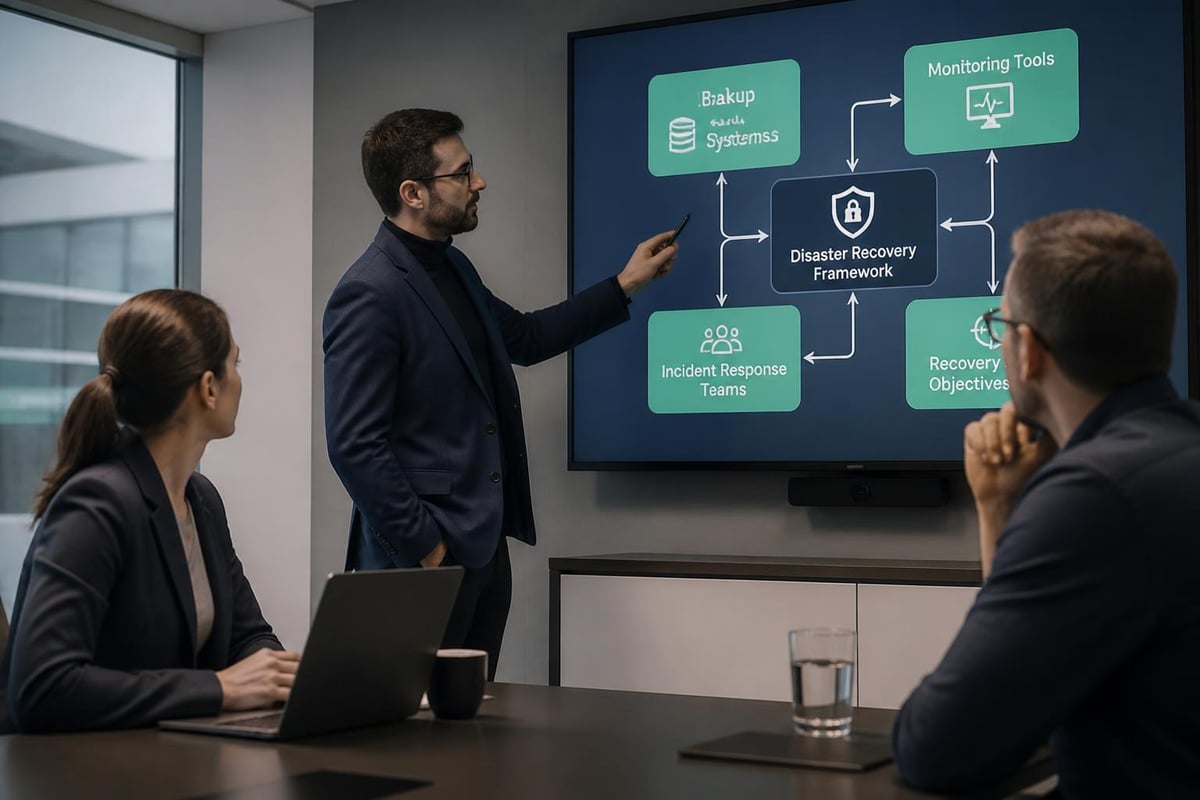
The foundation of disaster recovery cyber security rests on several interconnected elements that work together to minimize downtime and data loss:
- Redundant backup systems stored in geographically separate locations
- Real-time monitoring that detects anomalies before they escalate
- Incident response protocols that activate immediately upon threat detection
- Recovery time objectives (RTO) defining acceptable downtime thresholds
- Recovery point objectives (RPO) establishing acceptable data loss parameters
These components must function cohesively rather than as isolated solutions. A backup system without monitoring capabilities may replicate corrupted data, while monitoring without recovery protocols leaves businesses knowing about problems but unable to resolve them quickly.
The Evolving Threat Landscape for Small Businesses
Small businesses often mistakenly believe they're too insignificant to attract cybercriminal attention. However, recent data shows that businesses with fewer than 100 employees represent prime targets precisely because they typically lack enterprise-level security infrastructure.
Ransomware attacks alone increased 93% between 2024 and 2026, with attackers specifically targeting organizations in healthcare, finance, and professional services. The average ransom demand has risen to $247,000, though paying rarely guarantees data restoration.
Common Attack Vectors and Vulnerabilities
Understanding how threats manifest helps businesses prioritize their disaster recovery cyber security investments:
| Attack Type | Frequency | Average Recovery Time | Typical Data Loss |
|---|---|---|---|
| Ransomware | 48% of incidents | 21 days | 15-30% |
| Phishing | 35% of incidents | 7 days | 5-10% |
| Insider threats | 12% of incidents | 14 days | 20-40% |
| System failures | 5% of incidents | 3 days | 2-5% |
These statistics underscore why recovery becomes the strategy when cyberattacks are inevitable, shifting focus from prevention alone to comprehensive resilience planning.
The financial impact extends beyond immediate recovery costs. Businesses experience revenue loss during downtime, regulatory penalties for data breaches, increased insurance premiums, and potential customer attrition. For a typical small business generating $2 million annually, even three days of downtime translates to approximately $16,000 in lost revenue.
Building a Comprehensive Recovery Strategy
Developing disaster recovery cyber security capabilities requires systematic planning that addresses both technical and organizational dimensions. The process begins with thorough risk assessment identifying which systems are most critical to operations and which face the highest exposure to threats.
Risk Assessment and Business Impact Analysis
Every business depends on different systems for core operations. A manufacturing company might prioritize CAD software and production scheduling systems, while a professional services firm focuses on email, document management, and client databases.
Critical steps in the assessment process include:
- Cataloging all IT assets and their interdependencies
- Evaluating the potential impact of each system's failure
- Identifying data classification levels and compliance requirements
- Calculating current recovery capabilities and gaps
- Prioritizing investments based on risk and impact scores
This analysis reveals where to concentrate disaster recovery cyber security resources for maximum protection. A system supporting 80% of daily operations deserves more robust recovery capabilities than one used weekly for non-critical tasks.
Implementing Layered Defense Mechanisms
Effective protection requires multiple security layers that compensate for each other's limitations. When one control fails, others maintain protection and recovery capabilities.
The layered approach incorporates:
- Perimeter security through firewalls and intrusion detection systems
- Access controls limiting who can view or modify sensitive data
- Encryption protecting data both in transit and at rest
- Air-gapped backups isolated from network connections
- Continuous monitoring identifying unusual patterns that signal threats
Understanding the distinction between cyber recovery and disaster recovery helps organizations implement appropriate controls at each layer, ensuring comprehensive protection against diverse threat scenarios.

Testing and Maintaining Recovery Capabilities
Creating disaster recovery cyber security plans represents only the beginning. Without regular testing, businesses discover critical gaps only during actual emergencies when stakes are highest.
Structured Testing Methodologies
Organizations should implement progressively complex testing scenarios throughout the year:
Tabletop exercises gather key personnel to walk through recovery procedures verbally, identifying process gaps and unclear responsibilities without disrupting operations.
Simulation drills activate specific recovery procedures in controlled environments, testing whether backups restore correctly and whether staff can execute their assigned roles effectively.
Full-scale tests simulate complete system failures, requiring teams to restore operations using only designated recovery resources and procedures.
Each testing level reveals different insights. Tabletop exercises might expose communication breakdowns, while full-scale tests reveal whether recovery time objectives align with reality.
| Test Type | Frequency | Duration | Systems Impacted |
|---|---|---|---|
| Tabletop | Quarterly | 2-3 hours | None |
| Simulation | Semi-annually | 4-6 hours | Isolated test systems |
| Full-scale | Annually | 8-24 hours | All non-critical systems |
Measuring the effectiveness of cyber resilience requires tracking metrics like Mean Time to Clean Recovery (MTCR), which captures how quickly systems return to verified clean states after incidents.
Continuous Improvement and Documentation
Disaster recovery cyber security isn't static. New threats emerge, business processes evolve, and technology infrastructure changes, all requiring corresponding plan updates.
Documentation serves as the cornerstone of effective recovery. During high-stress incidents, staff need clear, accessible instructions rather than relying on memory or improvisation.
Essential documentation includes:
- Network diagrams showing system relationships and dependencies
- Contact lists with primary and backup personnel for each role
- Step-by-step recovery procedures for each critical system
- Vendor support information and service level agreements
- Password vaults and access credential management protocols
Update documentation immediately after infrastructure changes rather than during quarterly reviews. A server migration in March should trigger documentation updates that day, not during the June review cycle.
Incident Response Integration
When disasters strike, response speed determines outcomes. Organizations with effective cybersecurity incident response plans contain damage faster, recover more completely, and experience less operational disruption.
Response Team Structure and Roles
Effective incident response requires clear role definitions preventing both gaps in coverage and duplicated efforts. Even small businesses need designated responsibilities, though individuals may hold multiple roles.
Core incident response roles include:
- Incident commander coordinating overall response and making strategic decisions
- Technical lead directing system restoration and recovery activities
- Communications coordinator managing internal and external messaging
- Documentation specialist recording actions, decisions, and timeline
- Legal liaison ensuring compliance with notification and reporting requirements
For businesses working with managed IT service providers like Delphi Systems Inc., external experts often fill technical roles while internal staff handle communications and business continuity decisions.
The First 24 Hours After Detection
Initial response actions set the trajectory for entire recovery efforts. Mistakes during this critical window amplify damage and extend downtime significantly.

Immediate priorities focus on:
- Containment to prevent threat spread to unaffected systems
- Assessment determining the scope and nature of the incident
- Preservation of evidence for forensic analysis and potential legal action
- Communication with stakeholders about status and expectations
- Activation of recovery procedures for critical systems
Speed matters, but hasty actions often worsen situations. Taking 30 minutes to assess which systems are compromised prevents accidentally spreading ransomware to clean backup systems during rushed recovery attempts.
Data Backup Strategies for Comprehensive Protection
Backup systems form the backbone of disaster recovery cyber security, yet many businesses discover their backup strategies contain critical flaws only after data loss occurs. Following best practices for disaster recovery helps ensure backups actually protect when needed.
The 3-2-1 Rule and Beyond
The foundational 3-2-1 backup strategy provides redundancy across multiple dimensions:
- Three copies of important data (production plus two backups)
- Two different media types preventing single points of failure
- One copy stored offsite protecting against localized disasters
Modern threats require augmenting this traditional approach with additional protections. The 3-2-1-1-0 rule adds:
- One copy air-gapped and isolated from network access
- Zero errors verified through regular restoration testing
Air-gapped backups prove particularly valuable against ransomware, which typically encrypts all network-accessible storage including connected backup drives.
Backup Frequency and Retention
Determining appropriate backup schedules requires balancing data protection against storage costs and performance impacts.
| System Type | Backup Frequency | Retention Period | Method |
|---|---|---|---|
| Critical databases | Continuous/hourly | 30 days rolling | Incremental |
| Email systems | Every 4 hours | 90 days | Differential |
| File servers | Daily | 60 days | Full weekly, incremental daily |
| Workstations | Weekly | 30 days | Image-based |
Organizations must also consider compliance requirements. Healthcare businesses need seven-year retention for certain records, while financial services face different regulatory timeframes.
Cloud Integration and Hybrid Recovery Models
Cloud computing fundamentally changed disaster recovery cyber security economics. Previously, only large enterprises could afford geographically diverse recovery sites. Cloud services democratized access to sophisticated recovery capabilities, making them viable for businesses of all sizes.
Advantages of Cloud-Based Recovery
Cloud platforms offer several distinct advantages for disaster recovery:
- Scalability allowing instant resource expansion during recovery
- Geographic diversity without managing multiple physical locations
- Reduced capital expenses converting infrastructure costs to operational expenses
- Automated redundancy built into platform architecture
- Rapid deployment enabling fast recovery environment activation
However, recovery solutions operating within cloud environments require careful evaluation to ensure reliability and security meet organizational requirements.
Hybrid Approaches for Optimal Protection
Many businesses find hybrid models combining on-premises and cloud resources deliver optimal disaster recovery cyber security outcomes. Critical systems might replicate to both local backup appliances and cloud storage, providing multiple recovery pathways.
This redundancy proves valuable when primary recovery methods fail. A business facing a ransomware attack might discover encrypted on-premises backups but successfully restore from cloud copies that remained isolated from the attack.
Hybrid strategies also address bandwidth constraints. Restoring terabytes of data over internet connections takes days, while local backup appliances enable recovery in hours.
Regulatory Compliance and Legal Considerations
Data protection regulations increasingly mandate specific disaster recovery cyber security capabilities. Non-compliance carries substantial penalties beyond the direct costs of incidents themselves.
Key Regulatory Frameworks
Different industries face varying compliance requirements:
Healthcare organizations must satisfy HIPAA requirements including encryption, access controls, and breach notification protocols.
Financial services face regulations addressing data retention, recovery time objectives, and third-party service provider oversight.
Retail businesses processing credit cards must comply with PCI DSS standards covering data protection and incident response.
Even businesses without industry-specific regulations face general data protection requirements under privacy laws affecting customer information handling.
Documentation and Audit Requirements
Demonstrating compliance requires comprehensive documentation proving disaster recovery cyber security capabilities. Auditors examine:
- Written policies and procedures aligned with regulatory requirements
- Testing records showing regular validation of recovery capabilities
- Incident logs documenting responses to actual events
- Training records proving staff understand their responsibilities
- Vendor agreements ensuring third-party compliance
Maintaining current documentation serves dual purposes-satisfying auditors while providing operational guidance during actual incidents.
Financial Planning for Recovery Capabilities
Implementing disaster recovery cyber security requires investment in technology, services, and ongoing maintenance. Understanding costs helps businesses budget appropriately while avoiding both over-investment and dangerous gaps.
Direct and Indirect Cost Considerations
Technology purchases represent obvious expenses, but total cost of ownership extends much further:
Direct costs include:
- Backup software licenses and storage capacity
- Security tools and monitoring platforms
- Cloud service subscriptions
- Professional services for implementation and testing
- Training for staff and incident response teams
Indirect costs encompass:
- Staff time dedicated to testing and maintenance
- Productivity impact during testing exercises
- Opportunity costs of capital invested in recovery infrastructure
- Insurance premiums based on protection levels
Conversely, inadequate investment creates exposure to catastrophic losses. The average total cost of a data breach reached $4.88 million in 2026, with small businesses facing proportionally higher impacts relative to revenue.
Calculating Return on Investment
Quantifying disaster recovery cyber security ROI requires estimating avoided losses rather than measuring direct returns. This calculation considers:
- Probability of incidents occurring within planning periods
- Estimated downtime without adequate recovery capabilities
- Revenue loss per day of operational disruption
- Regulatory penalties for non-compliance or data breaches
- Customer attrition following service interruptions
A business generating $3 million annually with 5% net margins faces approximately $8,200 revenue loss per day of downtime. If recovery capabilities reduce average incident duration from seven days to two days, they prevent roughly $41,000 in lost revenue per incident.
Building Recovery Capabilities for Long-Term Resilience
Disaster recovery cyber security ultimately serves broader business continuity objectives. Organizations that view recovery capabilities as enabling business growth rather than merely preventing losses achieve better outcomes across all dimensions.
Integration with Business Strategy
Effective disaster recovery cyber security aligns with strategic business objectives. Companies expanding into new markets need recovery capabilities matching their geographic footprint. Businesses launching new products require protection for associated systems and data.
This strategic alignment ensures recovery investments support growth rather than constraining it. Following frameworks for creating data disaster recovery plans helps organizations develop capabilities that scale alongside business expansion.
Partnering for Enhanced Capabilities
Small businesses rarely possess internal expertise spanning all disaster recovery cyber security dimensions. Strategic partnerships with managed service providers deliver access to specialized knowledge, enterprise-grade tools, and 24/7 monitoring capabilities.
These relationships prove particularly valuable during incidents when immediate expert assistance determines outcomes. Having established relationships prevents fumbling through vendor selection processes while critical systems remain offline.
Managed service providers also maintain current knowledge as threats evolve, ensuring protection adapts to emerging risks rather than becoming obsolete as attackers develop new techniques.
Implementing comprehensive disaster recovery cyber security capabilities protects small businesses from the escalating threats that characterize today's digital landscape while ensuring compliance with regulatory requirements. Organizations that invest strategically in redundant systems, regular testing, and expert partnerships position themselves for resilience and growth regardless of disruptions. Delphi Systems Inc. helps Lethbridge-area businesses build and maintain robust disaster recovery capabilities through managed IT services, ensuring your critical systems remain protected and recoverable when you need them most.

