
Computer security firms have become indispensable partners for businesses of all sizes as cyber threats continue to evolve and intensify. These specialized organizations provide the expertise, tools, and round-the-clock monitoring that most companies cannot feasibly maintain in-house. For small and medium-sized businesses in particular, partnering with the right security provider can mean the difference between maintaining secure operations and facing devastating breaches that compromise customer data, operational continuity, and business reputation.
The Evolving Role of Computer Security Firms
The landscape of cybersecurity has transformed dramatically over the past decade. Computer security firms have evolved from simple antivirus vendors into comprehensive security partners that provide strategic guidance, threat intelligence, and proactive defense mechanisms. This shift reflects the increasingly sophisticated nature of cyber threats, from ransomware attacks that encrypt critical business data to advanced persistent threats that infiltrate networks over extended periods.
Today's security providers offer layered defense strategies rather than single-point solutions. These comprehensive approaches include network monitoring, endpoint protection, security awareness training, incident response planning, and compliance management. The escalating global cybersecurity spending projected to reach $213 billion in 2025 demonstrates how seriously organizations are taking these threats.
Strategic Partnership Models
Modern computer security firms function as strategic partners rather than mere service vendors. They work closely with business leadership to understand operational priorities, risk tolerance, and compliance requirements. This collaborative approach ensures that security measures align with business objectives rather than creating unnecessary friction or operational bottlenecks.
Key partnership characteristics include:
- Regular security assessments and vulnerability testing
- Customized security policies aligned with industry regulations
- Employee training programs to reduce human error risks
- Incident response planning and tabletop exercises
- Technology stack optimization for security and performance

Core Services Provided by Computer Security Firms
Computer security firms deliver a diverse range of services designed to address multiple threat vectors and business requirements. Understanding these service categories helps businesses identify which capabilities they need most urgently and which providers can deliver them effectively.
Managed Detection and Response
Managed Detection and Response (MDR) represents one of the fastest-growing service categories. MDR providers combine advanced technology platforms with human expertise to identify and respond to threats in real time. These services address the critical skills gap that many businesses face, where qualified security professionals are scarce and expensive to hire.
The eight key trends transforming the MDR market include skills shortages, regulatory pressures, and the integration of artificial intelligence into threat detection workflows. For small businesses, MDR services provide enterprise-grade security capabilities without the overhead of building an internal security operations center.
Network Security and Monitoring
Continuous network monitoring forms the foundation of effective cybersecurity. Computer security firms deploy sophisticated tools that analyze network traffic patterns, identify anomalies, and alert security teams to potential breaches before they escalate. This proactive approach contrasts sharply with reactive security models that only address problems after damage has occurred.
| Service Component | Business Benefit | Implementation Timeline |
|---|---|---|
| 24/7 Network Monitoring | Early threat detection | 1-2 weeks |
| Firewall Management | Controlled access | 1 week |
| Intrusion Detection | Real-time alerts | 2-3 weeks |
| Log Analysis | Compliance documentation | Ongoing |
Compliance and Regulatory Support
Regulatory compliance has become increasingly complex across industries. Computer security firms help businesses navigate requirements such as GDPR, HIPAA, PCI-DSS, and various industry-specific regulations. They provide documentation, audit support, and technical controls that demonstrate compliance to regulators and business partners.
Compliance services typically include:
- Gap analysis against regulatory requirements
- Policy and procedure development
- Technical control implementation
- Employee training and awareness programs
- Audit preparation and support
- Ongoing compliance monitoring
Selecting the Right Computer Security Firm
Choosing a security partner requires careful evaluation of capabilities, experience, and cultural fit. Not all computer security firms offer the same service quality, industry expertise, or customer support standards. Small businesses particularly need providers who understand their unique constraints around budget, staffing, and operational flexibility.
Evaluation Criteria
Technical capabilities represent the foundation of any security partnership. Evaluate providers based on the breadth and depth of their security technology stack, the certifications held by their staff, and their track record in your specific industry. Request case studies that demonstrate successful security implementations for businesses similar to yours in size and complexity.
Response time commitments matter significantly when security incidents occur. Understand the provider's service level agreements for incident response, system restoration, and ongoing support. The difference between a one-hour response time and a four-hour response time can be critical when facing an active security breach.
Transparency and communication separate exceptional providers from mediocre ones. Your security partner should provide regular reporting on security posture, threat landscape updates, and clear explanations of technical findings. Avoid providers who hide behind jargon or resist explaining their methodologies in business terms.

Industry Expertise Matters
Computer security firms that specialize in your industry bring valuable context to security planning. They understand sector-specific threats, regulatory requirements, and operational workflows that general-purpose providers might overlook. For example, healthcare providers face different security challenges than retail businesses or professional services firms.
The shift in how businesses think about the MSP market reflects growing demand for specialized expertise rather than generic IT support. Computer security firms that deeply understand your business context can anticipate threats and design more effective defenses.
The In-House vs. Outsourced Security Debate
Businesses face strategic decisions about whether to build internal security capabilities, outsource to computer security firms, or adopt hybrid models that combine both approaches. Each option presents distinct advantages and challenges that vary based on company size, risk profile, and available resources.
Cost-Benefit Analysis
Building an in-house security team requires significant investment in personnel, training, technology, and ongoing professional development. For most small and medium-sized businesses, these costs exceed what they would pay for comprehensive managed security services. However, some mid-market firms are bringing cybersecurity in-house as vendor trust declines and they seek greater control over security operations.
| Approach | Advantages | Challenges | Best For |
|---|---|---|---|
| In-House Team | Full control, deep business knowledge | High costs, retention challenges | Large enterprises |
| Outsourced Security | Cost-effective, diverse expertise | Less control, dependency | Small to mid-size businesses |
| Hybrid Model | Balanced approach, flexibility | Coordination complexity | Growing mid-market firms |
Scalability Considerations
Computer security firms provide inherent scalability that in-house teams struggle to match. As your business grows, opens new locations, or adopts new technologies, your security provider can quickly scale resources to match. This flexibility proves particularly valuable during periods of rapid change or when implementing major technology initiatives.
Outsourced providers also maintain current expertise across evolving threat landscapes. They invest continuously in training, certifications, and technology platforms that would strain most individual business budgets. This expertise sharing across multiple clients creates economies of scale that benefit all customers.
Emerging Trends Shaping Computer Security Firms
The cybersecurity industry continues to evolve rapidly in response to new threats, technologies, and business models. Understanding these trends helps businesses select forward-looking partners who will remain relevant as the security landscape shifts.
Artificial Intelligence Integration
Computer security firms increasingly leverage artificial intelligence and machine learning to enhance threat detection and response capabilities. These technologies analyze vast quantities of security data to identify patterns that human analysts might miss, automate routine tasks, and accelerate incident response workflows.
AI-powered security tools excel at:
- Analyzing user behavior to detect anomalies
- Identifying previously unknown malware variants
- Predicting potential attack vectors
- Automating threat hunting activities
- Reducing false positive alerts
Ransomware Defense Specialization
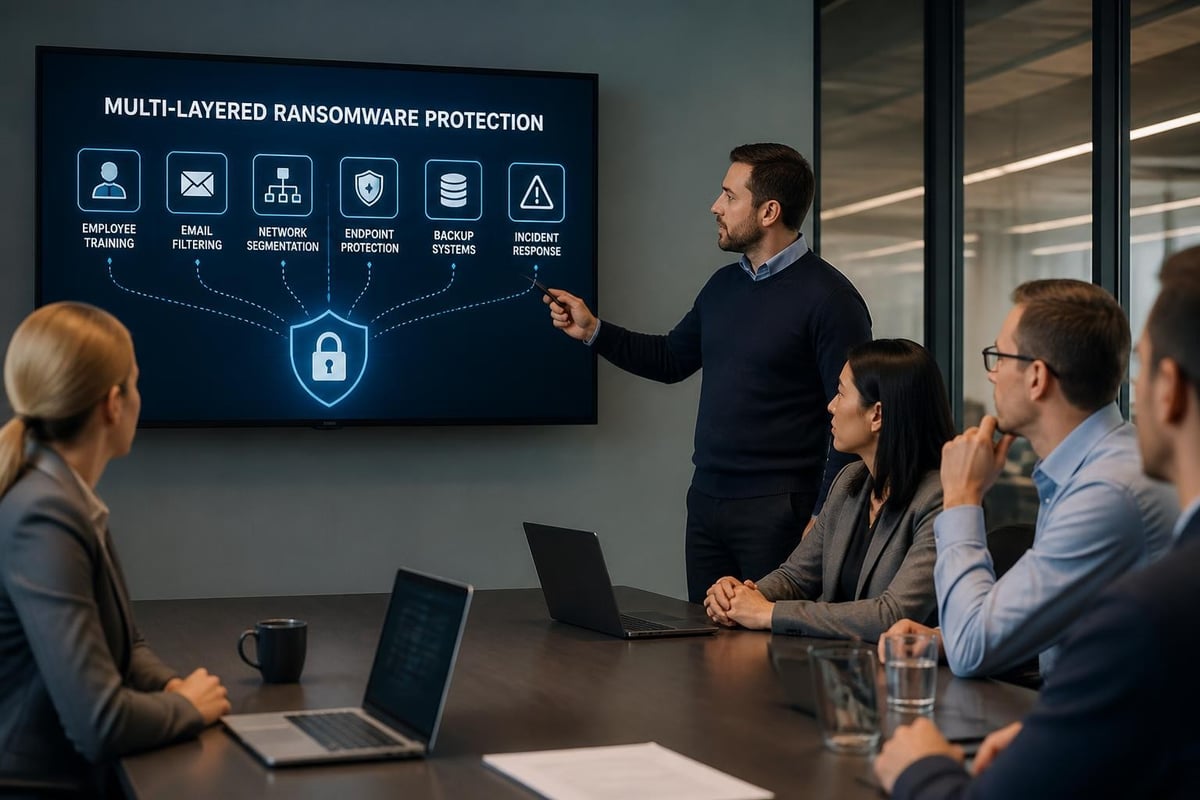
The alarming rise in ransomware group profits, which now exceed those of major corporations, has driven computer security firms to develop specialized ransomware defense capabilities. These include advanced backup strategies, network segmentation, endpoint detection and response tools, and ransomware-specific incident response planning.
Effective ransomware protection requires multiple defensive layers rather than relying on any single technology. Leading security providers combine preventive controls, detection mechanisms, and recovery capabilities to ensure businesses can withstand and recover from ransomware attacks without paying extortion demands.
Boardroom-Level Security Awareness
Security has transitioned from a back-office IT function to a boardroom priority that attracts investor attention and influences business valuations. Cybersecurity now moves from back office to boardroom as executives recognize that security incidents can destroy shareholder value, damage customer relationships, and create regulatory penalties.
Computer security firms increasingly engage with business leadership rather than exclusively with IT departments. They provide executive-level reporting, risk quantification in business terms, and strategic guidance that aligns security investments with business objectives. This elevated conversation helps justify security expenditures and ensures adequate resources for critical protections.
Measuring Security Provider Performance
Effective partnerships with computer security firms require clear performance metrics and regular evaluation. Businesses should establish measurable objectives that align security activities with business outcomes rather than focusing exclusively on technical metrics that lack business context.
Key Performance Indicators
Incident response time measures how quickly the provider detects and responds to security events. Track both the time to initial detection and the time to complete incident resolution. Industry benchmarks suggest that containing breaches within the first hour significantly reduces potential damage.
Mean time to remediate (MTTR) indicates how efficiently the provider resolves security issues once identified. Lower MTTR values demonstrate operational excellence and reduce the window of vulnerability during security incidents.
Security posture improvement tracks progress on identified vulnerabilities and security gaps. Quality providers deliver measurable improvements in overall security posture through systematic remediation of weaknesses and implementation of enhanced controls.
- Percentage of critical vulnerabilities remediated within SLA
- Reduction in security incidents period over period
- Employee security awareness test scores
- Compliance audit findings and remediation status
- System uptime and availability metrics
Regular Business Reviews
Schedule quarterly business reviews with your security provider to assess performance, discuss emerging threats, and align security strategies with evolving business priorities. These sessions should include both technical staff and business leadership to ensure comprehensive understanding of security posture and investment priorities.
Effective reviews examine recent incidents, review key metrics against targets, discuss threat intelligence relevant to your industry, and adjust security strategies based on business changes. This ongoing dialogue ensures the partnership remains valuable and responsive to your needs.
Building Long-Term Security Partnerships
The relationship between businesses and computer security firms works best as a long-term partnership rather than a transactional vendor relationship. Security providers who understand your business deeply deliver more effective protections than those treating you as just another account.
Communication and Transparency
Establish clear communication protocols that specify escalation procedures, reporting schedules, and contact methods for different scenarios. Your security provider should proactively communicate about emerging threats, planned maintenance activities, and security posture changes rather than only reaching out when problems occur.
Transparency about capabilities, limitations, and costs builds trust and prevents misunderstandings. Quality computer security firms honestly discuss what they can and cannot protect against, acknowledge when they lack specific expertise, and recommend additional measures when needed. This honesty proves more valuable than providers who promise unrealistic security guarantees.
Continuous Improvement Culture
Security effectiveness requires continuous adaptation as threats evolve and business needs change. Partner with computer security firms that demonstrate commitment to ongoing improvement through regular training, technology investments, and process refinement. Static security programs quickly become obsolete in today's dynamic threat environment.
Look for providers who conduct regular security assessments, implement lessons learned from incidents across their client base, and invest in emerging security technologies. This forward-looking approach ensures your business benefits from the collective experience of the provider's entire customer portfolio.
Regional Considerations for Small Businesses
Small businesses often benefit from working with computer security firms that understand local business conditions, regulatory environments, and support needs. Regional providers can offer more personalized service, faster on-site response when needed, and deeper understanding of local industry clusters and business relationships.
Local security providers typically maintain stronger relationships with regional law enforcement, legal resources, and industry associations that can prove valuable during security incidents. They understand area-specific threats such as targeting patterns by cybercriminal groups and can tailor defenses accordingly.
For businesses operating in smaller markets like Lethbridge and surrounding areas, Delphi Systems Inc. combines local presence with comprehensive security expertise, ensuring responsive support and personalized service that large national providers struggle to match.
Computer security firms have become essential partners for businesses navigating increasingly complex cyber threat landscapes. By carefully selecting providers based on technical capabilities, industry expertise, and cultural fit, businesses can establish security partnerships that protect operations, ensure compliance, and enable confident growth. If your business needs comprehensive cybersecurity protection with personalized local service and fixed-rate pricing that enables predictable budgeting, Delphi Systems Inc. delivers the managed IT and security services small businesses throughout the Lethbridge region need to operate securely and efficiently.

