
Small businesses face an unprecedented wave of cyber threats in 2026, making robust cybersecurity solutions for business more critical than ever. Every day, cybercriminals target companies with sophisticated attacks designed to steal data, disrupt operations, and damage reputations. For businesses in Lethbridge and across Canada, understanding and implementing comprehensive security measures isn't optional anymore. It's a fundamental requirement for survival and growth. The right cybersecurity approach protects your network infrastructure, safeguards customer information, and ensures business continuity even when threats emerge.
Understanding the Modern Threat Landscape
The cybersecurity challenges facing small businesses have evolved dramatically over the past few years. Ransomware attacks have become more targeted, phishing schemes more convincing, and data breaches more costly.
Cybercriminals no longer focus exclusively on large corporations. They've recognized that small businesses often lack dedicated IT security teams, making them easier targets. A single successful attack can cost a small business thousands of dollars in recovery expenses, lost productivity, and damaged customer trust.
Common threats include:
- Ransomware attacks that encrypt business data and demand payment for restoration
- Phishing emails designed to trick employees into revealing credentials or downloading malware
- Insider threats from careless or malicious employees with access to sensitive systems
- DDoS attacks that overwhelm networks and take systems offline
- Supply chain compromises where attackers exploit vulnerabilities in third-party software
According to the Federal Trade Commission’s cybersecurity guidance, small businesses should prioritize protecting customer information and securing their networks as foundational security measures.
Why Small Businesses Are Prime Targets
Small businesses present attractive opportunities for cybercriminals for several specific reasons. Limited security budgets often mean outdated software, unpatched systems, and inadequate monitoring. Many small companies also handle valuable data like customer payment information, employee records, and proprietary business intelligence.
The perception that small businesses won't invest in sophisticated security makes them appear vulnerable. Attackers know that many smaller organizations operate under the assumption that they're "too small to be targeted," which creates complacency.

Essential Components of Cybersecurity Solutions for Business
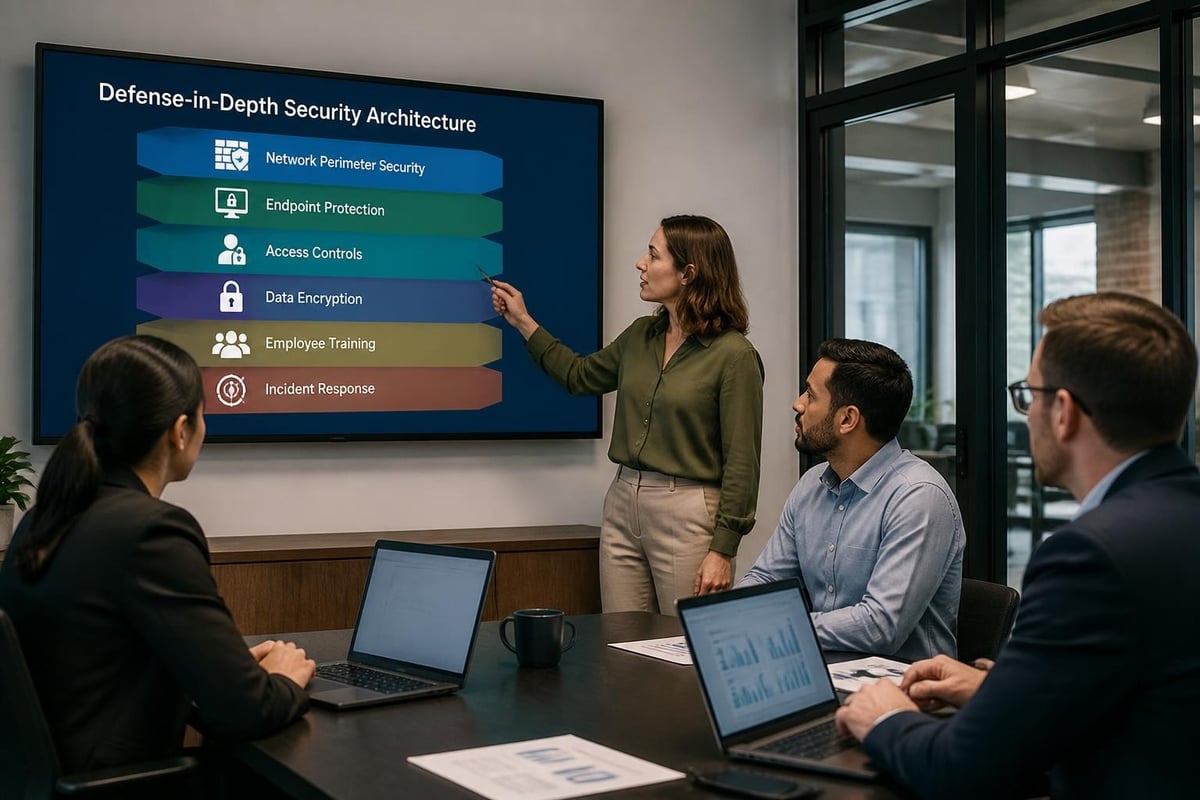
Building effective cybersecurity solutions for business requires a multi-layered approach that addresses vulnerabilities at every level. No single technology or practice provides complete protection. Instead, businesses need integrated systems that work together to detect, prevent, and respond to threats.
Network Security Foundation
Your network represents the backbone of your IT infrastructure and requires robust protection mechanisms. Implementing enterprise-grade firewalls creates the first line of defense against external threats. These systems monitor incoming and outgoing traffic, blocking suspicious activity before it reaches your internal systems.
Network segmentation divides your infrastructure into separate zones, limiting how far an attacker can move if they breach one area. Guest networks should remain completely isolated from business systems, preventing visitors from accessing sensitive resources.
| Security Layer | Purpose | Key Features |
|---|---|---|
| Firewall | Perimeter defense | Traffic filtering, intrusion prevention, application control |
| VPN | Secure remote access | Encrypted connections, authentication, access logging |
| Network Monitoring | Threat detection | Real-time alerts, traffic analysis, anomaly detection |
| Access Controls | User management | Role-based permissions, multi-factor authentication, session monitoring |
Virtual Private Networks (VPNs) ensure that remote workers connect securely to company resources. With hybrid work becoming standard in 2026, encrypted connections protect data transmitted between home offices and central servers.
Endpoint Protection and Management
Every device that connects to your network represents a potential entry point for attackers. Computers, smartphones, tablets, and IoT devices all require protection through comprehensive endpoint security solutions.
Modern antivirus and anti-malware software goes far beyond signature-based detection. Advanced endpoint protection platforms use behavioral analysis and machine learning to identify and block previously unknown threats. These systems can detect ransomware based on suspicious file encryption patterns and stop attacks before damage occurs.
Regular patch management addresses vulnerabilities in operating systems and applications. The National Institute of Standards and Technology emphasizes that keeping software updated ranks among the most effective security measures businesses can implement.
Critical endpoint security practices:
- Deploy managed antivirus across all devices
- Enable automatic security updates for operating systems
- Implement device encryption for laptops and mobile devices
- Enforce strong password policies with complexity requirements
- Install mobile device management for smartphones and tablets
Data Backup and Recovery Systems
Even the most sophisticated cybersecurity solutions for business can't guarantee 100% protection against every threat. Data backup and recovery systems ensure business continuity when attacks succeed or hardware failures occur.
The 3-2-1 backup strategy remains the industry standard: maintain three copies of your data, store them on two different media types, and keep one copy offsite. Cloud-based backup solutions offer automated, encrypted backups that execute without user intervention.
Testing backup restoration regularly confirms that your recovery systems actually work when needed. Many businesses discover backup failures only after experiencing data loss, when it's too late to implement corrections.
Employee Training and Security Awareness
Technology alone cannot secure a business when employees inadvertently create vulnerabilities. Human error contributes to the majority of successful cyberattacks, making security awareness training essential.
Building a Security-Conscious Culture
Effective training programs teach employees to recognize phishing attempts, handle sensitive data appropriately, and follow security protocols consistently. Regular simulated phishing tests help identify vulnerable employees who need additional guidance.
Security awareness shouldn't be a one-time orientation session. Ongoing training keeps cybersecurity top-of-mind and addresses emerging threats as they develop. Monthly security tips, quarterly training sessions, and immediate alerts about current scam campaigns maintain awareness.
Creating clear security policies establishes expectations for acceptable technology use. Policies should cover password management, acceptable use of company devices, social media guidelines, and incident reporting procedures.
The U.S. Small Business Administration’s cybersecurity resources provide frameworks for developing security policies appropriate for small business environments.
Access Management and Authentication
Controlling who accesses what resources forms a cornerstone of effective cybersecurity solutions for business. The principle of least privilege ensures employees can only access systems and data necessary for their specific roles.
Implementing Multi-Factor Authentication
Multi-factor authentication (MFA) adds critical security beyond passwords alone. Even if attackers steal or guess a password, they can't access accounts without the second authentication factor. MFA combines something you know (password), something you have (smartphone or hardware token), and something you are (biometric verification).
Implementing MFA across all business applications, particularly email and financial systems, dramatically reduces unauthorized access risks. Many cloud services now offer built-in MFA options that integrate seamlessly with existing workflows.
Access control best practices include:
- Regular access reviews to remove unnecessary permissions
- Immediate credential revocation when employees leave
- Privileged access management for administrator accounts
- Activity logging and monitoring for suspicious behavior
- Password managers to enable complex, unique passwords
Role-Based Access Controls
Role-based access controls (RBAC) assign permissions based on job functions rather than individual users. When employees change positions, updating their role automatically adjusts their access rights. This approach simplifies administration while reducing the risk of excessive permissions.
Guest and contractor access requires special attention. Temporary accounts should expire automatically, and external users should never receive the same access levels as permanent employees.
Cloud Security Considerations
As businesses increasingly adopt cloud computing platforms, securing cloud environments becomes paramount. Cloud security represents a shared responsibility between service providers and customers.
Cloud providers secure the infrastructure, while businesses must protect their data, configure security settings properly, and manage user access. Misconfigured cloud storage buckets have exposed millions of records in recent data breaches, often because businesses failed to enable basic security controls.
| Cloud Security Measure | Implementation | Benefit |
|---|---|---|
| Encryption at rest | Enable in cloud service settings | Protects data stored in cloud systems |
| Encryption in transit | Use TLS/SSL for all connections | Secures data during transmission |
| Access logging | Enable audit trails | Tracks who accessed what data and when |
| Geographic restrictions | Configure allowed regions | Limits data exposure and ensures compliance |

Compliance and Regulatory Requirements
Many industries face specific cybersecurity regulations that businesses must follow. Healthcare organizations must comply with HIPAA, financial institutions face regulatory requirements, and businesses handling payment cards must meet PCI DSS standards.
Even businesses without industry-specific regulations should align with recognized frameworks. The Center for Internet Security provides guidance for managed service providers and their clients on implementing comprehensive security controls.
Privacy Legislation Impact
Canadian privacy laws, including PIPEDA and provincial regulations, require businesses to implement reasonable security safeguards for personal information. Data breach notification requirements mean companies must report significant breaches to affected individuals and regulatory authorities.
Maintaining compliance documentation demonstrates your commitment to security and provides evidence of due diligence if breaches occur. Documentation should include security policies, training records, risk assessments, and incident response plans.
Selecting Cybersecurity Solutions for Business
Choosing appropriate security solutions requires assessing your specific business needs, risks, and budget constraints. Not every business requires enterprise-level security, but every business needs foundational protections.
Risk Assessment Process
Begin with a comprehensive risk assessment that identifies your most valuable assets, likely threats, and existing vulnerabilities. The North Carolina Department of Information Technology offers tools specifically designed to help small businesses conduct effective security assessments.
Understanding your risk profile helps prioritize security investments. Businesses handling sensitive customer data should invest heavily in data protection and access controls. Companies dependent on continuous operations might prioritize redundancy and disaster recovery.
Assessment considerations:
- Inventory all devices, applications, and data repositories
- Identify compliance requirements for your industry
- Evaluate current security measures and gaps
- Estimate potential impact of various threat scenarios
- Calculate acceptable risk levels versus mitigation costs
Managed Security Services
Many small businesses lack the expertise or resources to manage sophisticated cybersecurity solutions for business internally. Managed IT service providers offer comprehensive security management at fixed monthly costs.
Delphi Systems Inc. demonstrates how managed services deliver enterprise-grade security to small businesses. Professional management ensures security systems receive proper configuration, regular updates, and continuous monitoring without requiring in-house expertise.
Managed security services typically include 24/7 network monitoring, threat detection and response, patch management, security assessments, and compliance support. This approach provides predictable costs while ensuring expert oversight.
Incident Response Planning
Despite best efforts, security incidents will occur. Having a documented incident response plan ensures your team knows exactly how to react when breaches happen, minimizing damage and recovery time.
Response Plan Components
Effective incident response plans identify response team members, define communication protocols, and outline specific steps for containing, investigating, and recovering from different incident types.
Plans should address various scenarios including ransomware attacks, data breaches, DDoS attacks, and insider threats. Each scenario requires different response procedures, though common elements include isolating affected systems, preserving evidence, and notifying stakeholders.
Testing your incident response plan through tabletop exercises reveals gaps and ensures team members understand their roles. Annual testing keeps plans current as your infrastructure evolves.
| Response Phase | Key Actions | Responsible Party |
|---|---|---|
| Detection | Identify and verify incident | Security monitoring team |
| Containment | Isolate affected systems | IT administrator |
| Investigation | Determine scope and cause | Security specialist |
| Eradication | Remove threat from environment | Technical team |
| Recovery | Restore normal operations | IT operations |
| Review | Document lessons learned | Management team |
Communication protocols define who contacts customers, regulatory authorities, law enforcement, and media if necessary. Prepared templates for breach notifications save critical time during high-stress incidents.
Security Monitoring and Maintenance
Implementing cybersecurity solutions for business isn't a one-time project. Ongoing monitoring, maintenance, and adaptation ensure security measures remain effective against evolving threats.
Continuous Monitoring Approaches
Security Information and Event Management (SIEM) systems aggregate logs from across your infrastructure, correlating events to detect sophisticated attacks that span multiple systems. These platforms identify patterns indicating compromised accounts, lateral movement within networks, and data exfiltration attempts.
Regular vulnerability scanning identifies security weaknesses before attackers exploit them. Monthly or quarterly scans test for missing patches, misconfigurations, weak passwords, and exposed services.
Penetration testing takes vulnerability assessment further by simulating actual attacks against your systems. Annual penetration tests provide valuable insights into how well your defenses perform against determined attackers.
Keeping Pace with Threats
Threat intelligence feeds provide information about emerging attack techniques, newly discovered vulnerabilities, and active threat campaigns. Integrating threat intelligence into security monitoring helps detect attacks earlier in their lifecycle.
Security solutions require regular updates beyond just patching software. Firewall rules need refinement, access controls require periodic review, and backup procedures should adapt to changing business needs.
Budget Considerations for Small Businesses
Small businesses must balance comprehensive security against budget constraints. Fortunately, effective cybersecurity solutions for business don't require unlimited resources when implemented strategically.
Prioritize investments based on risk assessment findings. Protect your most critical assets first, then address secondary concerns as budget allows. Free and low-cost tools can provide adequate protection for many functions when properly implemented.
Cost-effective security measures:
- Use reputable free antivirus solutions for basic endpoint protection
- Leverage built-in security features in existing software and services
- Implement strong policies that cost nothing but provide significant protection
- Focus training resources on high-risk employees first
- Consider managed services for predictable monthly costs
Many security vendors offer solutions specifically designed for small business budgets. These scaled-down versions of enterprise platforms provide essential protection without unnecessary features that increase costs.
Fixed-rate managed IT services eliminate unpredictable security expenses while ensuring professional oversight. This model aligns cybersecurity costs with business budgets, making advanced protection accessible to organizations of all sizes.
Integration with Business Operations
Effective security solutions integrate seamlessly with business processes rather than creating obstacles. Overly restrictive security measures frustrate employees and encourage workarounds that create new vulnerabilities.
Balance security requirements against operational needs. Multi-factor authentication adds friction to login processes but provides essential protection. Finding the right balance requires understanding specific business workflows and risks.
Security measures should enable business growth, not hinder it. Cloud security solutions allow safe expansion into new markets. Secure remote access enables hiring talent regardless of location. Proper data protection builds customer trust and competitive advantage.
Future-Proofing Your Security Strategy
The cybersecurity landscape continues evolving rapidly, with artificial intelligence enhancing both attack and defense capabilities. Future-proof security strategies build flexibility into infrastructure and maintain adaptability as threats change.
Artificial intelligence and machine learning increasingly power both defensive and offensive security tools. AI-enhanced threat detection identifies anomalies faster and more accurately than traditional rule-based systems. However, attackers also leverage AI to create more convincing phishing messages and evade detection systems.
Zero trust architecture represents the future of network security, operating on the principle of "never trust, always verify." Rather than trusting users inside the network perimeter, zero trust continuously validates every access request regardless of source.
Planning for quantum computing's eventual impact on encryption ensures long-term data protection. While practical quantum computers remain years away, beginning transition planning now prevents future vulnerabilities.
Protecting your business from cyber threats requires comprehensive cybersecurity solutions for business that address technical vulnerabilities, human factors, and operational processes. Small businesses in Lethbridge and surrounding areas don't need to navigate these complex security challenges alone. Delphi Systems Inc. provides managed IT services including cybersecurity, network monitoring, data backup, and ongoing support with predictable fixed-rate pricing, allowing you to focus on growing your business while ensuring your IT infrastructure remains secure and efficiently managed.

