
Small businesses face an increasingly complex technology landscape in 2026, where maintaining secure, efficient IT infrastructure demands expertise that many organizations lack in-house. IT managed IT services have emerged as the strategic solution, enabling companies to access enterprise-level technology management without the overhead of building internal IT departments. This approach transforms how businesses operate, shifting from reactive troubleshooting to proactive infrastructure management that prevents problems before they impact productivity.
Understanding the Modern Managed IT Service Model
The foundation of it managed it services rests on a partnership model where external specialists assume responsibility for maintaining, monitoring, and securing business technology systems. Unlike traditional break-fix IT support that responds only after problems occur, managed services operate on a continuous monitoring basis with fixed-rate fee structures that create budget predictability.
Core components typically include:
- 24/7 network monitoring and performance optimization
- Proactive security threat detection and response
- Regular system updates and patch management
- Cloud infrastructure management and optimization
- Help desk support for end-user technical issues
- Strategic technology planning and consultation
This comprehensive approach addresses the reality that managed service providers have become critical digital trust infrastructure, serving as the frontline defense against increasingly sophisticated cyber threats. The shift represents a fundamental change in how businesses approach technology, treating IT as a strategic asset rather than a necessary expense.
Service Delivery Structure
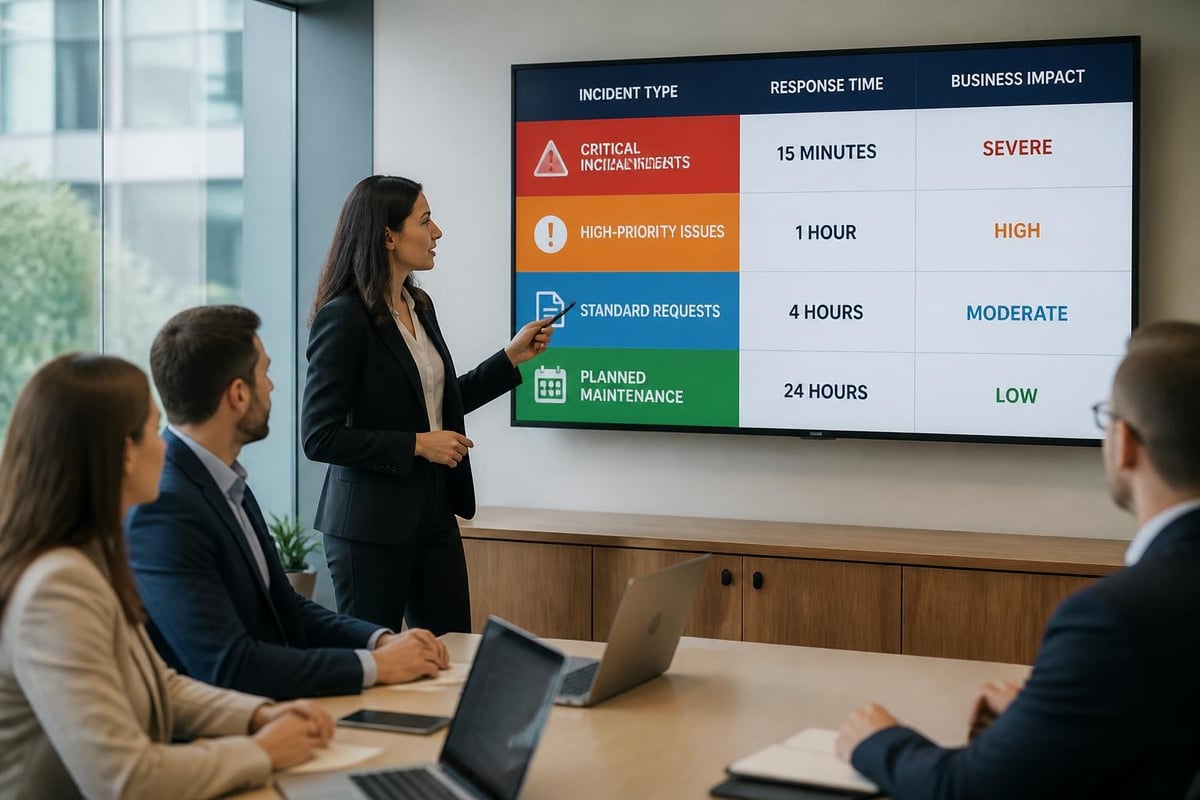
Modern it managed it services operate through layered service agreements that define responsibilities, response times, and performance metrics. These agreements establish clear expectations for both parties, eliminating ambiguity about who handles specific technology functions.
| Service Tier | Response Time | Coverage Hours | Typical Applications |
|---|---|---|---|
| Critical | 15-30 minutes | 24/7 | Server outages, security breaches |
| High Priority | 2-4 hours | Business hours | Email issues, network slowdowns |
| Standard | 8-24 hours | Business hours | Software questions, minor bugs |
| Planned | Scheduled | Flexible | Updates, upgrades, training |
The tiered approach ensures that resources align with business impact, directing immediate attention to issues that affect operations while handling routine matters through scheduled maintenance windows.
The Financial Architecture of Managed IT Solutions
Pricing structures for it managed it services have evolved beyond simple per-user models to reflect the complexity and value of modern technology management. According to recent managed IT pricing statistics, most U.S. businesses invest between $100 and $200 per user monthly, though actual costs vary significantly based on geographic location, service scope, and industry requirements.
Factors influencing pricing include:
- Infrastructure complexity – Number of servers, applications, and integration points
- Security requirements – Compliance obligations, data sensitivity levels
- User count and distribution – Total employees and remote workforce percentage
- Service level expectations – Response times, availability guarantees
- Strategic services – Cloud migration support, digital transformation initiatives
The fixed-rate model common in it managed it services creates budget certainty that traditional IT spending cannot match. Businesses eliminate unpredictable emergency repair costs, expensive downtime, and the challenge of estimating technology expenses quarter to quarter.
Return on Investment Calculations
Evaluating the financial impact of managed services requires looking beyond monthly fees to total cost of ownership. Organizations must compare the complete expense of internal IT operations against outsourced management.
Internal IT costs include salaries, benefits, training, certification maintenance, software licenses, monitoring tools, and the opportunity cost of management attention diverted to technology issues. When comprehensive calculations include these factors, many small businesses discover that it managed it services deliver superior capabilities at lower total cost.
The productivity gains prove equally significant. When employees spend less time waiting for technical support and systems experience fewer disruptions, the operational efficiency improvements often justify the investment independent of direct cost comparisons.
Cybersecurity Within Managed Service Frameworks
Security represents the most critical component of modern it managed it services, particularly as cyber threats grow more sophisticated and regulatory requirements expand. Small businesses increasingly find themselves targeted by attackers who view them as easier prey than large enterprises with extensive security teams.
Managed security services typically encompass multiple protective layers working in concert to prevent, detect, and respond to threats. This defense-in-depth approach acknowledges that no single security measure provides complete protection.
Essential Security Components
Perimeter defense establishes the first line of protection through firewalls, intrusion detection systems, and email filtering that blocks threats before they reach internal networks. These systems require constant updates to recognize emerging attack patterns.
Endpoint protection secures individual devices through antivirus software, application whitelisting, and device management policies that prevent unauthorized software installation and data access.
Access management controls who can reach specific systems and data through multi-factor authentication, role-based permissions, and regular access reviews that ensure employees maintain only necessary privileges.
Security monitoring provides continuous surveillance of network activity, identifying anomalous behavior that might indicate compromise. This 24/7 vigilance catches threats that automated systems miss.
| Security Layer | Primary Function | Common Tools | Update Frequency |
|---|---|---|---|
| Network Perimeter | Block external threats | Next-gen firewalls, IDS/IPS | Daily signature updates |
| Email Security | Filter phishing, malware | Gateway scanners, sandboxing | Hourly pattern updates |
| Endpoint Protection | Secure individual devices | EDR platforms, antivirus | Real-time threat intelligence |
| Identity Management | Control access rights | SSO, MFA, PAM | Continuous authentication |
The integration of these security elements within it managed it services ensures that protection stays current without requiring internal expertise in each specialized area. As AI demand soars in managed services, with 48% of providers citing it as a top client priority, artificial intelligence increasingly enhances threat detection capabilities beyond what human analysts can achieve alone.

Cloud Integration and Management
Cloud computing has transformed from an optional technology to a foundational element of business operations, making cloud management a central feature of it managed it services. Organizations leverage cloud platforms for applications, storage, backup, disaster recovery, and entire infrastructure environments.
Primary cloud service categories include:
- Software as a Service (SaaS) – Applications like Microsoft 365, Salesforce, and collaboration tools
- Infrastructure as a Service (IaaS) – Virtual servers, storage, and networking from providers like AWS and Azure
- Platform as a Service (PaaS) – Development environments and application hosting frameworks
- Backup as a Service (BaaS) – Cloud-based data protection and recovery solutions
Managing these diverse cloud environments requires expertise in vendor platforms, security configurations, cost optimization, and integration with on-premises systems. Small businesses often find that cloud complexity exceeds their internal capabilities, making professional management essential to realizing cloud benefits.
Cloud Cost Optimization
One of the most valuable aspects of cloud-focused it managed it services involves controlling the expenses that can spiral out of control without proper oversight. Cloud platforms bill based on resource consumption, creating situations where unused virtual machines, oversized storage allocations, and inefficient configurations drive unnecessary costs.
Managed service providers monitor cloud spending patterns, identify waste, rightsize resources to match actual needs, and implement governance policies that prevent cost overruns. These optimization efforts frequently save more than the cost of management services themselves.
Data Protection and Business Continuity
Data backup and disaster recovery planning form critical components of comprehensive it managed it services, yet many small businesses underestimate their importance until facing data loss. The statistics prove sobering: organizations that lose critical data often struggle to recover, with some never resuming full operations.
Modern backup strategies follow the 3-2-1 rule as a minimum standard: maintain three copies of data, store copies on two different media types, and keep one copy offsite. Cloud backup solutions have simplified implementing this approach while improving recovery capabilities.
Recovery Time and Point Objectives
Business continuity planning centers on two key metrics that define acceptable data loss and downtime tolerances. Recovery Point Objective (RPO) specifies how much data loss the organization can tolerate, measured in time between backups. Recovery Time Objective (RTO) defines how quickly systems must be restored after disruption.
Understanding these requirements drives backup frequency, storage locations, and recovery procedures within it managed it services agreements. A business requiring four-hour RTO needs fundamentally different infrastructure than one accepting 24-hour restoration windows.
| Business Type | Typical RPO | Typical RTO | Backup Frequency | Common Solution |
|---|---|---|---|---|
| Professional Services | 4-8 hours | 8-24 hours | Daily incremental | Cloud backup with local cache |
| Healthcare | 1-2 hours | 2-4 hours | Continuous replication | Hybrid cloud with failover |
| Retail | 2-4 hours | 4-8 hours | Multiple daily backups | Cloud-based disaster recovery |
| Manufacturing | 8-12 hours | 12-24 hours | Daily full backups | Offsite cloud storage |
Testing recovery procedures regularly ensures that theoretical backup plans actually work when needed. Many organizations discover backup failures only during actual emergencies, making routine testing an essential element of professional it managed it services.
Strategic Technology Planning and Consultation
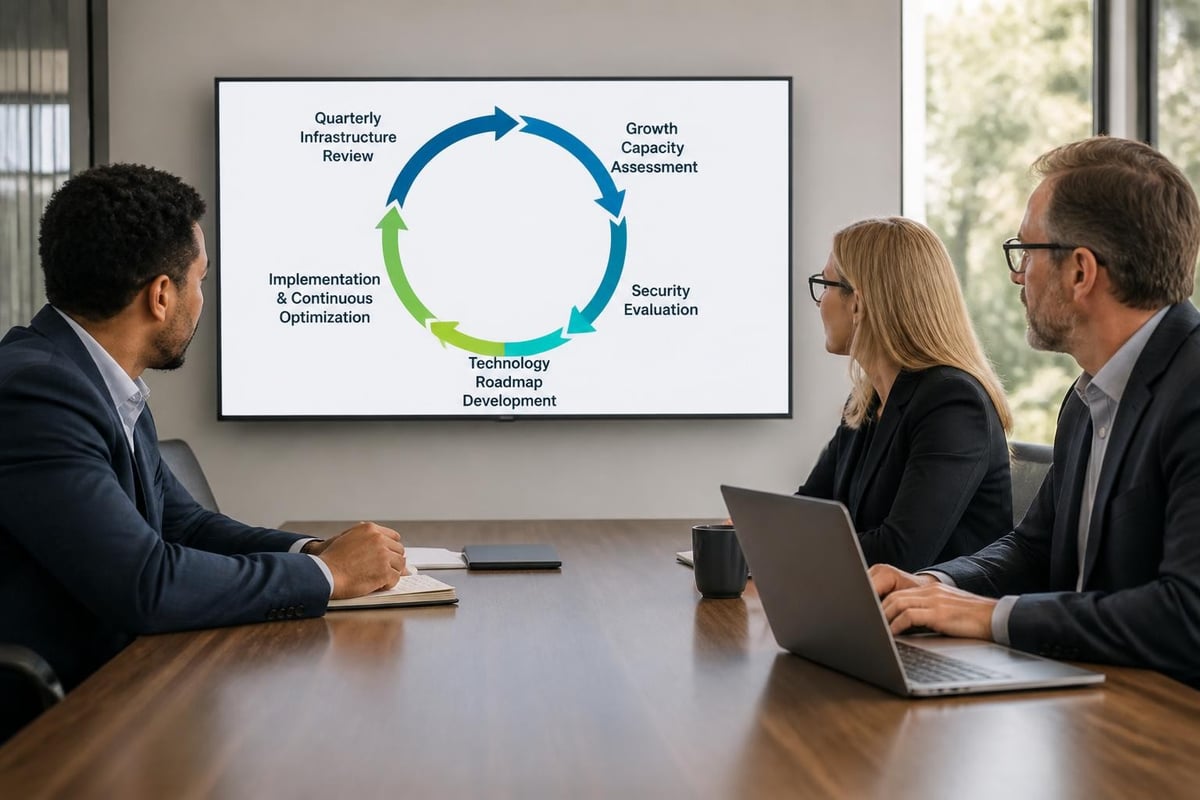
Beyond daily operational support, effective it managed it services include strategic planning that aligns technology investments with business objectives. This forward-looking approach prevents the common pattern of reactive technology decisions that create fragmented, inefficient systems.
Strategic planning sessions typically occur quarterly or semi-annually, reviewing current infrastructure performance, identifying limitations affecting business growth, evaluating emerging technologies relevant to the industry, and developing multi-year technology roadmaps.
Planning considerations include:
- Scalability assessment – Whether current systems can support anticipated growth
- Technology lifecycle management – Timing hardware and software refresh cycles
- Security posture evaluation – Identifying and addressing vulnerability gaps
- Compliance requirements – Ensuring systems meet regulatory obligations
- Digital transformation opportunities – Leveraging technology for competitive advantage
This consultative relationship transforms IT from a reactive support function into a strategic business enabler. The extensive knowledge that managed service providers gain across multiple clients provides valuable perspective on what technologies deliver actual business value versus those that generate hype without substance.
Service Agreement Essentials and Partner Selection
Selecting an it managed it services provider requires careful evaluation of capabilities, cultural fit, and contractual terms that protect both parties. According to guidance on essential managed service agreement components, successful partnerships depend on clearly defined service level agreements, specific scope definitions, and fair termination provisions.
Critical agreement elements include:
- Defined service scope – Explicitly listing included and excluded services
- Performance metrics – Measurable standards for response times and resolution rates
- Security responsibilities – Clarifying who handles specific security functions
- Escalation procedures – Processes for addressing service failures or disputes
- Change management – How modifications to services or fees are handled
- Exit provisions – Terms for transitioning services if the relationship ends
The partnership succeeds when expectations align from the start. Vague agreements create friction as parties discover different interpretations of responsibilities. Detailed contracts prevent misunderstandings while establishing accountability frameworks.
Evaluating Provider Capabilities
Assessing potential it managed it services partners involves examining technical certifications, client references, financial stability, and cultural compatibility. Technical expertise matters, but so does communication style and responsiveness.
Request demonstrations of monitoring platforms, review sample reports that clients receive, ask about staffing levels and escalation procedures, and verify certifications from major technology vendors. The provider's investment in tools and training indicates their commitment to service quality.
Industry-specific experience adds significant value, as providers familiar with particular business types understand relevant compliance requirements, common technology challenges, and effective solutions. Research shows significant variation in managed IT service focus by industry, with 65% targeting healthcare and 63% serving finance, while only 31% focus on manufacturing despite its high cybersecurity risks.
Artificial Intelligence Integration in Managed Services
Artificial intelligence represents the most significant evolution in it managed it services since cloud computing adoption, fundamentally changing how providers monitor networks, detect threats, and optimize performance. As AI emerges as key to MSP success, providers increasingly leverage machine learning for predictive maintenance, automated incident response, and intelligent resource allocation.
AI-enhanced monitoring systems analyze patterns across thousands of data points simultaneously, identifying anomalies that human analysts would miss. These systems predict equipment failures before they occur, enabling proactive replacement that prevents downtime.
AI applications in managed services include:
- Predictive analytics – Forecasting system failures and capacity needs
- Automated threat detection – Identifying security incidents through behavioral analysis
- Intelligent ticket routing – Directing support requests to appropriate specialists
- Performance optimization – Automatically adjusting configurations for efficiency
- Natural language help desk – Chatbots handling routine support questions
The integration of AI doesn't eliminate human expertise but rather amplifies its effectiveness. Technical specialists focus on complex problem-solving and strategic initiatives while AI handles repetitive monitoring and initial incident triage.
Transition Planning and Implementation
Moving to it managed it services requires careful planning to ensure continuity during the transition period. Rushed implementations create gaps in coverage and service disruptions that undermine the partnership from the start.
Effective transitions typically span 30 to 90 days depending on infrastructure complexity, following a structured process that begins with comprehensive discovery. The provider documents existing systems, configurations, passwords, vendor relationships, and user requirements to establish baseline understanding.
Phased Transition Approach
- Discovery and assessment phase – Documenting current environment and requirements
- Monitoring implementation – Installing tools and establishing visibility
- Service desk transition – Transferring user support responsibilities
- Proactive management activation – Implementing maintenance and optimization
- Strategic planning initiation – Beginning long-term technology roadmap development
Running parallel support during initial weeks provides safety nets, allowing internal staff to remain available while the new provider assumes responsibilities. This overlap period identifies gaps and allows process refinement before complete handoff.
Communication with employees proves crucial during transitions, explaining new support procedures, introducing help desk contacts, and setting expectations for response times. Users adapt more readily when they understand changes and see consistent service quality.
Measuring Service Value and Performance
Successful it managed it services partnerships depend on transparent performance measurement that demonstrates value delivery. Monthly or quarterly business reviews provide forums for examining metrics, discussing challenges, and planning improvements.
Key performance indicators typically tracked include:
| Metric Category | Specific Measures | Target Ranges | Business Impact |
|---|---|---|---|
| Availability | System uptime percentage | 99.5-99.9% | Revenue continuity, productivity |
| Response | Ticket response times | Per SLA tiers | User satisfaction, issue resolution |
| Security | Blocked threats, incidents | Threat reduction trends | Risk mitigation, compliance |
| Resolution | First-call resolution rate | 70-85% | Efficiency, user experience |
| Performance | Network speed, application response | Baseline improvements | Operational efficiency |
Beyond technical metrics, business-focused measures demonstrate how technology improvements affect organizational performance. Tracking help desk ticket volumes over time reveals whether proactive management reduces support needs. Monitoring system availability shows uptime improvements. Documenting security incident trends demonstrates risk reduction.
The most valuable managed service relationships evolve beyond vendor-client dynamics into trusted advisor partnerships where technology decisions receive strategic business context and recommendations align with organizational objectives rather than simply technical preferences.
Industry-Specific Considerations and Compliance
Different industries face unique technology requirements that influence how it managed it services are structured and delivered. Healthcare organizations must comply with HIPAA regulations governing patient data protection. Financial services firms face SEC and FINRA requirements. Professional services businesses need robust confidentiality protections for client information.
Managed service providers with industry experience understand these specific requirements and build compliance into standard service delivery. They maintain certifications relevant to the sectors they serve, implement appropriate security controls, and document procedures that satisfy auditor requirements.
Regulatory Framework Integration
Compliance obligations affect backup retention periods, access control implementations, encryption requirements, and audit logging capabilities. For comprehensive guidance on how businesses can leverage managed services while meeting regulatory demands, resources like those available at Delphi Systems Inc. provide valuable frameworks tailored to specific industry needs.
Organizations in regulated industries should verify that potential providers maintain relevant certifications, request compliance documentation and audit reports, review security policies and procedures, and understand how the provider handles breach notification obligations. The partnership must clearly define compliance responsibilities to ensure no gaps exist between what the provider handles and what remains the client's obligation.
Remote Work and Distributed Team Support
The shift toward remote and hybrid work models has transformed requirements for it managed it services, demanding solutions that provide consistent user experiences regardless of location. Employees working from home need the same secure access, reliable performance, and responsive support as those in traditional offices.
Supporting distributed teams requires cloud-based applications accessible from any location, virtual private networks securing remote connections, endpoint management tools maintaining remote device security, and help desk systems supporting users across time zones and locations.
Remote work technology stack components:
- Collaboration platforms enabling communication and document sharing
- Cloud-based productivity suites accessible from any device
- Secure remote access solutions protecting corporate resources
- Video conferencing infrastructure supporting virtual meetings
- Mobile device management controlling phones and tablets
The geographic distribution of workers also affects backup strategies, as traditional office-based servers no longer serve as single data repositories. Cloud-based backup solutions naturally accommodate distributed data creation while simplifying recovery procedures.
Vendor Management and Technology Ecosystem Coordination
Modern businesses rely on dozens of technology vendors providing everything from internet connectivity to specialized industry applications. Managing relationships with these diverse providers, coordinating support when issues span multiple systems, and ensuring proper integration creates significant administrative burden.
Comprehensive it managed it services assume vendor coordination responsibilities, serving as single point of contact for technology issues regardless of which underlying vendor requires involvement. This consolidation simplifies operations and accelerates problem resolution by eliminating finger-pointing between vendors.
The provider maintains relationships with telecommunications carriers, software publishers, cloud platform operators, and hardware manufacturers. When issues arise, they leverage these relationships and technical expertise to drive rapid resolution rather than leaving clients to navigate complex vendor support systems.
Modern business success increasingly depends on technology infrastructure that remains secure, efficient, and aligned with organizational objectives, yet maintaining these systems demands expertise that extends beyond most small business capabilities. Implementing comprehensive it managed it services transforms technology from a source of frustration into a strategic asset that enables growth while protecting critical business information. If your organization in Lethbridge or surrounding areas needs reliable technology management that maintains peak network operation while freeing your team to focus on core business activities, Delphi Systems Inc. delivers the expertise and commitment required for long-term success.

