
Small businesses face mounting pressure to maintain competitive technology infrastructure while managing tight budgets and limited internal resources. Managed IT service solutions have emerged as a strategic answer, enabling organizations to access enterprise-level expertise and technology without the overhead of building in-house IT departments. By partnering with experienced providers, businesses gain proactive monitoring, comprehensive security, and predictable costs that align with their growth objectives while freeing leadership to focus on core business activities.
Understanding the Core Components of Managed IT Service Solutions
Modern managed IT service solutions encompass far more than basic help desk support. These comprehensive packages deliver integrated technology management that addresses every aspect of business IT infrastructure. Understanding what managed IT services truly offer helps businesses make informed decisions about their technology partnerships.
Network Monitoring and Maintenance
Proactive network monitoring forms the foundation of effective managed IT service solutions. Providers continuously track network performance, identifying potential issues before they escalate into costly downtime. This around-the-clock vigilance ensures that businesses maintain optimal connectivity and system availability.
Advanced monitoring systems track dozens of performance metrics simultaneously:
- Server health and resource utilization
- Network bandwidth and traffic patterns
- Application performance and response times
- Hardware status and failure predictions
- Security event logs and anomaly detection
This data-driven approach allows IT professionals to address problems during off-hours, minimizing disruption to daily operations. Small businesses in Lethbridge particularly benefit from this proactive stance, as even brief outages can significantly impact customer service and revenue generation.

Cybersecurity Protection and Compliance
Cybersecurity threats continue evolving at an alarming pace, with small businesses increasingly targeted by sophisticated attackers. Managed IT service solutions provide multi-layered security defenses that adapt to emerging threats. These protections include endpoint security, firewall management, intrusion detection systems, and regular security assessments.
Beyond technical controls, comprehensive security programs incorporate employee training and policy development. Human error remains a leading cause of security breaches, making education a critical component of any defense strategy. Regular phishing simulations and security awareness training help staff recognize and respond appropriately to threats.
| Security Layer | Protection Type | Business Benefit |
|---|---|---|
| Endpoint Security | Anti-malware, device encryption | Protects individual workstations and mobile devices |
| Network Security | Firewalls, intrusion prevention | Blocks unauthorized access attempts |
| Email Security | Spam filtering, phishing detection | Reduces malicious email delivery |
| Access Control | Multi-factor authentication, privilege management | Ensures only authorized users access sensitive data |
Strategic Advantages of Fixed-Rate Service Models
The financial predictability offered by managed IT service solutions transforms IT from a variable expense into a planned operational cost. Traditional break-fix IT support creates budgeting challenges, with emergency repairs and unexpected failures driving unpredictable expenses. Fixed-rate models eliminate these surprises while incentivizing providers to maintain system health.
Budget Predictability and Financial Planning
Monthly fixed fees enable accurate financial forecasting and eliminate the anxiety of unexpected IT costs. Small businesses can allocate resources more effectively when technology expenses remain consistent. This stability proves especially valuable for organizations with seasonal revenue fluctuations or those managing multiple cost centers.
The all-inclusive nature of comprehensive service agreements covers routine maintenance, software updates, security patches, and most hardware replacements. Businesses gain clarity around their total cost of IT ownership, facilitating more strategic technology investments.
Access to Enterprise-Level Expertise
Building an internal IT team with diverse expertise requires significant investment in recruitment, training, and retention. Managed IT service solutions provide immediate access to professionals with specialized knowledge across networking, security, cloud computing, and compliance. This breadth of expertise would be prohibitively expensive for most small businesses to maintain in-house.
Service providers invest heavily in ongoing training and certifications for their teams, ensuring clients benefit from current best practices and emerging technologies. As top-performing MSPs focus on continuous improvement, businesses receive guidance aligned with industry trends and proven strategies.
Cloud Computing Integration and Migration Support
Cloud technology has fundamentally transformed how businesses access applications, store data, and scale infrastructure. Managed IT service solutions include expert guidance for cloud adoption, helping organizations navigate the complex landscape of service providers, deployment models, and security considerations.
Hybrid and Multi-Cloud Strategies
Most businesses benefit from hybrid approaches that combine on-premises infrastructure with cloud services. Managed IT service solutions help determine the optimal balance based on specific workload requirements, compliance needs, and performance expectations. This strategic planning prevents costly mistakes and ensures seamless integration between environments.
Migration planning represents a critical phase where expert guidance proves invaluable. Providers assess existing systems, identify dependencies, and develop phased migration roadmaps that minimize disruption. Post-migration optimization ensures applications perform efficiently in their new environment while costs remain controlled.
- Application Assessment: Determining cloud-readiness and migration complexity
- Data Migration Planning: Ensuring secure, complete transfers with minimal downtime
- Performance Optimization: Tuning configurations for cost-effectiveness and speed
- Security Implementation: Applying appropriate controls for cloud environments
- Backup Integration: Connecting cloud services with disaster recovery systems

Data Backup and Disaster Recovery Capabilities
Data loss events can devastate small businesses, with studies indicating that many organizations never recover from catastrophic data losses. Comprehensive managed IT service solutions include robust backup systems and tested disaster recovery procedures. These protections ensure business continuity regardless of the incident type, whether hardware failure, ransomware attack, or natural disaster.
Backup Architecture and Testing Protocols
Modern backup strategies follow the 3-2-1 rule: maintaining three copies of data on two different media types with one copy stored off-site. Managed service providers implement automated backup schedules that capture critical data without manual intervention. Regular testing verifies that backups remain viable and recovery procedures function as expected.
Essential managed IT service agreements define specific recovery time objectives (RTO) and recovery point objectives (RPO). These metrics establish clear expectations for how quickly systems will be restored and the maximum acceptable data loss during an incident.
| Backup Type | Frequency | Purpose | Retention Period |
|---|---|---|---|
| Full Backup | Weekly | Complete system snapshot | 4 weeks |
| Incremental | Daily | Changes since last backup | 30 days |
| Continuous | Real-time | Critical database transactions | 90 days |
| Off-site Replication | Hourly | Disaster recovery copy | 1 year |
Recovery procedures extend beyond technical restoration. Documentation ensures that staff understand their roles during incidents, communication plans keep stakeholders informed, and alternate work arrangements maintain productivity during system recovery.
Artificial Intelligence and Automation Integration
The technology landscape continues evolving rapidly, with artificial intelligence representing the most significant shift in recent years. AI has emerged as a top growth driver for IT service providers, moving from experimental technology to operational integration. Managed IT service solutions now incorporate AI-powered tools for everything from threat detection to help desk automation.
Intelligent Monitoring and Predictive Maintenance
Machine learning algorithms analyze historical performance data to establish baseline patterns and identify anomalies that might indicate developing problems. This predictive capability enables maintenance scheduling before failures occur, extending hardware lifespan and preventing unexpected outages.
AI-powered help desk systems use natural language processing to understand user requests and provide instant responses to common issues. These systems learn from each interaction, continuously improving accuracy and expanding their knowledge base. For repetitive tasks like password resets or software installations, automation handles requests without human intervention.
Businesses benefit from faster issue resolution and reduced support costs while maintaining high service quality. Current trends in managed IT services emphasize the importance of balancing automation with personalized support for complex situations.
Service Level Agreements and Performance Metrics
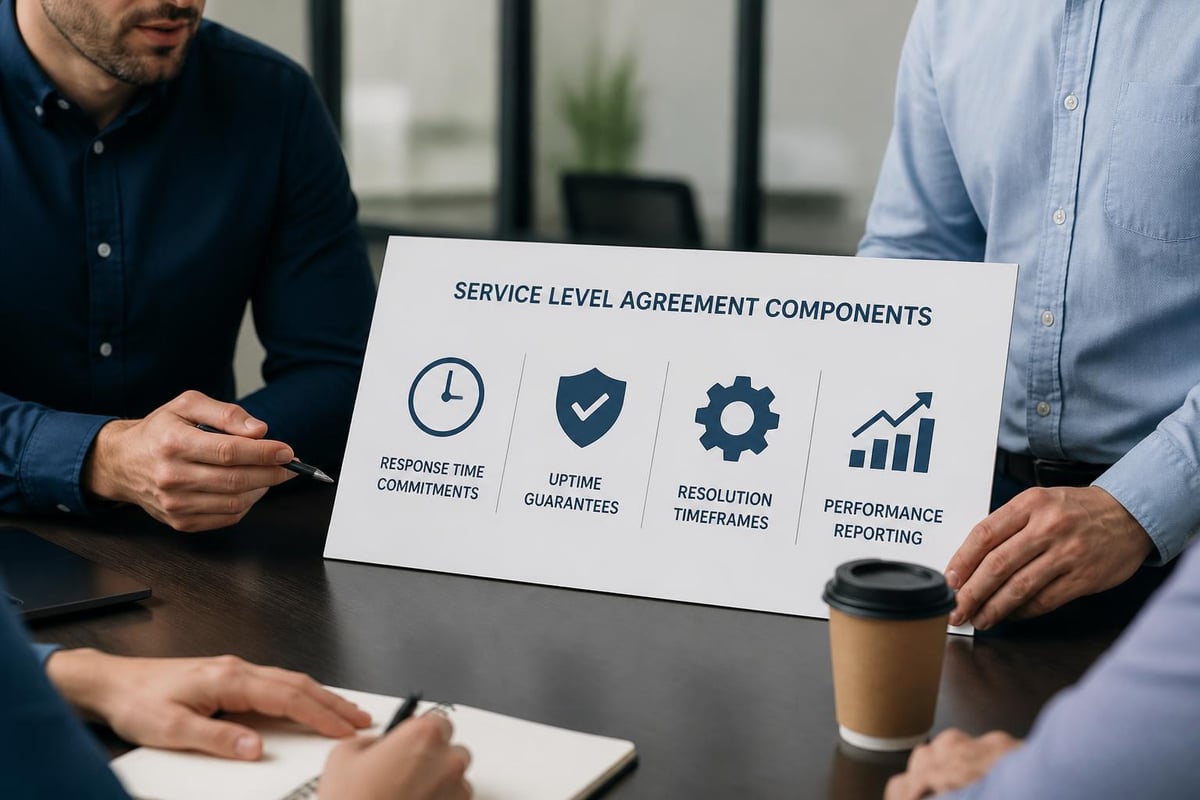
Accountability mechanisms distinguish professional managed IT service solutions from informal support arrangements. Service Level Agreements (SLAs) establish measurable performance standards and define provider responsibilities. These contractual commitments protect businesses by ensuring predictable service delivery and creating recourse when standards are not met.
Defining Critical Performance Indicators
Effective SLAs specify response times for different issue priorities, system uptime guarantees, and resolution timeframes. Priority classifications help ensure that critical business systems receive immediate attention while less urgent matters are addressed within appropriate windows.
Common SLA metrics include:
- First Response Time: How quickly the provider acknowledges reported issues
- Resolution Time: Maximum duration for resolving problems by priority level
- System Uptime: Percentage of time services remain available
- Patch Management: Timeline for applying security updates
- Reporting Frequency: How often performance reports are delivered
Transparency in reporting builds trust and enables continuous improvement. Monthly reviews examine ticket volumes, resolution patterns, and emerging trends that might indicate underlying infrastructure problems or training needs.
Scalability and Business Growth Support
Technology infrastructure must evolve alongside business growth. Managed IT service solutions provide the flexibility to scale resources up or down based on changing needs. This adaptability proves crucial for businesses experiencing rapid growth, seasonal fluctuations, or market uncertainty.
Infrastructure Planning for Expansion
Strategic technology planning aligns IT investments with business objectives. Providers work with leadership to understand growth projections, new location plans, and evolving operational requirements. This collaborative approach ensures that infrastructure decisions support rather than constrain business development.
Capacity planning prevents bottlenecks before they impact operations. Regular assessments evaluate current utilization and project future needs based on growth trends. Managed service providers following best practices conduct quarterly business reviews to maintain alignment between technology capabilities and organizational goals.
Resource allocation becomes more efficient when managed IT service solutions include vendor management. Providers leverage their purchasing power and industry relationships to negotiate favorable terms for hardware, software licenses, and cloud services. This procurement expertise saves businesses both money and the time required to research and evaluate options independently.
Compliance and Regulatory Support
Businesses operating in regulated industries face complex compliance requirements for data handling, retention, and security. Healthcare organizations must comply with HIPAA, financial services follow strict data protection standards, and any business collecting customer information must consider privacy legislation. Managed IT service solutions include expertise to navigate these requirements.
Documentation and Audit Readiness
Compliance programs require extensive documentation of security controls, access policies, and incident response procedures. Providers maintain these records as part of standard service delivery, ensuring businesses remain audit-ready. When regulatory examinations occur, organized documentation demonstrates due diligence and reduces compliance risk.
Regular security assessments identify gaps between current practices and regulatory requirements. Remediation plans address deficiencies systematically, prioritizing the most critical issues. This proactive stance prevents costly violations and protects business reputation.
Training programs ensure staff understand their compliance responsibilities. Role-based education addresses the specific regulations relevant to each position, from customer service representatives handling personal information to administrators managing system access.
Vendor Management and Technology Coordination
Modern businesses rely on dozens of technology vendors for different services and solutions. Managing these relationships consumes valuable time and creates coordination challenges when problems span multiple systems. Managed IT service solutions serve as a single point of contact, coordinating vendor interactions and ensuring integrated functionality.
Simplified Vendor Communications
When issues arise involving multiple systems, providers manage vendor communications and technical troubleshooting. This coordination accelerates problem resolution and prevents finger-pointing between vendors. Businesses benefit from unified support regardless of which underlying system causes the problem.
Technology refresh cycles require careful planning to maintain compatibility and minimize disruption. Providers track warranty expirations, end-of-life announcements, and upgrade paths for all infrastructure components. Proactive planning prevents emergency replacements and ensures adequate budget allocation.
Employee Productivity and Help Desk Support
Technical problems that prevent employees from working create immediate productivity losses and frustration. Responsive help desk support minimizes these disruptions by providing rapid assistance through multiple channels. Managed IT service solutions typically offer phone, email, and portal-based support with clear escalation procedures for complex issues.
User-friendly ticketing systems track all support requests, ensuring nothing falls through the cracks. Status updates keep requesters informed about progress, while historical data helps identify recurring problems that might indicate training needs or system deficiencies.
Self-service knowledge bases empower users to resolve simple issues independently. Well-organized articles, video tutorials, and step-by-step guides address common questions about software usage, connectivity, and basic troubleshooting. This resource reduces help desk volume for routine matters while providing 24/7 access to assistance.
Organizations partnering with Delphi Systems Inc. benefit from local expertise combined with enterprise-level capabilities, ensuring their technology infrastructure supports rather than hinders business success.
Emerging Technologies and Future-Proofing Strategies
Technology continues advancing at an accelerating pace, creating both opportunities and challenges for small businesses. Managed IT service solutions help organizations evaluate emerging technologies and determine appropriate adoption timelines. Not every innovation warrants immediate implementation, but strategic investments can provide competitive advantages.
Technology Assessment and Implementation
Structured evaluation processes examine new technologies through the lens of business value, implementation complexity, and total cost of ownership. This disciplined approach prevents wasteful spending on unproven solutions while ensuring promising innovations receive appropriate consideration.
Pilot programs allow businesses to test new technologies with limited risk before full-scale deployment. Small-scale implementations provide practical experience and reveal potential issues in controlled environments. Successful pilots can then expand organization-wide with confidence based on demonstrated results.
The evolution of managed services emphasizes the strategic role technology plays in business transformation. As organizations increasingly recognize IT as a competitive differentiator rather than back-office necessity, managed IT service solutions become strategic partnerships rather than transactional vendor relationships.
Small businesses in Lethbridge and surrounding areas face the same technology challenges as larger enterprises but with fewer resources to address them. Managed IT service solutions level this playing field by providing access to expertise, security, and infrastructure that would be impossible to build internally. Delphi Systems Inc. specializes in delivering comprehensive IT management for small businesses, offering fixed-rate service models that eliminate budget uncertainty while ensuring your technology supports growth objectives. Contact their team to discover how proactive IT management can transform your operations and free your focus for core business activities.

