

The digital transformation has fundamentally changed how small businesses operate, with cloud computing now serving as the backbone of modern IT infrastructure. As organizations migrate critical applications and sensitive data to cloud platforms, understanding the role of cloud security in cyber security has become essential for business continuity and regulatory compliance. For small businesses in Alberta and across North America, the intersection of cloud technology and cybersecurity presents both opportunities and challenges that require careful navigation and expert guidance.
Understanding Cloud Security in Cyber Security
Cloud security in cyber security represents a specialized subset of security measures designed specifically to protect cloud-based systems, data, and infrastructure. Unlike traditional on-premises security, cloud security frameworks must address unique challenges such as shared responsibility models, multi-tenancy environments, and dynamic resource allocation.
The fundamental difference lies in where data resides and how it's accessed. Traditional cybersecurity focuses on perimeter defense, essentially building walls around physical servers and networks. Cloud security in cyber security, however, operates in a borderless environment where resources are distributed across multiple data centers and accessed from anywhere.
The Shared Responsibility Model
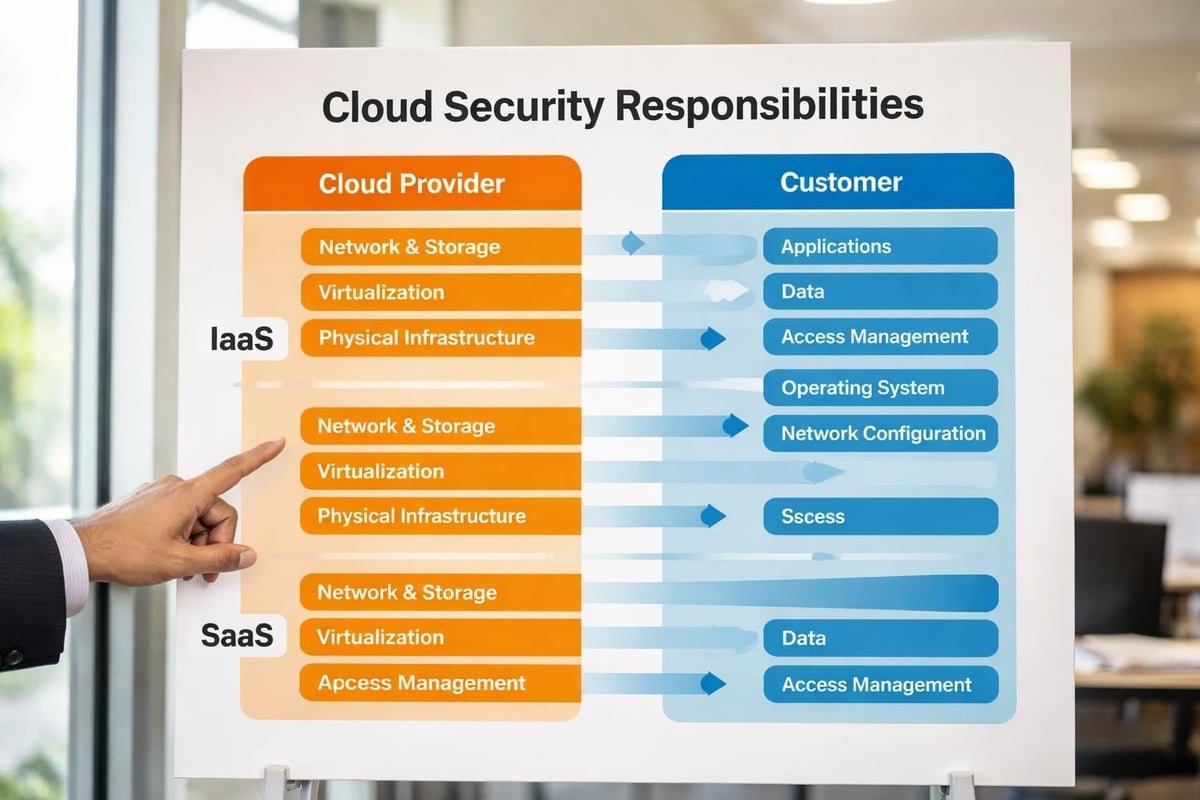
One of the most critical concepts in cloud security involves understanding the division of security responsibilities between cloud service providers and customers. This shared responsibility model varies depending on whether you're using Infrastructure as a Service (IaaS), Platform as a Service (PaaS), or Software as a Service (SaaS).
Provider Responsibilities:
- Physical security of data centers
- Network infrastructure protection
- Hypervisor security
- Hardware maintenance and updates
Customer Responsibilities:
- Identity and access management
- Data encryption and classification
- Application security
- User authentication and authorization
Small businesses often underestimate their portion of this shared responsibility. Even when using fully managed cloud services, organizations remain responsible for configuring security settings properly, managing user access, and ensuring data is encrypted both in transit and at rest.
Core Components of Cloud Security
Cloud security in cyber security encompasses multiple layers of protection, each addressing specific vulnerabilities and threats. These components work together to create a comprehensive defense strategy that adapts to evolving cyber threats.
Identity and Access Management
Identity and Access Management (IAM) serves as the foundation of cloud security. In 2026, sophisticated IAM systems incorporate artificial intelligence to detect anomalous access patterns and enforce zero-trust principles.
| IAM Component | Function | Business Impact |
|---|---|---|
| Multi-factor Authentication | Requires multiple verification methods | Reduces unauthorized access by 99.9% |
| Role-based Access Control | Assigns permissions based on job functions | Minimizes insider threat risk |
| Single Sign-On | Centralizes authentication across applications | Improves user experience and security |
| Privileged Access Management | Controls administrative access | Protects critical systems from compromise |
Implementing strong IAM policies means employees only access the specific cloud resources necessary for their roles. This principle of least privilege significantly reduces the attack surface and limits potential damage from compromised credentials.
Data Encryption and Protection
Data encryption represents a non-negotiable element of cloud security in cyber security. Modern encryption strategies protect data in three states: at rest, in transit, and increasingly, in use through technologies like confidential computing.
For small businesses, encryption might seem complex, but cloud platforms have made it more accessible through managed encryption services. These services handle key management automatically while maintaining industry-standard encryption protocols like AES-256.
Beyond encryption, data protection includes:
- Regular automated backups to geographically distributed locations
- Data loss prevention (DLP) tools that prevent sensitive information from leaving your control
- Classification systems that automatically identify and protect confidential data
- Version control and retention policies that ensure compliance with regulations
Common Cloud Security Threats in 2026
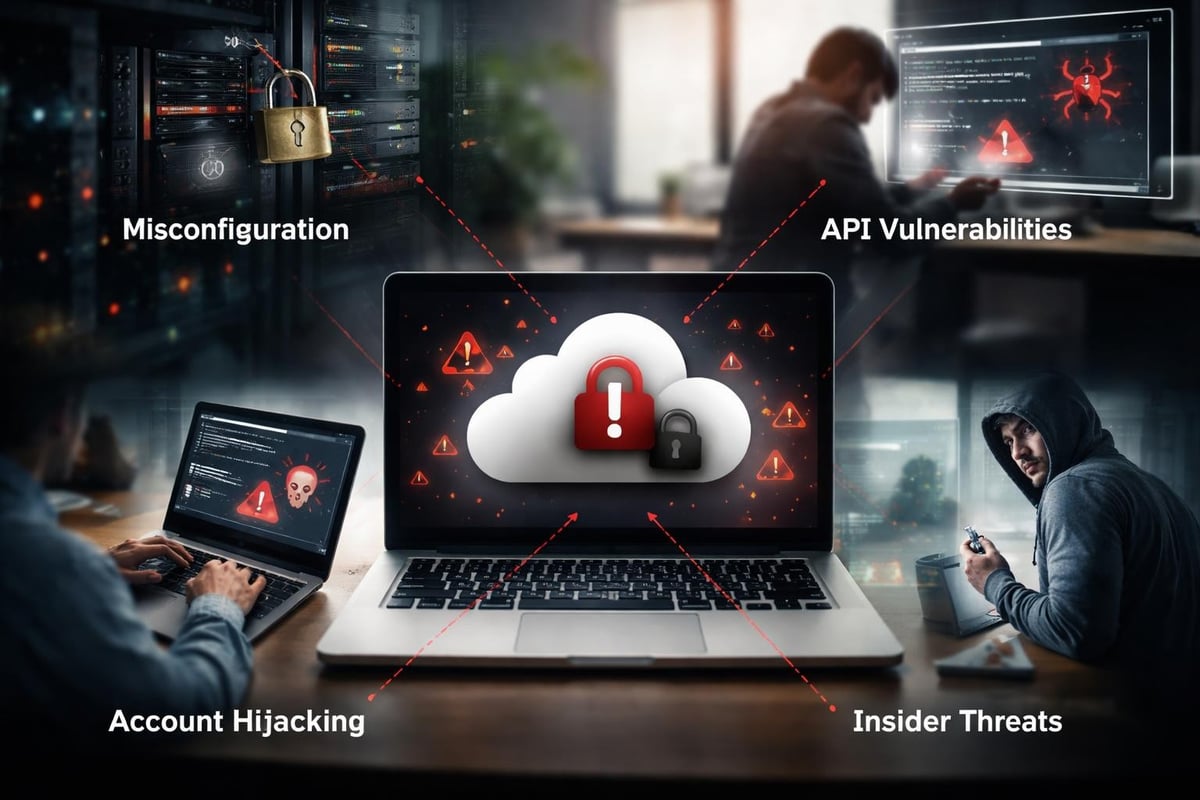
Understanding the threat landscape helps businesses prioritize their security investments and prepare appropriate defenses. Cloud security challenges have evolved significantly as attackers develop more sophisticated techniques.
Misconfiguration Vulnerabilities
The leading cause of cloud security breaches remains misconfiguration. Simple errors like leaving storage buckets publicly accessible, failing to enable encryption, or using default security settings create openings for attackers.
Common misconfiguration mistakes include:
- Publicly exposed databases and storage containers
- Overly permissive IAM policies granting excessive privileges
- Disabled logging and monitoring features
- Unpatched systems and outdated software versions
- Weak password policies and missing MFA requirements
These misconfigurations often result from rapid deployment pressures, lack of cloud expertise, or insufficient security reviews. Small businesses particularly struggle with this challenge when IT resources are limited.
API Security Risks
Application Programming Interfaces (APIs) connect cloud services and applications, creating potential attack vectors if not properly secured. In 2026, API attacks have increased by 40% compared to 2024, targeting authentication weaknesses and rate limiting gaps.
Securing APIs requires authentication tokens, rate limiting to prevent abuse, input validation to block injection attacks, and comprehensive logging of all API calls. Many businesses overlook API security until after experiencing a breach.
Best Practices for Cloud Security Implementation
Implementing effective cloud security in cyber security requires a systematic approach combining technology, processes, and people. Small businesses benefit most from starting with fundamental protections and expanding as their cloud footprint grows.
Security Assessment and Planning
Begin with a comprehensive assessment of your current cloud environment. Document all cloud services in use, including shadow IT applications that employees may have adopted without IT approval. This inventory provides the foundation for security planning.
- Identify all cloud assets and data flows
- Classify data based on sensitivity and compliance requirements
- Map current security controls to identified risks
- Prioritize gaps based on likelihood and potential impact
- Develop a phased implementation roadmap
Regular security assessments should occur quarterly at minimum, with continuous monitoring in between. Oracle’s cloud security framework provides excellent guidance for structuring these assessments.
Zero Trust Architecture
The zero trust security model operates on the principle "never trust, always verify." Rather than assuming everything inside your cloud environment is safe, zero trust continuously validates every access request regardless of origin.
Key zero trust principles:
- Verify explicitly using all available data points
- Apply least privilege access uniformly across all resources
- Assume breach and minimize blast radius through segmentation
Implementing zero trust doesn't require replacing existing infrastructure. Small businesses can adopt zero trust incrementally, starting with critical applications and expanding over time. The approach works particularly well in cloud environments where software-defined networking enables granular access controls.
Continuous Monitoring and Response
Cloud security in cyber security demands real-time visibility into your environment. Security Information and Event Management (SIEM) systems aggregate logs from multiple sources, applying machine learning to detect anomalies and potential threats.
Modern cloud-native SIEM solutions offer several advantages:
- Automatic scaling to handle varying log volumes
- Pre-built integrations with major cloud platforms
- AI-powered threat detection reducing false positives
- Automated response playbooks for common incidents
For small businesses, managed SIEM services provide enterprise-grade monitoring without requiring dedicated security analysts. These services alert you to suspicious activities and can automatically respond to certain threat types.
Compliance and Regulatory Considerations
Cloud security in cyber security extends beyond preventing breaches to ensuring compliance with various regulations and standards. In 2026, regulatory requirements have expanded significantly, particularly around data privacy and residency.
Major Compliance Frameworks
Different industries face specific compliance requirements that influence cloud security strategies. Understanding which frameworks apply to your business ensures you implement appropriate controls.
| Framework | Applicability | Key Requirements |
|---|---|---|
| PIPEDA | Canadian businesses handling personal information | Consent, accuracy, safeguards, accountability |
| SOC 2 | Service providers handling customer data | Security, availability, confidentiality controls |
| PCI DSS | Businesses processing credit card payments | Network security, encryption, access controls |
| HIPAA | Healthcare organizations | Patient data protection, audit trails, encryption |
Each framework requires specific security controls, documentation, and regular audits. Cloud providers often maintain their own compliance certifications, but businesses remain responsible for ensuring their use of cloud services meets regulatory requirements.
Data Residency and Sovereignty
Canadian businesses must consider where their data physically resides. Many regulations require that certain data types remain within Canadian borders, creating challenges when using global cloud providers.
Major cloud platforms now offer Canadian data center regions, allowing businesses to specify exactly where their data is stored and processed. This geographic control becomes critical for compliance with provincial privacy laws and federal regulations.
Cloud Security Tools and Technologies
The cloud security market has matured significantly, offering specialized tools that address specific protection needs. Understanding these technologies helps small businesses select appropriate solutions without overinvesting in unnecessary capabilities.
Cloud Access Security Brokers
Cloud Access Security Brokers (CASBs) sit between users and cloud applications, enforcing security policies and providing visibility into cloud usage. These platforms excel at discovering shadow IT, enforcing data loss prevention policies, and monitoring user activities across multiple cloud services.
CASBs offer four primary functions through the acronym VICE:
- Visibility into all cloud service usage and data movement
- Compliance enforcement through automated policy application
- Data Security via encryption and tokenization
- Threat Protection detecting and blocking malicious activities
Small businesses often implement CASB solutions as their cloud adoption expands beyond basic services. The visibility component alone frequently reveals dozens of unsanctioned cloud applications in use.
Cloud Workload Protection Platforms
Cloud Workload Protection Platforms (CWPP) secure servers, containers, and serverless functions running in cloud environments. Unlike traditional antivirus software, CWPPs understand cloud-native architectures and protect workloads regardless of where they run.
CWPP capabilities include:
- Vulnerability scanning for operating systems and applications
- Runtime protection against exploits and malware
- Configuration compliance monitoring
- Network microsegmentation enforcement
- Container security throughout the development lifecycle
For businesses running applications in the cloud, CWPP solutions provide essential protection that traditional endpoint security tools cannot match.

Building a Cloud Security Strategy for Small Business
Small businesses face unique challenges in implementing cloud security in cyber security. Limited budgets, smaller IT teams, and rapidly evolving business needs require pragmatic approaches that balance security with operational efficiency.
Prioritizing Security Investments
Not all security measures provide equal value. Small businesses should prioritize investments based on their specific risk profile and cloud usage patterns. Start by securing what matters most: customer data, financial information, and intellectual property.
A phased approach works best:
- Foundation (Months 1-3): Enable MFA, implement basic encryption, establish backup procedures
- Expansion (Months 4-6): Deploy monitoring tools, conduct security training, formalize access policies
- Optimization (Months 7-12): Implement advanced threat detection, establish incident response procedures, pursue compliance certifications
This timeline allows businesses to spread costs while building security capabilities progressively. Each phase delivers tangible risk reduction, demonstrating ROI to stakeholders.
Leveraging Managed Security Services
Many small businesses lack the expertise and resources to manage cloud security in cyber security internally. Managed Security Service Providers (MSSPs) offer a cost-effective alternative, providing enterprise-grade security capabilities at a fraction of the cost of building internal teams.
Managed services typically include 24/7 monitoring, threat detection and response, vulnerability management, compliance reporting, and security tool management. The fixed-rate fee structure allows businesses to budget predictably while accessing specialized expertise.
When evaluating managed security providers, consider their experience with your specific cloud platforms, their response time commitments, and their ability to integrate with your existing IT infrastructure. Understanding how quickly providers can detect and respond to breaches makes a significant difference in minimizing damage from security incidents.
The Future of Cloud Security
Cloud security in cyber security continues evolving as new technologies emerge and threat actors develop more sophisticated attack methods. Understanding these trends helps businesses prepare their security strategies for the coming years.
AI and Machine Learning in Cloud Security
Artificial intelligence has transformed cloud security from reactive to predictive. Modern security platforms use machine learning to analyze vast amounts of data, identifying subtle patterns that indicate emerging threats before they cause damage.
AI applications in cloud security include:
- Behavioral analytics detecting account compromises through unusual access patterns
- Automated threat hunting identifying sophisticated persistent threats
- Predictive vulnerability assessment prioritizing patching based on exploit likelihood
- Intelligent policy recommendations optimizing security configurations
These AI capabilities level the playing field for small businesses, providing them with threat detection sophistication previously available only to large enterprises with dedicated security teams.
Multi-Cloud and Hybrid Security
The average business now uses services from multiple cloud providers, creating complex security challenges. Managing security across multicloud environments requires unified visibility and consistent policy enforcement regardless of where workloads run.
Cloud security platforms increasingly offer multi-cloud management capabilities, providing single-pane-of-glass visibility across AWS, Azure, Google Cloud, and other providers. This consolidation simplifies security operations while ensuring consistent protection standards.
Hybrid environments combining on-premises infrastructure with cloud services add another layer of complexity. Security strategies must protect data and applications seamlessly as they move between environments, maintaining consistent controls regardless of location.
Risk Management and Incident Response
Even with robust preventive measures, security incidents can occur. Cloud security in cyber security requires not just prevention but also preparation for detection and response when breaches happen.
Developing an Incident Response Plan
An effective incident response plan outlines specific steps to take when security events occur. This preparation dramatically reduces response times and minimizes damage from security incidents.
Essential incident response elements:
- Preparation: Establish response team roles, document procedures, maintain current contact information
- Detection and Analysis: Define indicators of compromise, establish monitoring thresholds, classify incident severity
- Containment: Isolate affected systems, preserve evidence, prevent lateral movement
- Eradication: Remove malware, close access vectors, patch vulnerabilities
- Recovery: Restore systems from clean backups, verify security before resuming operations
- Lessons Learned: Document incidents, update procedures, implement improvements
Regular tabletop exercises testing your incident response plan ensure team members understand their roles and can execute effectively under pressure. These simulations reveal gaps in procedures before real incidents occur.
Business Continuity in the Cloud
Cloud platforms offer unprecedented opportunities for business continuity and disaster recovery. Geographic distribution of data and automatic failover capabilities enable small businesses to achieve resilience previously available only to large enterprises.
Modern backup strategies leverage cloud services to maintain multiple copies of critical data across different regions. Data backup and recovery services ensure businesses can restore operations quickly following security incidents, natural disasters, or system failures.
Recovery Time Objectives (RTO) and Recovery Point Objectives (RPO) define acceptable downtime and data loss. Cloud technologies enable aggressive targets: RTOs measured in minutes rather than hours, and RPOs approaching zero through continuous replication.
Security Training and Awareness
Technology alone cannot secure cloud environments. Cloud security in cyber security requires trained personnel who understand threats and follow security best practices consistently.
Employee Security Education
Human error remains the leading cause of cloud security incidents. Comprehensive security training reduces risks by teaching employees to recognize threats and respond appropriately.
Effective training programs cover:
- Phishing recognition and reporting procedures
- Password hygiene and MFA usage
- Secure file sharing and collaboration practices
- Mobile device security for cloud access
- Incident reporting procedures
Training should occur during onboarding and continue quarterly with updated content reflecting current threats. Short, focused modules prove more effective than lengthy annual courses that employees quickly forget.
Building Security Culture
Beyond formal training, organizations must cultivate security-conscious cultures where protecting information becomes second nature. This cultural shift starts with leadership demonstrating commitment to security and extends through recognition programs rewarding security-positive behaviors.
Encourage employees to report suspicious activities without fear of blame. Many security incidents are discovered by observant staff members who notice something unusual. Creating safe reporting channels and responding promptly to concerns reinforces that security is everyone's responsibility.
Measuring Cloud Security Effectiveness
Cloud security in cyber security requires continuous measurement and improvement. Establishing metrics helps businesses understand whether their security investments deliver expected results and where additional focus is needed.
Key Performance Indicators
Track these essential metrics to evaluate cloud security effectiveness:
| Metric | Target | Significance |
|---|---|---|
| Mean Time to Detect (MTTD) | < 24 hours | How quickly threats are identified |
| Mean Time to Respond (MTTR) | < 4 hours | Speed of incident containment |
| Vulnerability Remediation Time | < 30 days critical, < 90 days high | Patch management effectiveness |
| Security Training Completion | 100% annually | Staff preparedness level |
| Multi-Factor Authentication Adoption | 100% for privileged accounts | Access security strength |
| Failed Login Attempts | Declining trend | Effectiveness of access controls |
Regular reporting on these metrics provides visibility into security posture trends. Improvements demonstrate program effectiveness, while degradation signals areas requiring attention.
Security Audits and Assessments
Independent security assessments provide objective evaluation of cloud security controls. These audits identify vulnerabilities that internal teams might overlook and validate that security measures function as intended.
Consider conducting:
- Penetration testing simulating real-world attacks against cloud environments
- Configuration reviews ensuring cloud services follow security best practices
- Compliance audits verifying adherence to regulatory requirements
- Vulnerability assessments identifying software weaknesses requiring patches
Annual comprehensive assessments supplemented by focused quarterly reviews maintain security effectiveness as cloud environments evolve. Recent research on cloud adoption security impacts emphasizes the importance of continuous assessment as cloud usage expands.
Cloud security in cyber security represents a critical investment for small businesses operating in today's digital landscape, requiring comprehensive strategies that address technology, processes, and people. As cyber threats continue evolving and cloud adoption accelerates, partnering with experienced professionals ensures your business maintains robust protection without diverting focus from core operations. Delphi Systems Inc. provides comprehensive managed IT services throughout Lethbridge and surrounding areas, delivering expert cloud security and cybersecurity solutions with transparent fixed-rate pricing that helps small businesses protect their digital assets while focusing on growth and customer service.

