

Small businesses face an increasingly complex digital landscape where cloud computing and information security intersect at every operational level. As organizations migrate critical systems and sensitive data to cloud platforms, understanding the security implications becomes essential for maintaining business continuity and protecting customer trust. The shift to cloud-based infrastructure offers tremendous operational advantages, but it also introduces new vulnerabilities that require careful management and strategic planning.
Understanding the Cloud Security Landscape
The evolution of cloud computing has fundamentally transformed how businesses approach IT infrastructure. Organizations no longer need to maintain expensive on-premises servers and can instead leverage scalable cloud resources that grow with their needs. This transformation brings significant benefits including reduced capital expenditure, enhanced flexibility, and improved disaster recovery capabilities.
However, these advantages come with inherent security considerations. When data moves from local servers to cloud environments, businesses must adapt their security posture to address new threat vectors and compliance requirements.
Primary Security Concerns in Cloud Environments
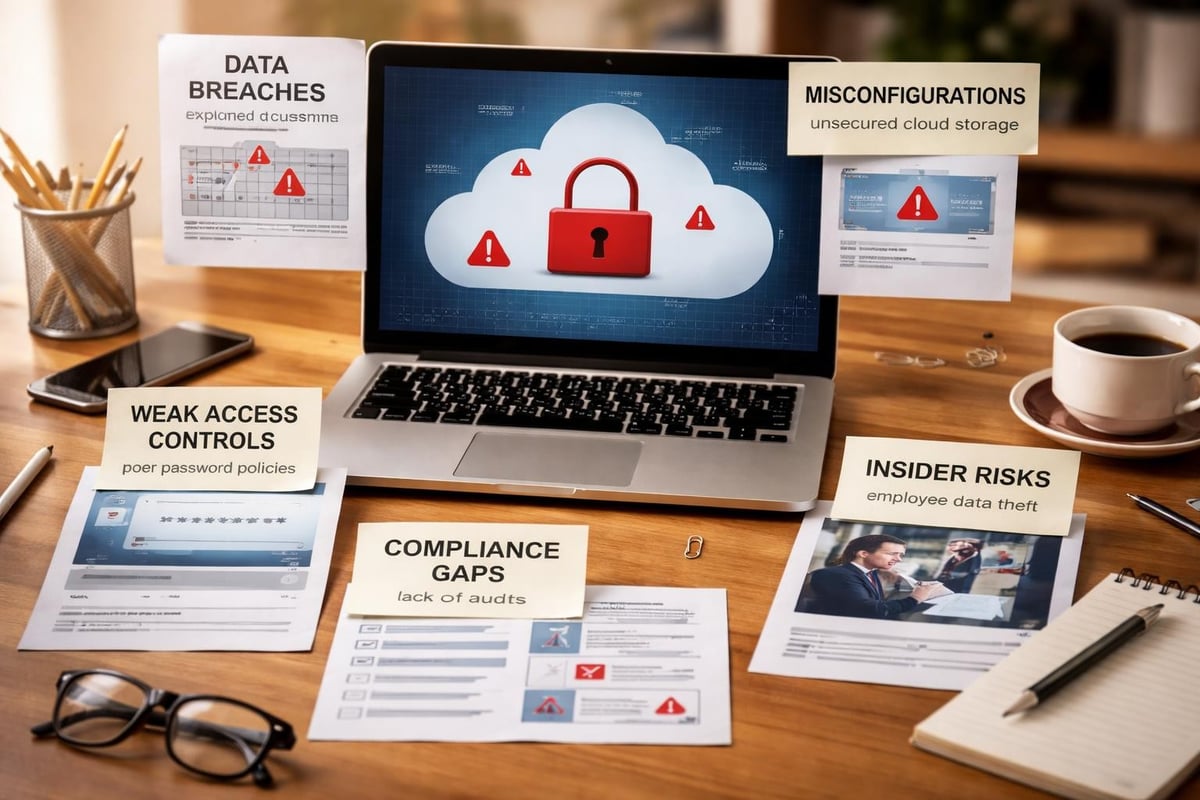
Cloud computing and information security challenges fall into several distinct categories that small businesses must address:
- Data breaches and unauthorized access: Sensitive information stored in the cloud becomes a target for cybercriminals seeking financial data, customer records, and intellectual property
- Misconfigured security settings: Default configurations often leave vulnerabilities that attackers can exploit to gain unauthorized access
- Insufficient access controls: Weak authentication mechanisms and poorly managed user permissions create security gaps
- Compliance violations: Industry regulations require specific data handling practices that must be maintained in cloud environments
- Insider threats: Employees with legitimate access may intentionally or accidentally compromise sensitive information
The shared responsibility model defines which security tasks fall to the cloud provider versus the customer. Infrastructure-as-a-Service (IaaS) platforms require customers to handle more security configuration compared to Software-as-a-Service (SaaS) solutions where providers manage additional layers.
Implementing Effective Cloud Security Controls
Organizations must deploy multiple security layers to protect cloud-based resources effectively. A comprehensive approach addresses both technical controls and operational procedures that together create a robust defense against potential threats.
Authentication and Access Management
Strong authentication forms the foundation of cloud computing and information security strategies. Multi-factor authentication (MFA) should be mandatory for all users accessing cloud resources, requiring something they know (password), something they have (security token), and potentially something they are (biometric verification).
Role-based access control (RBAC) ensures employees only access the specific resources necessary for their job functions. This principle of least privilege minimizes the potential damage from compromised credentials or insider threats.
| Access Control Method | Implementation | Security Benefit |
|---|---|---|
| Multi-Factor Authentication | Required for all cloud logins | Prevents 99.9% of automated attacks |
| Single Sign-On (SSO) | Centralized authentication portal | Reduces password fatigue and improves monitoring |
| Role-Based Access | Permissions tied to job functions | Limits exposure from compromised accounts |
| Privileged Access Management | Special controls for admin accounts | Protects critical system configurations |
Regular access reviews identify and remove unnecessary permissions that accumulate over time. Employees who change roles or leave the organization should have their access promptly adjusted or revoked.
Data Encryption Strategies
Encryption protects data both in transit and at rest, ensuring that even if unauthorized parties intercept information, they cannot read its contents. Modern cloud platforms support encryption by default, but organizations must verify proper implementation.
Transport Layer Security (TLS) encrypts data moving between users and cloud services, preventing eavesdropping on network traffic. All connections should use TLS 1.2 or higher with strong cipher suites.
At-rest encryption protects stored data using industry-standard algorithms like AES-256. Cloud providers typically manage encryption keys, but sensitive environments may require customer-managed keys for additional control.
End-to-end encryption ensures data remains encrypted throughout its entire lifecycle, readable only by authorized users with proper decryption keys. This approach provides maximum protection but requires careful key management to prevent data loss.
Compliance and Regulatory Frameworks
Small businesses operating in regulated industries must ensure their cloud implementations meet specific legal and industry requirements. Cloud computing security involves understanding how different frameworks apply to cloud environments and implementing appropriate controls.
Common Compliance Standards
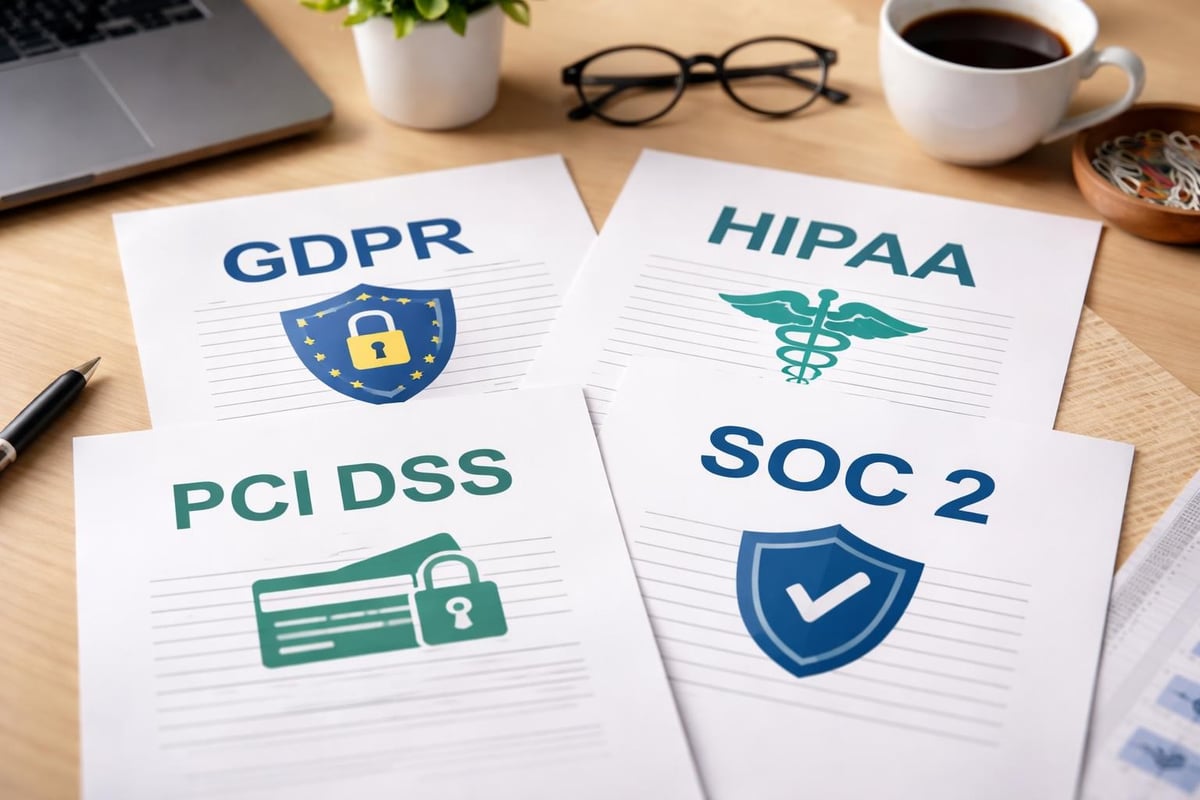
- General Data Protection Regulation (GDPR): Applies to businesses handling personal data of European Union residents, requiring strict data protection measures and breach notification procedures
- Health Insurance Portability and Accountability Act (HIPAA): Mandates security and privacy controls for healthcare information stored or processed in the cloud
- Payment Card Industry Data Security Standard (PCI DSS): Requires specific security measures for organizations processing credit card transactions through cloud-based systems
- SOC 2 Type II: Demonstrates that cloud service providers maintain appropriate security controls over extended periods
Compliance requires documentation of security policies, regular audits, and evidence that controls function as intended. Cloud providers often obtain certifications that customers can leverage, but organizations remain responsible for their own compliance obligations.
Zero Trust Architecture
The traditional security perimeter has dissolved as cloud computing and information security converge in distributed environments. Zero Trust principles assume that threats exist both inside and outside the network, requiring verification for every access request regardless of origin.
The Certificate of Competence in Zero Trust (CCZT) represents industry recognition of the importance of Zero Trust concepts in modern cloud security. This certification validates expertise in implementing Zero Trust frameworks that continuously verify user identity, device health, and access context.
Zero Trust implementation involves several key components:
- Continuous authentication and authorization for all access requests
- Micro-segmentation dividing networks into small, isolated zones
- Least privilege access granting minimal necessary permissions
- Comprehensive logging and monitoring of all activities
- Automated threat detection and response capabilities
Managing Cloud Security Operations
Effective cloud computing and information security requires ongoing operational activities rather than one-time implementation. Small businesses must establish processes for monitoring, updating, and responding to security events.
Continuous Monitoring and Threat Detection
Cloud environments generate massive amounts of log data from user activities, system events, and network traffic. Security Information and Event Management (SIEM) tools aggregate this data and apply analytics to identify suspicious patterns.
Automated alerts notify security teams of potential incidents such as unusual login locations, failed authentication attempts, or abnormal data transfers. Setting appropriate alert thresholds prevents alert fatigue while ensuring genuine threats receive prompt attention.
| Monitoring Activity | Frequency | Purpose |
|---|---|---|
| Security log review | Daily | Identify unauthorized access attempts |
| Vulnerability scanning | Weekly | Discover configuration weaknesses |
| Access audit | Monthly | Remove unnecessary permissions |
| Security assessment | Quarterly | Validate overall security posture |
| Penetration testing | Annually | Test defenses against real attacks |
Patch Management and Configuration Control
Cloud platforms continuously evolve with new features and security updates. Organizations must establish procedures to evaluate and apply patches that address newly discovered vulnerabilities.
Configuration drift occurs when cloud resources deviate from approved security baselines over time. Infrastructure-as-code tools define desired configurations in version-controlled templates, enabling automated deployment and compliance checking.
Regular security assessments identify gaps between current practices and best practices. These reviews should examine access controls, encryption implementation, network segmentation, and backup procedures.
Data Protection and Business Continuity
Protecting data in cloud environments requires strategies that address both security threats and operational failures. Cloud computing and information security intersect most critically in how organizations safeguard their most valuable digital assets.
Backup and Recovery Strategies
Cloud-based backup solutions offer significant advantages over traditional approaches, including geographic redundancy, automated scheduling, and rapid restoration capabilities. The 3-2-1 backup rule remains relevant: maintain three copies of data, on two different media types, with one copy stored off-site.
Recovery Point Objective (RPO) defines the maximum acceptable data loss measured in time. A one-hour RPO means systems must capture backups frequently enough that no more than one hour of data is lost during recovery.
Recovery Time Objective (RTO) specifies how quickly systems must be restored after an incident. Cloud platforms enable faster recovery through snapshot technologies and redundant infrastructure.
Testing backup restoration procedures regularly ensures they function as expected during actual emergencies. Many organizations discover backup failures only when they attempt to recover from a disaster.

Incident Response Planning
Despite best preventive efforts, security incidents will occur. Documented response procedures enable teams to react quickly and effectively, minimizing damage and recovery time.
An incident response plan should outline:
- Detection and analysis: How potential incidents are identified and verified as genuine threats
- Containment: Steps to isolate affected systems and prevent incident spread
- Eradication: Removing the threat and closing vulnerabilities that enabled the incident
- Recovery: Restoring normal operations while monitoring for residual issues
- Post-incident review: Analyzing what happened and improving defenses
Communication protocols define who receives notifications during incidents, including internal stakeholders, affected customers, and potentially regulatory authorities depending on the incident nature.
Selecting Secure Cloud Service Providers
Small businesses must evaluate cloud vendors carefully to ensure they meet security requirements. Not all cloud computing services offer equivalent protection, and organizations remain accountable for security even when outsourcing infrastructure.
Vendor Assessment Criteria
Due diligence before selecting a cloud provider should examine several critical factors. Security certifications demonstrate that independent auditors have verified the provider's controls against recognized standards.
Data sovereignty considerations determine where information physically resides and which legal jurisdictions govern it. Some regulations require data to remain within specific geographic boundaries.
Service Level Agreements (SLAs) define uptime guarantees, support response times, and provider responsibilities during incidents. Understanding these commitments helps set realistic expectations and identify gaps requiring additional controls.
Vendor lock-in risks arise when proprietary technologies make migration to alternative providers difficult or expensive. Evaluating exit strategies before committing to a platform prevents future complications.
Security Questionnaires and Audits
Organizations should request detailed information about provider security practices including encryption methods, access controls, vulnerability management procedures, and incident response capabilities. Standardized questionnaires like the Consensus Assessments Initiative Questionnaire (CAIQ) provide structured approaches to this evaluation.
Third-party audit reports such as SOC 2 Type II or ISO 27001 certificates offer independent verification of security claims. However, these reports typically lag several months behind current practices, so supplementing them with recent security assessments provides more current information.
Emerging Security Challenges and Solutions
Cloud computing and information security continue evolving as new technologies and threat vectors emerge. Small businesses must stay informed about developing risks and defensive capabilities.
Container and Serverless Security
Modern application architectures using containers and serverless functions introduce unique security considerations. These ephemeral compute resources require different approaches than traditional virtual machines.
Container security involves scanning images for vulnerabilities, implementing runtime protection, and securing orchestration platforms like Kubernetes. Serverless functions need careful permission management since they often integrate with numerous cloud services.
Artificial Intelligence in Security Operations
AI and machine learning enhance threat detection by identifying subtle patterns that human analysts might miss. These technologies analyze vast datasets to establish normal behavior baselines and flag anomalies warranting investigation.
However, adversaries also leverage AI to develop more sophisticated attacks that adapt to defensive measures. The arms race between defensive and offensive AI applications will shape cloud computing and information security throughout the coming years.
Organizations must balance AI benefits against risks including algorithmic bias, false positives that waste security team time, and potential manipulation of machine learning models.
Managing Third-Party Security Risks
Small businesses increasingly rely on ecosystems of integrated cloud services, each introducing potential security vulnerabilities. Supply chain attacks target weak links in these interconnected systems to compromise multiple organizations.
Vendor Risk Management Programs
Systematic evaluation of third-party security should extend beyond initial selection to ongoing monitoring throughout the relationship. Critical vendors require deeper assessment than those handling less sensitive functions.
Regular reviews confirm that vendors maintain security commitments as their own environments evolve. Changes in vendor ownership, service offerings, or security posture may necessitate reevaluation of the relationship.
Contractual agreements should clearly define security responsibilities, breach notification requirements, and audit rights. These provisions provide leverage to ensure vendors prioritize security appropriately.
Protecting cloud infrastructure requires a comprehensive approach combining technical controls, operational procedures, and strategic planning. Small businesses benefit tremendously from cloud computing but must implement appropriate security measures to protect their data and maintain customer trust. Delphi Systems Inc. helps Lethbridge businesses navigate cloud computing and information security challenges with managed IT services that include cybersecurity, network monitoring, and secure cloud implementations, allowing you to focus on core business activities while maintaining robust protection for your digital assets.

