


In 2025, cyber threats have become more advanced, targeting organizations of every size. With networks growing in complexity, its network security is now a critical business priority.
This essential guide provides IT leaders and professionals with a proven roadmap to understanding, implementing, and maintaining effective protections. You will gain actionable insights and the latest strategies to defend your infrastructure.
Discover how to navigate the evolving threat landscape, apply foundational principles, leverage advanced technologies, and meet regulatory demands. Use this guide to assess and strengthen your network security posture for the challenges ahead.
The Evolving Threat Landscape for ITS Networks in 2025
In 2025, the landscape for its network security is more volatile and complex than ever before. New threats emerge rapidly, targeting both the digital and physical layers of ITS networks. As a result, understanding these evolving dangers is essential for every organization responsible for critical infrastructure.

Emerging Cyber Threats and Attack Vectors
The threat landscape for its network security is shifting at an unprecedented pace. Attackers are increasingly leveraging zero-day exploits and advanced persistent threats (APTs) to compromise ITS infrastructure. These attacks are often highly targeted and difficult to detect until significant damage has occurred.
Malware such as ransomware, spyware, and rootkits now specifically target networked environments. The proliferation of IoT devices and smart sensors within ITS networks creates new entry points for attackers, making IoT-based attacks a growing concern. Distributed Denial of Service (DDoS) attacks have become more frequent and destructive, with botnets of unprecedented scale capable of crippling transportation and municipal ITS systems.
Man-in-the-middle and man-in-the-browser attacks are also rising, putting critical data in transit at risk. Social engineering and phishing campaigns have evolved to specifically target network administrators and end-users alike. Supply chain vulnerabilities now threaten both software and hardware components, as highlighted by recent events where attackers exploited flaws in security devices. For instance, the U.S. warns of Cisco device vulnerabilities after a surge in attacks exploiting these weaknesses, underlining the need for proactive its network security strategies.
Recent statistics from 2024 reveal a 35% increase in DDoS attacks aimed at transportation and municipal ITS networks, a clear sign that adversaries are sharpening their focus on critical infrastructure.
Vulnerabilities and Risks Unique to ITS Networks
Unlike traditional IT environments, ITS networks face unique vulnerabilities that demand specialized approaches to its network security. Many ITS environments still rely on legacy systems with outdated protocols and insufficient patch management, making them attractive targets for cybercriminals.
The integration of cloud, on-premises, and edge computing resources adds layers of complexity, often resulting in misconfigurations and gaps in security. Remote access and third-party integrations further expand the attack surface, introducing new risks with each connection. Physical security remains a pressing issue, with endpoints and removable devices frequently left unsecured.
A recent case study demonstrates the consequences of ignoring these vulnerabilities. In one city, an unpatched legacy network device within a traffic management system was exploited, resulting in a significant breach. This incident underscores that effective its network security requires both technical and physical safeguards, as well as vigilant patch management and system monitoring.
To address these risks, organizations must regularly assess their environments, identify weak points, and implement layered defenses designed specifically for ITS network architectures.
Regulatory and Compliance Pressures
The regulatory environment for its network security in 2025 is more demanding than ever. New and updated standards like NIST, ISO/IEC 27001, and evolving local data protection laws impose strict requirements on organizations managing ITS networks.
Failure to comply can result in severe penalties and operational disruptions. For example, GDPR-like fines are now being levied for ITS data breaches in both the EU and North America, placing additional pressure on compliance teams. These regulations mandate not only technical controls but also comprehensive documentation and regular audits.
Staying compliant requires ongoing investment in its network security processes, including policy updates, staff training, and continuous monitoring. Organizations must remain vigilant, adapting their practices to meet new regulatory expectations. By prioritizing compliance, businesses not only avoid costly fines but also strengthen their overall network resilience.
Core Principles of ITS Network Security
Understanding the core principles of its network security is fundamental for any organization aiming to protect critical infrastructure. These principles guide every decision, technology implementation, and policy that shapes a resilient ITS environment. By mastering these concepts, professionals lay the groundwork for effective, adaptable security in a rapidly changing threat landscape.
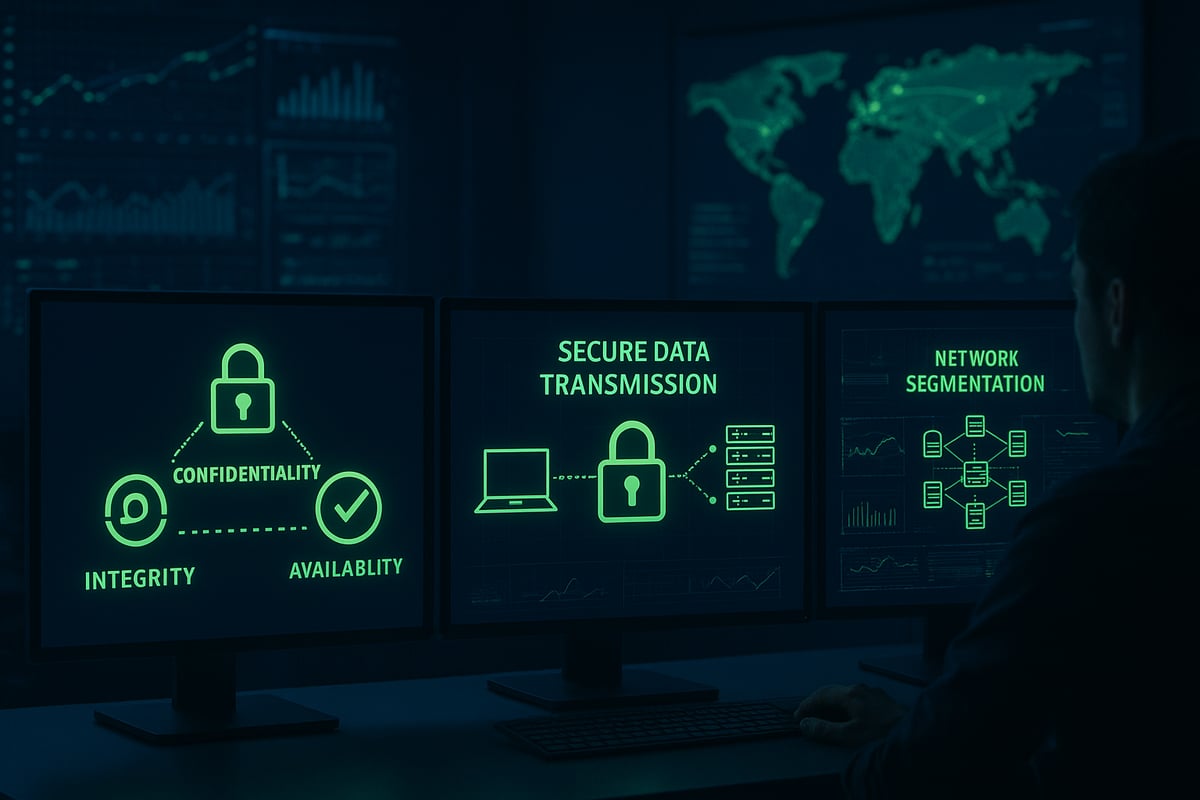
The CIA Triad: Confidentiality, Integrity, and Availability
At the heart of its network security is the CIA Triad. Each element plays a distinct and vital role:
| Principle | Definition | Real-world Example |
|---|---|---|
| Confidentiality | Only authorized users or systems access sensitive data | Data breach from unauthorized admin access |
| Integrity | Information is accurate and unaltered | Tampered traffic sensor data causing wrong routing |
| Availability | Network resources are reliably accessible | Ransomware halting city traffic management operations |
Confidentiality ensures that only those with proper credentials can view or modify sensitive ITS data. Integrity protects data from unauthorized changes, preventing malicious actors from altering traffic signals or sensor outputs. Availability guarantees that ITS resources remain online, preventing disruptions that could endanger public safety.
When any part of the CIA Triad is compromised, the entire ITS network security posture is weakened. For example, a failure in confidentiality can lead to leaked traffic patterns, while a lapse in availability can paralyze emergency response systems.
Additional Security Concepts
Beyond the CIA Triad, several advanced concepts further strengthen its network security:
- Non-repudiation: Audit logs and digital signatures provide proof of actions, stopping users from denying their activities.
- Least privilege: Users and systems receive only the access they need, reducing potential damage from compromised accounts.
- Separation of services: Isolating critical systems, such as traffic control from public Wi-Fi, limits exposure.
- Defense in depth: Multiple overlapping controls, like firewalls and encryption, create robust protection.
These concepts align with the shift towards Zero Trust models, which require continuous verification for all users and devices. As Zero Trust becomes the default, organizations must blend administrative controls (like security training) and technical controls (such as encrypted wireless protocols) to keep their ITS network security strong.
Risk Management Fundamentals
Risk management is the process that ensures its network security adapts to new threats. It involves:
- Identifying threats and vulnerabilities: Catalog all possible risks, from outdated devices to social engineering.
- Performing regular risk assessments: Use tools like vulnerability scanners and impact analyses to gauge exposure.
- Prioritizing mitigation strategies: Focus first on the most likely and damaging scenarios, such as buffer overflow exploits.
For instance, a city’s ITS team might discover a vulnerability in legacy traffic controllers. By assessing its impact and likelihood, they can prioritize patching or isolating those devices. This methodical approach to risk helps keep its network security resilient, responsive, and future-ready.
Key Technologies and Tools for ITS Network Security in 2025
Staying ahead in its network security demands a proactive approach, leveraging the latest advancements to protect critical infrastructure. In 2025, new threats and system complexities require a blend of traditional defense mechanisms and innovative tools tailored to the unique needs of ITS environments.

Network Security Technologies
ITS network security relies on a suite of next-generation technologies to defend against evolving threats. Key components include:
- Next-generation firewalls: These devices provide deep packet inspection and application awareness.
- Intrusion detection and prevention systems (IDS/IPS): Identify and block suspicious traffic patterns.
- Endpoint protection platforms: Secure devices connected to the network, from traditional computers to IoT sensors.
- Network segmentation and micro-segmentation: Isolate critical assets to minimize lateral movement risks.
- Encryption protocols: WPA3 for wireless, TLS 1.3 for data in transit, and BitLocker for storage.
For example, implementing WPA3 across wireless ITS devices greatly reduces the risk of unauthorized interception. By layering these technologies, organizations can achieve a robust its network security posture across all network layers.
Identity and Access Management (IAM)
Controlling access is fundamental to its network security. IAM solutions ensure that only authorized users and devices can interact with sensitive resources.
- Multi-factor authentication (MFA): Adds an extra layer of verification for logins.
- Single sign-on (SSO): Simplifies secure access across applications.
- Role-based access control (RBAC): Assigns permissions based on job roles, reducing unnecessary access.
- Kerberos and Trusted Platform Module (TPM): Secure authentication and device trust.
For instance, enforcing least privilege and strong password policies through RBAC and MFA reduces the risk of credential theft. IAM tools streamline access management, supporting compliance and effective its network security.
Backup, Recovery, and Business Continuity
A resilient backup and recovery strategy is central to its network security, mitigating data loss from attacks or system failures. Key elements include:
| Backup Type | Description | Use Case |
|---|---|---|
| Full | Complete copy of all data | Periodic, baseline backups |
| Incremental | Changes since last backup | Daily, efficient storage |
| Differential | Changes since last full backup | Faster restore than incremental |
Automated, offsite, and cloud-based backups offer redundancy. Regular disaster recovery testing verifies readiness. For example, recovering from a ransomware attack is possible when recent incremental backups are available and secure. These strategies ensure its network security by safeguarding critical operational data.
Patch Management and System Hardening
Timely updates and system hardening protect ITS networks from exploitation. Key practices for its network security include:
- Regular patch deployment: Apply updates promptly to all devices and software.
- Disable unnecessary services: Reduce potential attack surfaces.
- Restrict administrative access: Limit who can change system settings.
- Hardening checklists: Ensure consistency in securing configurations.
Sample Hardening Checklist:
1. Apply latest firmware and OS patches.
2. Disable unused ports and services.
3. Enforce strong authentication.
4. Encrypt sensitive data by default.
Proactive patch management helps prevent zero-day attacks. When combined with hardening measures, these steps create a strong foundation for its network security.
Monitoring and Incident Response
Continuous monitoring and rapid incident response are vital for its network security in 2025. Organizations use:
- Real-time network monitoring: Detect anomalies and suspicious activity.
- Centralized logging and SIEM tools: Aggregate and analyze security events.
- Automated alerts: Enable swift responses to threats.
- Incident response plans: Guide teams through containment and recovery.
Advanced solutions increasingly leverage artificial intelligence for threat detection. Notably, frameworks like the AI-driven intrusion detection framework enable earlier identification of complex attacks, enhancing situational awareness and response. For example, automated alerts can help contain a DDoS attack before it disrupts operations, reinforcing its network security in dynamic environments.
Step-by-Step Guide to Building a Robust ITS Network Security Framework
Establishing a resilient ITS network security framework requires a systematic, step-by-step approach. By following these six essential steps, organizations can strengthen their defenses and ensure the safety of critical infrastructure.

Step 1: Assess Current Network Security Posture
Begin by conducting a comprehensive audit of your network architecture and endpoints. Map every asset, including IoT devices, legacy systems, and remote connections. This inventory lays the foundation for effective its network security planning.
Utilize vulnerability scanners and penetration testing tools to identify weaknesses. Look for unauthorized devices, unpatched software, and misconfigured systems. Document all findings for ongoing reference.
A sample assessment checklist might include:
| Assessment Area | Tool/Technique | Frequency |
|---|---|---|
| Device Discovery | Network Scanners | Quarterly |
| Patch Status | Vulnerability Scanners | Monthly |
| Access Review | Manual Audit | Biannually |
| Penetration Testing | External Consultant | Annually |
Spotting gaps early can prevent costly incidents. For example, a recent scan revealed unauthorized endpoints on a municipal network, prompting swift corrective action.
Step 2: Define Security Policies and User Training
Robust policies are the backbone of its network security. Develop clear rules for passwords, device usage, remote access, and data handling. Ensure these policies are enforceable and regularly updated.
User training is equally vital. Conduct awareness sessions on phishing, social engineering, and safe computing practices. Simulate phishing attacks to test employee readiness and adjust the program based on results.
Administrative controls, such as requiring multi-factor authentication and regular password changes, further reduce risk. After implementing targeted training, many organizations see a marked reduction in successful phishing attempts.
Step 3: Implement Technical Controls
Deploy technical controls that align with best practices in its network security. Install firewalls, IDS/IPS, and endpoint protection tools. Use network segmentation and secure remote access solutions like VPNs.
Encryption is essential for protecting sensitive data, both in transit and at rest. Adopt the latest protocols, such as WPA3 for wireless communications and TLS 1.3 for web traffic.
Stay informed about emerging trends like Zero Trust architectures and evolving cloud security measures. For deeper insight, review the Top cybersecurity trends for 2025, which discusses strategies that are directly relevant to modern ITS network security.
Micro-segmentation can help prevent attackers from moving laterally within the network. By layering these controls, you significantly reduce the risk of breaches.
Step 4: Manage Access and Authentication
Effective access management is a core element of its network security. Start by implementing strong password policies and multi-factor authentication for all users. Use role-based access control (RBAC) to assign permissions based on job roles, ensuring each user has the minimum necessary access.
Regularly review and update access rights, especially when employees change roles or leave the organization. Promptly revoking former employee credentials is crucial to prevent insider threats.
Automating access reviews and leveraging group policy management makes this process more efficient and reduces human error. Strong authentication policies are a frontline defense against unauthorized access.
Step 5: Establish Backup and Recovery Procedures
A comprehensive backup and recovery strategy is non-negotiable for its network security. Schedule regular backups using a mix of full, incremental, and differential methods to ensure data redundancy.
Store backups securely, both onsite and offsite or in the cloud. Test backup integrity and disaster recovery plans under realistic scenarios to guarantee fast restoration.
A quick-reference table may help:
| Backup Type | Frequency | Location |
|---|---|---|
| Full | Weekly | Onsite/Cloud |
| Incremental | Daily | Offsite |
| Differential | Bi-weekly | Cloud |
Having reliable backups can be the difference between swift recovery and prolonged downtime after incidents like ransomware or accidental deletions.
Step 6: Monitor, Respond, and Evolve
Continuous monitoring and rapid response complete the its network security framework. Deploy real-time monitoring tools and anomaly detection systems to identify threats as they emerge.
Establish a clear incident response plan. Regularly conduct tabletop exercises to ensure all stakeholders know their roles during an event.
Review and update your security measures monthly to adapt to new threats. As the threat landscape evolves, so must your defenses. Embracing a culture of continuous improvement ensures its network security remains robust and future-ready.
Best Practices and Future Trends in ITS Network Security
Staying ahead in ITS network security means adopting a forward-thinking mindset. As threats evolve and technology advances, organizations must update their strategies to protect critical infrastructure. The following best practices and trends will help you build resilience and readiness for 2025 and beyond.
Proactive Security Strategies
A proactive approach is vital for robust ITS network security. Adopting a zero trust model means no device or user is automatically trusted, which limits lateral movement across networks. Integrating continuous vulnerability management ensures that new threats are quickly identified and addressed.
Incorporating real-time threat intelligence helps organizations anticipate and counter emerging attack vectors. Regular penetration testing and red team exercises reveal weaknesses before attackers can exploit them. For example, one regional ITS network reduced incident rates after deploying a zero trust framework.
Key practices include:
- Zero trust architecture for all users and devices
- Ongoing vulnerability scans and patching
- External threat intelligence feeds
- Scheduled penetration tests and simulated attacks
By making these efforts routine, ITS network security becomes a living, adaptive system.
Addressing Human Factors
Human error remains a leading cause of breaches in ITS network security. Ongoing user education builds awareness of phishing, social engineering, and common attack tactics. Regular training sessions, security drills, and simulated phishing tests can significantly reduce successful attacks.
Enforcing least privilege ensures users access only what they need. Separation of duties prevents single individuals from having too much control, reducing insider risk. A policy change prompted by a password-related incident demonstrates how quickly organizations can improve security.
Best practices:
- Mandatory security awareness training for all staff
- Clear password and access control policies
- Regular review of user roles and permissions
Addressing these human factors is crucial for strengthening ITS network security.
Leveraging Artificial Intelligence and Automation
Artificial intelligence is transforming ITS network security. AI-driven threat detection systems can identify subtle anomalies in network traffic far faster than manual methods. Automated incident response tools help contain threats in real time, reducing the impact of attacks.
Machine learning algorithms analyze patterns and predict vulnerabilities, allowing organizations to act before problems escalate. Predictive analytics support proactive maintenance and risk management. For instance, an AI security tool detected unusual traffic and stopped a breach before any data was lost.
Key innovations:
- AI-powered anomaly detection
- Automated response to identified threats
- Machine learning for predictive risk analysis
These advancements make ITS network security more dynamic and responsive.
Regulatory Compliance and Data Privacy
Regulatory pressures on ITS network security are intensifying globally. Staying current with frameworks like GDPR, NIST, and ISO/IEC 27001 is essential. Privacy-by-design principles should be integrated into all ITS solutions to protect user data from the outset.
Regular compliance audits and thorough documentation help avoid costly fines and reputational damage. Meeting the latest 2025 data privacy requirements can be challenging, but it is necessary for maintaining trust with stakeholders.
Compliance checklist:
- Adherence to relevant local and international regulations
- Privacy impact assessments for all new deployments
- Scheduled compliance audits and reporting
Ensuring compliance is a non-negotiable aspect of ITS network security.
Preparing for the Future
The future of ITS network security will be shaped by new technologies and threats. Quantum computing, 5G/6G networks, and increasingly complex infrastructures demand adaptable security architectures. Investing in continuous training for IT staff ensures teams are prepared for whatever comes next.
Building modular, resilient systems allows for easier updates and integration of advanced security tools. To stay informed about emerging standards, organizations can consult resources like the NIST Cybersecurity Framework.
Steps for future readiness:
- Monitor technological advancements and threat trends
- Prioritize staff training and upskilling
- Design networks with scalability and flexibility in mind
By preparing now, you future-proof your ITS network security for years to come.
After exploring the essential strategies and technologies for securing ITS networks in 2025, you may realize that taking action is more important than ever. Whether you want to assess your current network security or implement the latest solutions, having a trusted partner can make all the difference. At Delphi Systems Inc., we help small businesses in Lethbridge and surrounding areas maintain secure, high performing IT environments so you can focus on what matters most. If you’re ready to strengthen your network and protect your business, let’s talk. Call us now

