

Network infrastructure management serves as the backbone of modern business operations, determining whether organizations thrive or struggle with connectivity issues, security breaches, and productivity losses. For small businesses in Lethbridge and surrounding areas, implementing effective network infrastructure management isn't just about keeping systems running-it's about creating a stable foundation that supports growth, protects sensitive data, and enables teams to work efficiently. As networks become increasingly complex with cloud integration, remote access requirements, and evolving security threats, understanding how to properly manage these critical systems has never been more important.
Understanding Network Infrastructure Management
Network infrastructure management encompasses all activities related to planning, deploying, monitoring, and maintaining the hardware and software components that make up an organization's network. This includes routers, switches, firewalls, wireless access points, servers, and the connections between them.
The scope extends beyond physical equipment to include network protocols, IP addressing schemes, security policies, and performance optimization strategies. Effective management ensures that data flows smoothly between devices, users can access resources when needed, and potential problems are identified before they cause disruptions.
Modern network infrastructure management integrates multiple disciplines:
- Performance monitoring to track bandwidth usage and identify bottlenecks
- Security management to protect against unauthorized access and cyber threats
- Configuration management to maintain consistent settings across devices
- Capacity planning to ensure the network can handle current and future demands
- Incident response to quickly resolve issues when they occur
Small businesses often underestimate the complexity involved until they experience network failures that halt operations. The convergence of network management and security has made it essential to adopt integrated approaches that address both operational efficiency and threat protection simultaneously.
The Core Components of Network Infrastructure
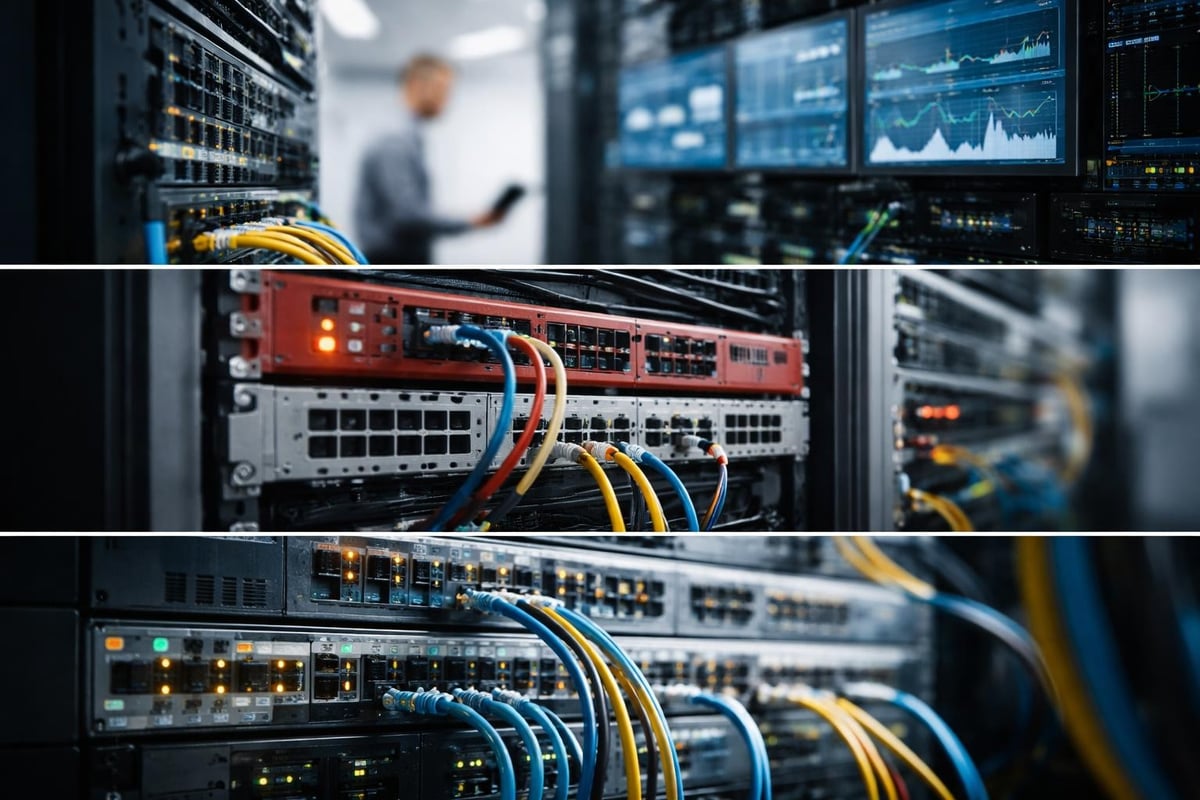
Physical infrastructure forms the foundation, including cabling systems, network switches that direct traffic, and routers that connect different network segments. Wireless access points extend connectivity beyond wired connections, while firewalls act as security gatekeepers controlling traffic flow.
Virtual components have become equally important. Software-defined networking (SDN) separates network control from hardware, enabling more flexible management. Cloud-based services integrate with on-premises equipment, creating hybrid environments that require coordinated oversight.
Building a Robust Network Management Strategy
Developing an effective network infrastructure management strategy starts with comprehensive documentation. Network mapping creates visual representations showing how devices connect, which helps troubleshoot problems and plan upgrades. Documentation should include IP address assignments, device configurations, warranty information, and vendor contacts.
Establishing baseline performance metrics provides reference points for normal operation. By measuring typical bandwidth consumption, latency, packet loss, and device utilization during regular business hours, administrators can quickly identify anomalies that signal potential issues.
Implementing Monitoring and Alerting Systems
Continuous monitoring represents one of the most critical aspects of network infrastructure management. Modern monitoring tools automatically track hundreds of metrics across network devices, generating alerts when thresholds are exceeded.
Key monitoring capabilities include:
- Real-time traffic analysis showing which applications consume bandwidth
- Device health checks monitoring CPU, memory, and temperature on network equipment
- Uptime tracking measuring availability and identifying frequent failure points
- Security event logging recording access attempts and policy violations
- Performance trending revealing patterns that indicate capacity constraints
The top network monitoring best practices emphasize the importance of customizable dashboards that present relevant information to different stakeholders. IT staff need detailed technical metrics, while business leaders want high-level views showing overall network health and availability.
Automated alerting prevents small issues from becoming major outages. When a switch experiences high CPU utilization or a connection drops packets, immediate notifications allow technicians to investigate before users experience problems.
Security Integration in Network Management
Network infrastructure management and cybersecurity have become inseparable disciplines. Every network device represents a potential entry point for attackers, making security configuration a fundamental management responsibility.
Zero Trust architecture has emerged as the preferred framework, assuming that threats exist both outside and inside the network perimeter. This approach requires continuous verification of user identity and device health before granting access to resources. The future of networking increasingly emphasizes secure-by-design principles that integrate security controls throughout the infrastructure rather than treating them as separate layers.
Implementing security within network infrastructure management involves several practices:
| Security Practice | Purpose | Implementation |
|---|---|---|
| Network Segmentation | Limit lateral movement of threats | VLANs separating departments and guest access |
| Access Control Lists | Restrict traffic between segments | Firewall rules based on least privilege |
| Patch Management | Close known vulnerabilities | Scheduled firmware updates for network devices |
| Intrusion Detection | Identify malicious activity | IDS/IPS monitoring traffic patterns |
| Encryption | Protect data in transit | TLS for management interfaces, VPNs for remote access |
Regular security audits verify that configurations align with policies. The Center for Internet Security emphasizes network infrastructure management as Critical Security Control 12, highlighting the need to actively manage network devices to prevent exploitation of vulnerable services.

Automation and Optimization Techniques
Manual network infrastructure management becomes impractical as networks grow beyond a handful of devices. Automation tools handle repetitive tasks, enforce consistency, and respond to events faster than human administrators can.
Configuration management automation ensures that all devices maintain approved settings. When an administrator updates a security policy, automation applies the change across relevant devices simultaneously, eliminating errors from manual entry.
Network automation platforms can:
- Deploy new devices with standardized configurations
- Back up configurations on scheduled intervals
- Detect unauthorized configuration changes
- Roll back failed updates to previous working states
- Generate compliance reports showing adherence to standards
Performance optimization through automation identifies and resolves common issues without human intervention. If a wireless access point experiences high client density, automated load balancing can redirect connections to nearby access points with available capacity.
Capacity Planning and Scalability
Effective network infrastructure management includes forecasting future requirements based on business growth patterns. Capacity planning analyzes current utilization trends to predict when upgrades will become necessary, allowing organizations to budget appropriately and avoid emergency purchases.
Growth indicators to monitor include:
- Monthly bandwidth consumption trends
- Number of connected devices over time
- Storage capacity utilization rates
- Application performance under peak loads
- User complaints about responsiveness
Small businesses particularly benefit from scalable infrastructure that grows incrementally. Starting with enterprise-grade switches that have unused ports allows easy expansion when new employees join or additional offices open.
Cloud Integration and Hybrid Network Management
Modern network infrastructure management must accommodate cloud services that host applications and data outside the traditional network perimeter. Hybrid environments combining on-premises infrastructure with cloud resources require unified management approaches.
SD-WAN technology has revolutionized how organizations connect branch locations and cloud services. By intelligently routing traffic across multiple connections based on application requirements and link quality, SD-WAN improves performance while reducing costs. Network infrastructure design best practices for security highlight how SD-WAN simplifies management while maintaining robust protection.
Managing cloud-integrated networks involves additional considerations:
- Identity federation ensuring users authenticate once to access both local and cloud resources
- Direct cloud connectivity bypassing the corporate network for SaaS application traffic
- Consistent security policies applying the same protections regardless of data location
- Centralized visibility monitoring performance across distributed infrastructure
- Cost optimization tracking cloud service consumption to control expenses
The shift toward AI, edge computing, and modern infrastructure management reflects how traditional network boundaries have dissolved, requiring comprehensive platforms that manage both physical and virtual components.
Remote Work Infrastructure Management
Supporting remote employees has become a permanent requirement for network infrastructure management. VPN concentrators, remote desktop gateways, and cloud-based collaboration tools all require ongoing management to ensure secure, reliable access.
Remote infrastructure challenges include:
| Challenge | Impact | Solution |
|---|---|---|
| VPN capacity limits | Connection failures during peak times | Scalable cloud VPN services |
| Home network security | Exposure to compromised devices | Endpoint security requirements |
| Bandwidth constraints | Poor video conferencing quality | Traffic prioritization policies |
| Support complexity | Difficulty troubleshooting remote issues | Remote management tools |
Network infrastructure management for distributed workforces requires visibility into endpoint security status, not just corporate device health. Before granting access, systems should verify that remote computers have current antivirus protection and operating system patches installed.

Best Practices for Small Business Networks
Small businesses face unique network infrastructure management challenges, balancing limited IT budgets against the need for reliable, secure connectivity. Adopting proven practices helps maximize return on infrastructure investments.
Standardization simplifies management by reducing the variety of equipment types and vendors. When all switches come from the same manufacturer, administrators become proficient with a single management interface and firmware update process. Spare parts inventory requirements decrease when devices share common components.
Regular maintenance schedules prevent emergency situations. Monthly tasks should include reviewing security logs, verifying backup completion, and checking available storage capacity. Quarterly activities might involve firmware updates, wireless spectrum analysis, and access control list reviews.
Partnering with Managed Service Providers
Many small businesses lack the internal expertise or staffing to handle comprehensive network infrastructure management. Partnering with managed IT service providers offers access to specialized knowledge and enterprise-grade tools without hiring full-time network administrators.
Managed services typically include:
- 24/7 network monitoring with immediate incident response
- Proactive maintenance and firmware updates
- Security patch management and vulnerability scanning
- Performance reporting and capacity planning
- Help desk support for network-related user issues
The fixed-rate fee structure common among managed service providers makes IT expenses predictable, simplifying budget planning. Rather than reacting to problems with expensive emergency service calls, businesses pay consistent monthly fees for comprehensive coverage.
Addressing Common Management Challenges
Network complexity continues to increase, creating management challenges even for well-resourced IT teams. Cybersecurity complexity and organizational infrastructure compound these difficulties, as security requirements add layers of controls that must be coordinated.
Alert fatigue represents a significant issue when monitoring systems generate excessive notifications. Cyber teams struggling with torrents of security alerts illustrates how poorly tuned systems overwhelm administrators, causing them to miss critical warnings among false positives.
Effective network infrastructure management addresses alert fatigue through:
- Baseline tuning that sets realistic thresholds
- Alert correlation combining related events into single notifications
- Severity classification prioritizing critical issues
- Automated remediation handling routine problems without human intervention
- Regular review of alert effectiveness and adjustment of triggers
Documentation drift occurs when network changes aren't recorded in documentation, creating gaps between actual configuration and documented state. Enforcing change management processes that require documentation updates before implementing modifications maintains accuracy.
Vendor Management and Support Contracts
Network infrastructure typically includes equipment and software from multiple vendors, each with different support models and contract terms. Tracking warranty expiration dates, support entitlements, and vendor contact information prevents situations where critical equipment fails outside warranty periods.
Consolidating vendors where possible simplifies support relationships. Working with distributors that provide multi-vendor support can reduce the number of contacts needed when troubleshooting complex issues involving multiple systems.
Measuring Network Infrastructure Management Success
Quantifying the effectiveness of network infrastructure management helps justify investments and identify improvement opportunities. Key performance indicators should align with business objectives rather than focusing solely on technical metrics.
Business-relevant measurements include:
- Network availability percentage during business hours
- Mean time to resolution for reported network issues
- Number of unplanned outages per month
- Percentage of users reporting satisfactory network performance
- Security incidents prevented through proactive management
- Cost per user for network services
Technical metrics provide diagnostic value when investigating problems. Tracking packet loss rates, latency measurements, and bandwidth utilization helps identify degrading performance before users complain.
Regular reporting demonstrates the value of network infrastructure management to business leadership. Monthly reports showing consistent uptime, resolved security threats, and completed improvement projects build confidence in IT operations.
Continuous Improvement Programs
Network infrastructure management should evolve as business requirements change and new technologies emerge. Quarterly reviews examining recent incidents, user feedback, and industry trends identify areas requiring attention.
Questions to guide improvement efforts:
- Which network segments experienced the most issues this quarter?
- Are current monitoring tools providing adequate visibility?
- Have new applications created unexpected bandwidth demands?
- Do security policies align with current threat landscapes?
- Are disaster recovery procedures tested and effective?
Staying informed about emerging threats like sophisticated espionage ecosystems ensures that network infrastructure management practices adapt to evolving risks. Long-term infiltration attempts specifically target network infrastructure, making behavioral anomaly detection an increasingly important capability.
Training investments keep IT staff current with management best practices and new technologies. Certifications in network administration, security, and vendor-specific platforms demonstrate expertise and provide frameworks for consistent management approaches.
Effective network infrastructure management protects business operations while enabling growth through reliable, secure connectivity. By implementing comprehensive monitoring, integrating security throughout the infrastructure, and adopting proven management practices, small businesses build networks that support rather than hinder productivity. Delphi Systems Inc. helps Lethbridge businesses maintain peak network operations with managed IT services that include monitoring, security, and proactive maintenance, all delivered through predictable fixed-rate pricing that lets you focus on your core business activities.

